
Digital Marketing
·
April 10, 2026
How SaaS Companies Handle Billing Disputes & Chargebacks
Learn how SaaS billing disputes happen, what triggers chargebacks, and how both sides can resolve them faster.

Compare ZoomInfo's broad B2B database with UserGems' CRM-focused, frequent job-move alerts to decide which fits your sales strategy.


When it comes to tracking job changes for sales opportunities, ZoomInfo and UserGems have distinct strengths. ZoomInfo offers a massive database for broad prospecting, while UserGems focuses on tracking existing CRM contacts like past customers and champions.
Key takeaways:
| Feature | UserGems | ZoomInfo |
|---|---|---|
| Focus | Job change tracking | Broad sales intelligence |
| Data Refresh Rate | Every 2–4 weeks | Every 6–18 months |
| CRM Integration | Automated lead creation | Enrichment-focused |
| Target Market | Mid-market to Enterprise | Large Enterprise |
| Best Use Case | Warm leads, preventing churn | Cold prospecting, market research |
If you prioritize timely updates and relationship-based selling, UserGems is a better fit. For cold outreach and large-scale lead generation, ZoomInfo delivers broader capabilities.
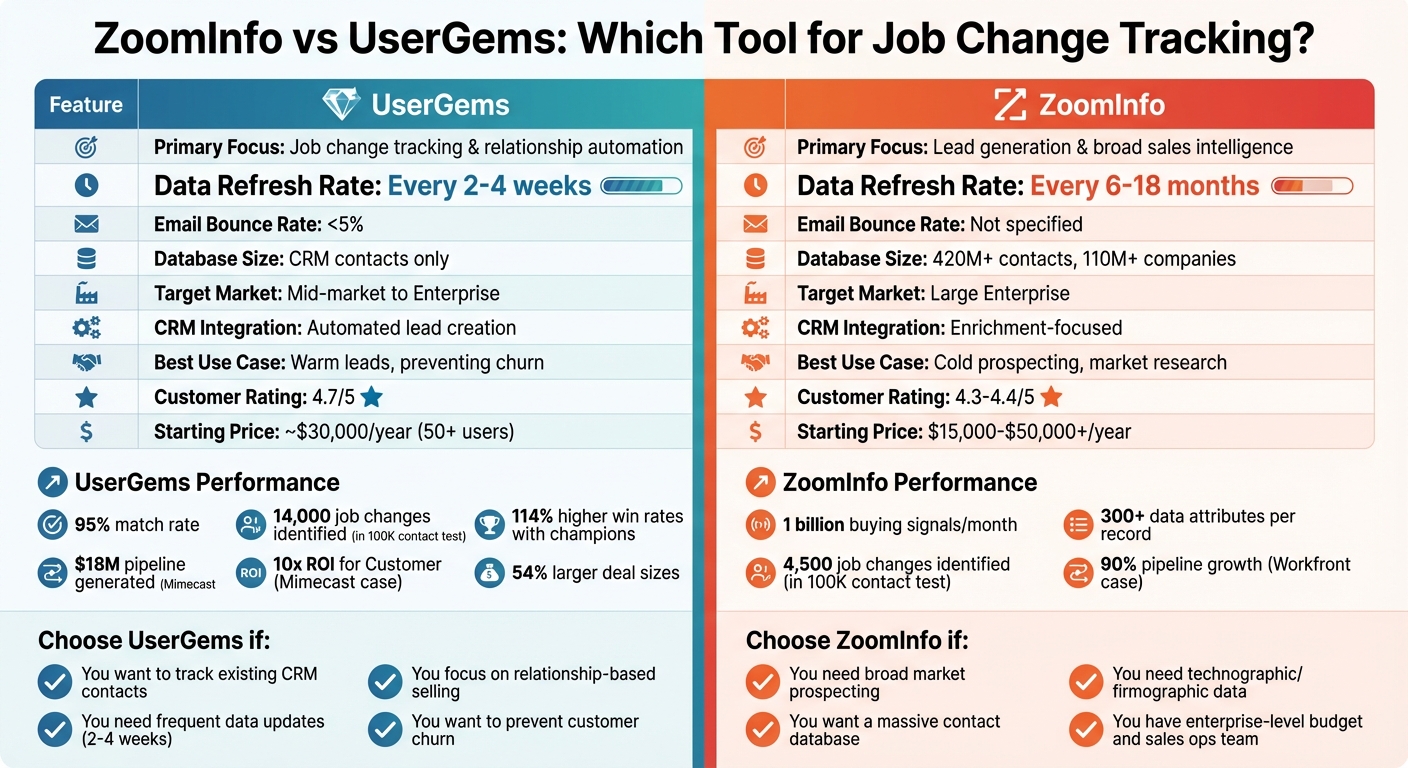
ZoomInfo vs UserGems: Feature Comparison for Job Change Tracking
ZoomInfo is a robust B2B intelligence platform, boasting a database of over 420 million contact profiles and 110 million company profiles [9]. While its primary focus isn't solely on job change tracking, it offers several tools that can help sales teams stay informed about key personnel shifts.
One standout feature is Tracker for Sales, which keeps tabs on selected contacts and delivers weekly verified job change alerts. The Copilot feature uses AI to identify buying signals, such as champion moves and organizational changes [6][8]. Additionally, Senior Job Posting Signals provide real-time alerts on senior-level transitions, giving teams a head start in reaching out [11]. To ensure accuracy, ZoomInfo Operations automates CRM data enrichment, keeping contact records up-to-date as people switch roles [10].
ZoomInfo also shines with its seamless integrations. It connects effortlessly with platforms like HubSpot, Salesforce, and Microsoft Dynamics, feeding job change alerts and updated contact details directly into your existing workflows [10]. The platform processes an impressive 1 billion buying signals each month and includes over 300 data attributes per record [9].
Take Workfront, for example. Under the guidance of Justin Hiatt, Vice President of Digital Sales, the company leveraged ZoomInfo Sales to achieve remarkable results:
"With ZoomInfo, we more than doubled our activity and our efficiency skyrocketed. Since then, we've grown our pipeline over 90% per year" [8].
However, while ZoomInfo offers powerful tools, it does have some limitations that may affect its timeliness and user experience.
Despite its claim of continuous updates via Tracker [6][12], the sheer size of ZoomInfo's database can lead to delays of up to six months in updating certain records [7]. This lag can be problematic, especially since new managers often make key budget decisions within their first 90 days [6].
"6 months is plenty of time for your competitors to get to your previous contact's new budget first and at that point, the data isn't useful or actionable anymore" [7].
Another challenge is the manual effort required for tracking. Without premium enrichment add-ons, sales teams must log in, locate contacts, and manually request tracking for each individual [7]. Additionally, ZoomInfo lacks built-in CRM reporting dashboards, making it harder to measure the ROI of job change outreach efforts [7].
ZoomInfo’s wide-ranging capabilities make it a strong choice for enterprises seeking comprehensive B2B intelligence. It’s particularly effective for tasks like building targeted account lists, enriching CRM data, and tracking various buying signals. The platform is ideal for identifying all members of a buying group or enriching CRM data with detailed firmographic and technographic insights. Its verified direct dials, mobile numbers, and organizational charts are especially valuable for enterprise teams.
However, ZoomInfo’s value is best realized by teams with dedicated sales operations staff who can handle the manual aspects of contact tracking and data enrichment. Given its pricing - ranging from $15,000 to over $50,000 annually - it’s a worthwhile investment for enterprises that can fully leverage its features [7].
UserGems zeroes in on tracking the contacts that matter most to your business. Instead of relying on an expansive external database, it integrates directly with your HubSpot CRM to pinpoint which contacts to monitor - whether they’re customers, active users, or part of open opportunities [13]. UserGems checks in on these contacts every two to four weeks, a stark contrast to the typical six- to 18-month refresh cycles seen in broader B2B databases [5]. This focused method helps re-engage leads quickly, all within your existing CRM setup.
When someone on your tracking list switches jobs, UserGems automatically flags their old record as inactive and creates a new, enriched contact profile tied to their new role [13]. These records are linked through the "UG - Past Contact" property, ensuring you retain key details like prior product usage, NPS scores, and whether the contact was a champion or a regular user [3][13].
UserGems boasts an impressive 95% match rate and provides verified email addresses with a bounce rate of less than 5% [3][5]. For teams needing similar precision at a different price point, there is a UserGems alternative with 94% accuracy available. In a benchmark test involving 100,000 contacts, UserGems identified 14,000 accurate job changes - far outpacing ZoomInfo, which found only 4,500 [5]. The platform also offers an AI-powered feature called "Gem-E", which crafts personalized messages based on the contact’s history and the priorities of their new company [14][13].
Sales teams benefit from real-time notifications via email, Slack, or CRM tasks whenever a tracked contact moves [3]. Plus, HubSpot workflows can be triggered automatically to route leads into tailored sequences. For example, if a former champion joins a target account, the system can initiate messaging specific to that relationship [13].
The results speak for themselves. Mimecast prevented leads from slipping through the cracks, generating $18 million in new pipeline after adopting UserGems [4]. At Cobalt, a BDR closed a $95,000 deal in just three weeks after reconnecting with a champion who had moved to a new company - dramatically faster than their usual five- to six-month sales cycle [4]. UserTesting scaled its outreach to alumni customers and generated over $28 million in pipeline [3].
"The key is to reach out to your alumni customers at the right time. UserGems helps us achieve that at scale." - Steve Jones, VP of Demand Generation, UserTesting [3]
Next, we’ll take a closer look at the platform’s limitations to provide a balanced view.
UserGems is designed to track contacts already in your CRM or product database, which means it’s not ideal for cold prospecting or building new account lists from scratch, leading many to seek UserGems alternatives for HubSpot. Additionally, the platform is more suited for use by organizations rather than individual sales reps, making it less flexible for solo users compared to tools like LinkedIn Sales Navigator [4].
UserGems shines when tracking five key contact types: customers from Closed Won accounts, active and deactivated product users, contacts from Closed Lost opportunities, individuals in open opportunities, and contacts from churned accounts [3][2]. These groups often deliver higher win rates and shorter sales cycles [4].
The platform is particularly effective for preventing customer churn. Customer Success teams using UserGems have reported ROI increases of up to 10x, showcasing its ability to retain customers [4].
Organizations with well-established HubSpot workflows and dedicated sales operations teams see the greatest value. The system is user-friendly, requiring only about 20 minutes of training for reps, and integrates seamlessly with tools like LeanData, Outreach, and Salesloft for automated lead routing [15][4]. By aligning with existing workflows, UserGems ensures job change notifications are used effectively to drive pipeline growth and efficiency.
ZoomInfo and UserGems take different paths when it comes to job change tracking. ZoomInfo operates as a comprehensive sales intelligence platform, offering a vast database ideal for cold prospecting. On the other hand, UserGems hones in on tracking contacts already in your CRM - like past customers, champions, and active users - as they transition to new roles or companies.
One key distinction lies in how often their data is updated. UserGems refreshes contact details every two to four weeks, while traditional B2B databases like ZoomInfo typically update every six to 18 months[5]. This difference can directly influence the timing of your outreach. Mikey Pawell, Director of Revenue Operations & Sales Development, shared his experience:
"We evaluated UserGems alongside a few other tools, including LinkedIn Sales Navigator and ZoomInfo. And UserGems data quality came out much better than the other tools."[5]
This contrast naturally leads to how these platforms integrate with HubSpot.
When it comes to HubSpot, UserGems automatically creates new CRM lead records and flags outdated ones to ensure you keep the context intact[4]. ZoomInfo, while offering lead enrichment through its CRM integrations, often requires more manual configuration to set up workflows.
Notifications are another area where the two differ. UserGems provides automated alerts via email, Slack, or CRM tasks as soon as a tracked contact changes roles. It can even trigger HubSpot workflows to route leads into specific sequences[3]. ZoomInfo, meanwhile, leverages tools like "Scoops", intent data, and its AI-powered Copilot to deliver broader market insights[1].
| Feature | UserGems | ZoomInfo |
|---|---|---|
| Primary Focus | Job change tracking & relationship automation | Lead generation & broad sales intelligence |
| Data Refresh Rate | Every 2–4 weeks[5] | Every 6–18 months[5] |
| Email Bounce Rate | Less than 5%[5] | Not specified |
| Target Market | Mid-market to Enterprise | Large Enterprise |
| HubSpot Automation | Automated lead creation[4] | Standard integration; enrichment focus |
| Best For | Tracking warm leads and preventing churn | Cold prospecting and market research |
| Customer Rating | 4.7/5[1] | 4.3/5 to 4.4/5[1] |
When deciding between tools like UserGems and ZoomInfo, consider how up-to-date your contact data needs to be. If your sales team thrives on engaging prospects right after a job change, UserGems refreshes data every 2–4 weeks, compared to ZoomInfo’s longer cycle of 6–18 months[5]. This difference can mean being first to connect - or playing catch-up with competitors.
Next, think about the scope of your database. ZoomInfo is ideal for broad prospecting and accessing large pools of contacts. On the other hand, UserGems specializes in tracking existing relationships, such as current customers, product users, and CRM contacts[1]. Daniel Bleichman, Sr. Marketing Manager at Cato Networks, highlighted the impact of UserGems:
"UserGems found that 75% of our buyer contacts were missing from the Target Accounts. And have since sent over 15,000 new potential buyers directly to our Salesforce." [5]
Consider how each tool integrates with your CRM workflows. ZoomInfo often requires manual research and data enrichment, while UserGems automates lead creation and routing, seamlessly delivering leads into your CRM without added effort.
Budget should also weigh into your decision. ZoomInfo generally caters to enterprise-level budgets, while UserGems starts at approximately $30,000 annually for teams of 50 or more[16]. Both tools are designed for team-based selling rather than individual use.
These factors can help you determine which tool aligns with your sales goals and operational needs.
Choose ZoomInfo if you’re a large enterprise aiming for growth through broad market coverage. Its strengths lie in identifying new accounts, qualifying cold leads with detailed technographic data, and managing complex sales cycles across different industries to drive timely conversions.
Opt for UserGems if you’re a mid-market company focused on maximizing returns from existing relationships. It’s particularly effective for tracking former customers, product champions, and contacts from closed-lost deals as they move to new companies. Deals involving previous champions often yield 114% higher win rates and 54% larger deal sizes[4].
For companies with an established customer base, UserGems can deliver immediate results. For example, Mimecast’s Revenue Operations Manager, Gar Smyth, used job-change tracking to create $18 million in new business pipeline, ensuring no high-value opportunities slipped through the cracks. Similarly, Cobalt closed a $95,000 deal - more than double their typical $40,000 deal - in just three weeks by reconnecting with a former customer who had joined a new company.
To cover both cold and warm leads, consider using ZoomInfo for top-of-funnel prospecting and UserGems for nurturing relationship-based leads. This combination ensures a balanced approach to driving sales success.
UserGems specializes in delivering real-time job-change alerts, giving sales teams a way to stay informed and spot potential leads. That said, the platform doesn’t openly share how often their data is updated, which makes it tricky to directly compare their update speed to ZoomInfo’s. While both tools are designed to strengthen sales pipelines by monitoring job changes, their success largely hinges on how well their update schedules align with your specific sales approach and CRM requirements.
ZoomInfo is an excellent option for businesses focused on high-level lead generation and managing large volumes of prospects. Its powerful AI-driven database allows sales teams to efficiently pinpoint and qualify thousands of leads, making it particularly well-suited for complex sales processes and account-based marketing approaches.
For organizations that value smooth CRM integration, strong data security, and regulatory compliance, ZoomInfo delivers with its advanced syncing features across major platforms. If your sales team relies on extensive data access, AI-powered insights, and the ability to scale for larger groups, ZoomInfo is likely the right choice.
UserGems works effortlessly with HubSpot by scanning your existing contact and company lists, keeping an eye out for job changes, and automatically updating records with fresh information in real time. This way, your CRM remains current with very little manual effort.
ZoomInfo also integrates with HubSpot through a dedicated connection. It enables you to sync data, map fields, manage duplicates, and adjust export settings. Its advanced field mapping and data synchronization options give you more flexibility in controlling how information moves into HubSpot.
While both tools integrate directly with HubSpot, their focus differs. UserGems emphasizes updating and enriching your existing records, whereas ZoomInfo offers a more comprehensive data sync solution with advanced customization features.