
Digital Marketing
·
April 10, 2026
How SaaS Companies Handle Billing Disputes & Chargebacks
Learn how SaaS billing disputes happen, what triggers chargebacks, and how both sides can resolve them faster.

Practical tactics to grow revenue from existing SaaS customers: identify high-potential accounts, automate workflows, align teams, and measure NRR and ARPA.


Account expansion is the process of increasing revenue from existing customers through upselling, cross-selling, seat expansion, and add-ons. Here’s why it matters:

SaaS Account Expansion: Key Statistics and ROI Metrics
Once you've mastered the basics, the next step is zeroing in on accounts with the most potential for growth. Here are three strategies to help you identify those opportunities.
Propensity models leverage AI to analyze customer behavior and assign a score (from 1 to 100) to each account. This score reflects how closely an account aligns with traits of others that have already expanded their business with you [9]. Accounts scoring between 80 and 100 are flagged as "High" priority, signaling they're ripe for proactive outreach [9].
To get a full picture, combine first-party data like feature adoption and seat utilization with firmographic details (e.g., company size, funding rounds, and location) and third-party intent signals [8][7]. This approach shifts your team from reacting to customer needs to anticipating them, identifying intent before customers even consider making additional purchases [6][8]. AI-driven models can achieve up to 88% accuracy in detecting accounts ready for expansion [7]. For companies in the top 40% of growth performers, 20% to nearly 40% of their revenue comes from expansion [11].
Certain behaviors signal that an account is ready to upgrade. For example, accounts using over 90% of available features or maintaining daily active usage for 30 consecutive days are showing signs they've outgrown their current plan [5][6]. Similarly, when a customer on a basic plan starts exploring advanced features like custom reporting, it often indicates they're ready for an upsell [6][8].
One of the strongest indicators? Team growth. If an account adds three or more new users within 30 days or begins inviting colleagues from multiple departments, it suggests organizational buy-in and a need for enterprise-level tools [5][6]. Another key signal is when accounts activate two or more new integrations within 60 days. This shows they're embedding your product into their workflow, which often means they'll need higher-tier features like advanced API access or automation tools [5]. Proactive outreach based on these behavior signals can deliver conversion rates of 35–45%, compared to just 8–12% for reactive efforts [5].
Real-time monitoring takes the guesswork out of identifying expansion opportunities. Automated alerts can notify your team when accounts hit 85–90% of their plan limits - whether it's for seats, API calls, storage, or project counts - prompting timely outreach [5][6]. Without proactive alerts, only 23% of customers upgrade after hitting their limits, meaning missed revenue opportunities [5].
Use your CRM to track metrics like "User Count Change" or "Feature Adoption Velocity" in real time [3]. For accounts crossing a key threshold, set up automated Slack notifications to your sales team with details like "Usage grown 50% month-over-month" [6][8]. AI-powered tools can also drastically cut down the time spent identifying these opportunities - from 12–18 hours to just 2–3 hours [7]. This allows your team to focus on meaningful conversations rather than sifting through data manually.
Even the best opportunities can slip through the cracks if teams aren’t working together. Silos between departments often mean missed chances. In fact, companies with strong inter-team alignment grow 19% faster and are 15% more profitable than their competitors [14]. Yet, 90% of sales and marketing professionals report that their strategies are out of sync [15].
So, how do you fix this? Start by creating shared accountability. Expansion shouldn’t just be a sales metric - it needs to be a shared goal. Align all teams around Net Revenue Retention (NRR) as a key performance indicator (KPI) [13]. This encourages collaboration between customer success managers (CSMs) and account executives (AEs) on renewals and upsells. Instead of stepping on each other’s toes or letting accounts go cold, they can work together seamlessly. One way to achieve this is by organizing cross-functional pods, where specific AEs and CSMs are paired by region or customer segment [13]. These partnerships build trust, improve communication, and ensure customers get a consistent experience.
Another critical piece is data visibility. Forty-three percent of professionals cite the lack of accurate or shared data on target accounts as a major obstacle to alignment [15]. Integrating tools like Gong, Outreach, and Aircall into your CRM can solve this by creating a shared timeline. This way, CSMs can review sales calls, and AEs can access support ticket histories without wasting time piecing together information [12]. Sly Orange summed it up perfectly:
"When 'Who is responsible for this account right now?' is anyone's guess, no one does. If your handoff is ad hoc, your funnel is leaking revenue." - Sly Orange [12]
True alignment comes from shared systems and clear role definitions. Start by using a RACI framework to outline responsibilities for different expansion activities [13]. For instance, customer success might handle smaller license increases, while sales takes on more complex cross-sells involving custom pricing or legal input.
Standardizing metrics is another crucial step. Create a joint NRR dashboard that all teams can access. Use consistent definitions for terms like "expansion", "upsell", and "churn" to avoid confusion [13]. Data shows that SaaS companies with automated workflows for sales and marketing close 508% more deals than those without [15]. Regular team syncs - where AEs and CSMs review expansion opportunities together - can further strengthen alignment [13].
Collaboration should also be rewarded. For example, implement a process where CSMs log potential upsell opportunities in the CRM and track "CS-sourced leads" as a performance metric [13]. If a CSM spots a promising upsell, they should be able to pass it to sales with full context - and get credit for their contribution.
Playbooks eliminate guesswork by providing clear steps for common expansion scenarios. For example, if a customer shows a major usage spike, the playbook might outline a series of tailored outreach actions. Good playbooks include details like product value, industry pain points, battlecards, and assets such as email templates and call scripts [17]. Companies with solid sales enablement practices report a 49% higher win rate [17].
Different roles require tailored reports. Provide comprehensive early-stage insights to the expansion team for planning, while offering CSMs account-specific reports for immediate action [10]. Keep playbooks flexible by personalizing messages based on customer behavior and firmographic data [17]. Regularly update them with performance data to keep improving their effectiveness.
When playbooks define the strategy, smooth handoffs ensure those strategies are executed effectively.
Even the best strategy won’t work if handoffs between teams are messy. A smooth handoff makes customers 3.5 times more likely to stick around [12]. Unfortunately, ad hoc transitions often leave accounts in limbo. The solution? Combine automation with clear ownership. Use CRM workflows to automatically assign a CSM when a deal is marked "Closed Won" and trigger follow-up tasks [12].
To maintain transparency, keep a record of everyone involved in the account. Instead of overwriting the primary owner in the CRM, use distinct fields for "BDR", "Sales", and "CSM" owners [12]. This ensures clear attribution and helps everyone stay on the same page.
Set up alerts for high-risk accounts. For instance, if an account has been inactive for more than 14 days, notify the CSM via Slack [18]. Before major milestones like Quarterly Business Reviews, have AEs and CSMs align on messaging and present as a unified team [13]. This level of coordination keeps customers engaged and builds trust throughout the relationship.
Tracking job changes can open doors for SaaS companies in three key ways: a new hire in a decision-making role might quickly support your solution, their replacement may need an introduction, and former advocates can often be re-engaged [22].
Timing is everything here. Research shows that new executives allocate 70% of their budget within the first three months of starting a role [23]. This "honeymoon period" is when they’re actively evaluating tools and making purchasing decisions. Plus, past customers are five times more likely to convert compared to cold leads [23]. Outreach tied to job changes also performs better, with response rates between 15–25%, far higher than the 5–8% typical of traditional cold prospecting [21].
On the flip side, job changes can also signal potential risks. If a key decision-maker leaves your account, your Customer Success team must act quickly to fill the gap. Without proper tracking, you risk delays or missed opportunities - 80% of salespeople report losing deals due to a stakeholder’s departure [22]. Worse, 89% of job changes go unnoticed when teams rely solely on manual LinkedIn checks [19]. This is where automated tools like KeepSync become a game-changer, ensuring no critical movement slips through the cracks.
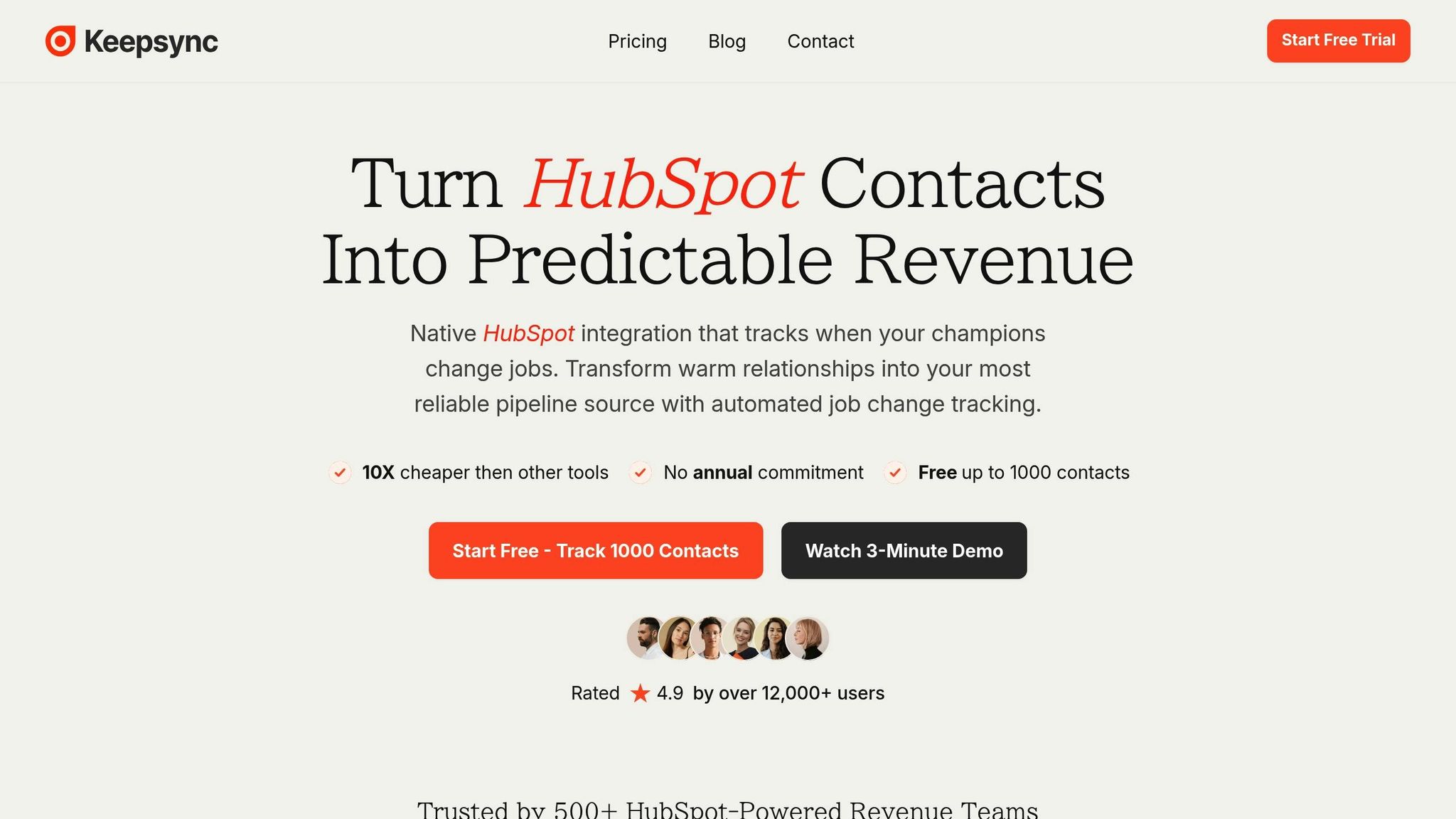
KeepSync simplifies job change tracking by monitoring your HubSpot contacts weekly across 30+ data sources. This ensures you’re among the first to know when someone changes roles. Its triple-verification process - using AI, multiple data points, and human oversight for executive-level changes - delivers highly accurate updates [19].
The setup is quick and seamless. Once integrated with HubSpot, KeepSync automatically imports your contacts and begins tracking job changes. When a change is identified, it enriches the contact record with updated details like job titles, verified email addresses, phone numbers, and company information. Alerts are sent in real time via Slack, email, or directly in HubSpot. You can even trigger automated workflows to assign leads to the right rep or launch personalized outreach campaigns [19]. This integration ensures no opportunity is overlooked and fits right into your growth strategy.
"Before this, we were completely blind to job changes. Our reps would manually check LinkedIn maybe once a month, and we'd constantly hear about champions moving to new companies weeks after the fact." - Marcus Rodriguez, RevOps Manager at Streamline Analytics [19]
"The ROI was immediate. Within 45 days we had closed two deals from former customers who moved to bigger companies." - Sarah Kim, Director of Sales at Velocity Commerce [19]
Start with a quick LinkedIn message to congratulate the contact, but hold off on a formal pitch for 30–60 days [21][22]. This gives them time to settle into their new role and prioritize their goals.
When you do reach out, make it personal. Use historical data from your CRM to reference specific products they used previously, highlight measurable ROI they achieved, or mention colleagues they worked with. A tailored message like this stands out from generic outreach [20]. Also, if they respond on LinkedIn, immediately remove them from any automated email sequences to avoid redundancy [20].
The numbers back up this strategy. For example, Cobalt generated $1.7M in pipeline, accounting for 8% of new logos, by tracking former champions who moved to new companies. Similarly, UserTesting closed over $1M in new business within a year by re-engaging past users, and Lattice created $6.7M in pipeline with a 40X ROI by tracking HR administrators who had previously used their platform [19]. These results highlight the power of targeted outreach in driving measurable growth.
Once you've identified high-potential accounts and aligned your teams, the next step is to strengthen customer engagement. This step is essential for driving account expansion and unlocking growth opportunities.
Quarterly Business Reviews (QBRs) are a great way to shift conversations from basic negotiations to strategic discussions centered on measurable ROI [24]. These sessions should focus on key areas like performance metrics, ROI achievements (e.g., cost savings or revenue gains), account health, roadmap alignment, and actionable feedback [24].
Here’s why this matters: Companies in the top 40% of growth cohorts generate between 20% and 40% of their revenue from expansion [11]. And according to a 2024 study, 30% of SaaS customers expect customer expansion to be their primary revenue driver [25]. QBRs naturally open the door to these discussions by showcasing the tangible value your product delivers. When you can demonstrate clear ROI - whether that’s time saved, revenue generated, or costs reduced - the conversation often shifts from "Should we continue?" to "What’s next?"
"QBRs turn defensive negotiations into planning processes built on proven success." - Outreach [24]
Pay close attention to usage data to identify when an account is ready for expansion. Key signals include frequent use of limited features, hitting plan caps like seat or storage limits, and increased engagement with advanced tools [11][8]. When you notice these patterns, make your outreach highly specific and tied to their behavior.
For instance, instead of sending a generic upgrade pitch, you could say: "Your [feature] usage surged 100% last month, which suggests you might benefit from our advanced plan" [11]. This approach resonates because it’s based on their actual experience with your product. To make this process seamless, use tools like HubSpot to set up automated workflows that notify account managers via Slack or CRM tasks when usage metrics increase by more than 10% [8].
| Expansion Signal | Metric | Action |
|---|---|---|
| Seat Overage | Active users vs. paid seats | Trigger an automated "Add Seats" email or CSM task [11][8] |
| Feature Limit Hit | Frequency of interaction with locked features | Send a personalized offer for the next tier up [11] |
| Usage Spike | >100% increase in core feature activity | Schedule a Strategic Business Review [16][11] |
| Advanced Adoption | Usage of 2+ "Pro" level tools | Offer a cross-sell for complementary products [11] |
By tailoring your messaging to these triggers, you can make your expansion offers feel relevant and timely.
In-app messaging is an effective way to engage customers while they’re already using your product [26]. Guided checklists for key actions - like inviting teammates or starting projects - can improve retention by reducing trial drop-off rates from 60% to under 25% and boosting trial conversions by 15% [26].
Another strategy is to offer immediate value when users interact with locked premium features. For example, you could provide a 7-day trial to remove delays between interest and experience [26]. Similarly, when users approach limits like seat capacity or storage, use gentle in-app prompts instead of hard stops to encourage upgrades [26].
"If you're not talking to your users inside the product, you're leaving growth on the table." - Paul Sullivan, AriseGTM [26]
Here’s the bottom line: Acquiring a new customer can cost 5 to 25 times more than retaining an existing one, and upselling to current customers is up to 14 times easier than selling to new prospects [27]. In-app education not only boosts product usage but also creates opportunities for expansion by showing customers the value of premium features before they even ask. Despite its potential, many SaaS companies still underutilize in-product engagement, missing out on key growth opportunities [26].
Tracking the right metrics is essential to understanding and improving your expansion strategy. Start with Net Revenue Retention (NRR) - this metric tells you how much recurring revenue you’re keeping from existing customers after factoring in expansion, contraction, and churn [28][1]. For perspective, top SaaS companies aim for an NRR above 120%. For example, HubSpot reported a 102% NRR in Q1 2026 [28]. Keep an eye on Expansion ARR, which shows the additional recurring revenue from upsells and cross-sells, and Average Revenue Per Account (ARPA) Growth, which measures how much more value each customer generates over time [1][29].
Besides these core metrics, look at leading indicators like usage trends. Accounts nearing 90% of their plan limits - whether it’s seats, storage, or API calls - are ripe for expansion [2][3]. Use tools like HubSpot to set up automated alerts for these signals, enabling proactive outreach. These metrics help you act at the right time and create clear triggers for your team.
Here’s a quick breakdown of critical metrics to guide your expansion efforts:
| Metric | Formula | Target/Benchmark |
|---|---|---|
| Net Revenue Retention (NRR) | (Starting MRR + Expansion - Contraction - Churn) / Starting MRR | >120% (Elite) [28][1] |
| Expansion Rate | Expansion MRR / Starting MRR | 10–30% annually [1][29] |
| Upsell Rate | (Number of Upgraded Customers / Total Customers) x 100 | 20–30% annually [29] |
| ARPA Growth | (End ARPA - Beginning ARPA) / Beginning ARPA | 10–15% annually [29] |
Retention is also more cost-effective than acquisition - it’s 42% cheaper [29]. That’s why companies in the top 40% of growth cohorts see 20% to 40% of their revenue come from expansion [3].
Once you’re tracking the right metrics, use them to set clear revenue goals. For instance, aim for expansion revenue to account for 30% to 40% of new ARR [29]. If your NRR is already on your radar, target 100% to 120% depending on your market, with elite performers exceeding 120% [29][28]. Segment these goals by customer type (e.g., SMB vs. Enterprise), as expansion patterns often vary significantly [28].
Operationalize this with playbooks tailored to specific triggers. For example, if a customer reaches 90% of their seat limit, trigger a notification and follow up with outreach focused on solving their challenges rather than pushing a sale [2]. Similarly, monitor when customers engage with free or "lite" versions of premium features - this often signals great cross-selling opportunities [2].
Integrating your CRM with billing systems ensures everyone - from Finance to Sales - works off the same data [28]. For instance, HubSpot’s custom objects can provide real-time revenue insights [28]. You can also automate workflows to flag renewal or expansion deals 90 days before contracts expire [31].
Take it a step further by linking product usage data to your CRM. Add custom properties like “Active Seats” or “Feature Usage Spikes” to identify accounts exceeding their current plans and trigger expansion plays [3]. This kind of integration provides full-funnel visibility and reliable payback metrics [30].
"Attribution doesn't replace HubSpot - it completes it. By binding spend, identity, and revenue to every contact, account, and deal, HubSpot becomes not just where growth is tracked, but where ROI is proven."
– AttributionApp Guide [30]
Move beyond static reports by adopting live dashboards for real-time decision-making [28]. This unified view ensures all teams - whether Customer Success or Finance - are aligned and can prioritize expansion efforts effectively.
Account expansion is the engine behind steady SaaS growth. Leading companies report that 20% to 40% of their revenue comes from existing customers [3]. The math is compelling: retaining a customer costs 5 to 25 times less than acquiring a new one, and upselling is 14 times easier than closing a brand-new deal [10][33]. The strategies outlined - like tracking usage patterns, automating renewals, and staying on top of stakeholder changes - offer a clear path to maximize revenue from your current customer base.
To start, leverage product usage data to identify accounts primed for expansion. Pay attention to signals like customers nearing feature limits, increasing their use of advanced tools, or approaching 90% seat utilization [3]. Build workflows that prompt outreach at least 120 days before renewal, allowing you to reinforce your value and address any concerns [4]. Ensure alignment across Sales, Marketing, and Customer Success teams by maintaining a shared CRM view. This unified approach helps everyone monitor account health and act on opportunities in real-time [32][16].
Don’t overlook stakeholder changes. Losing a primary sponsor can jeopardize an entire account - even when customer satisfaction scores are high. Peter Barnett of Action1 highlighted how losing a key sponsor can disrupt client relationships [4]. Stay proactive by tracking job changes, bounced emails, and leadership shifts, so you can engage new decision-makers before the account is at risk.
These steps lay the groundwork for using automation tools to streamline your efforts.
The right tools make all the difference, and KeepSync is built to simplify stakeholder monitoring.
KeepSync automatically tracks job changes across your HubSpot contacts with 94% accuracy, alerting you in real-time through Slack, email, or directly in HubSpot. If a champion moves to a new company or a key decision-maker changes roles, you’ll know immediately. This allows you to reconnect with former champions at their new organizations or establish relationships with new stakeholders at existing accounts - before opportunities slip away.
Setup is quick - KeepSync integrates with HubSpot in under five minutes, enriching contact records with verified information. Combined with the strategies in this guide, KeepSync ensures no revenue opportunity goes unnoticed.
SaaS companies can tap into AI-driven propensity models to uncover upsell and cross-sell opportunities by digging into customer data like product usage, purchase history, and engagement trends. These models rely on predictive analytics to pinpoint accounts with the highest likelihood of expansion, allowing teams to channel their energy toward customers with the most potential.
AI also picks up on critical signals such as license usage, feature adoption, or shifts within an organization that hint at readiness for additional purchases. When these insights are integrated into tools like CRMs, businesses can automate the process of identifying opportunities, fine-tune the timing of outreach, and create tailored offers. This not only boosts revenue but also strengthens the bond with customers.
Accounts primed for upselling or cross-selling often display certain telltale behaviors. These might include consistent, effective use of your product, frequent interaction with advanced or premium features, or regular reliance on features restricted by their current plan. Customers who express satisfaction - whether through positive feedback or tangible success with your product - are also likely candidates for expanding their engagement.
Other signals to watch for include exploring extra features, seeking additional support, or showing curiosity about related offerings. By leveraging CRM tools and automation, you can track these behaviors and pinpoint the ideal moment to present upsell or cross-sell opportunities. This approach not only aligns with customer needs but also ensures a smooth, value-added experience.
Tracking job changes as they happen can be a game-changer for growing existing accounts. When contacts move to new roles or organizations, they often bring a sense of familiarity and trust in your product or service - making them more receptive to reconnecting. These transitions can also position them as key decision-makers in their new roles, potentially influencing purchasing decisions.
By acting on this information, you open doors for upselling, cross-selling, or even reviving opportunities that may have previously gone cold. Staying updated on these shifts not only helps you maintain strong relationships but also builds loyalty and uncovers fresh revenue opportunities within your current customer base.