
Digital Marketing
·
April 10, 2026
How SaaS Companies Handle Billing Disputes & Chargebacks
Learn how SaaS billing disputes happen, what triggers chargebacks, and how both sides can resolve them faster.

Track former customers who change jobs to re-engage warm leads—higher win rates, bigger deals, and faster closes using CRM flags and automation.

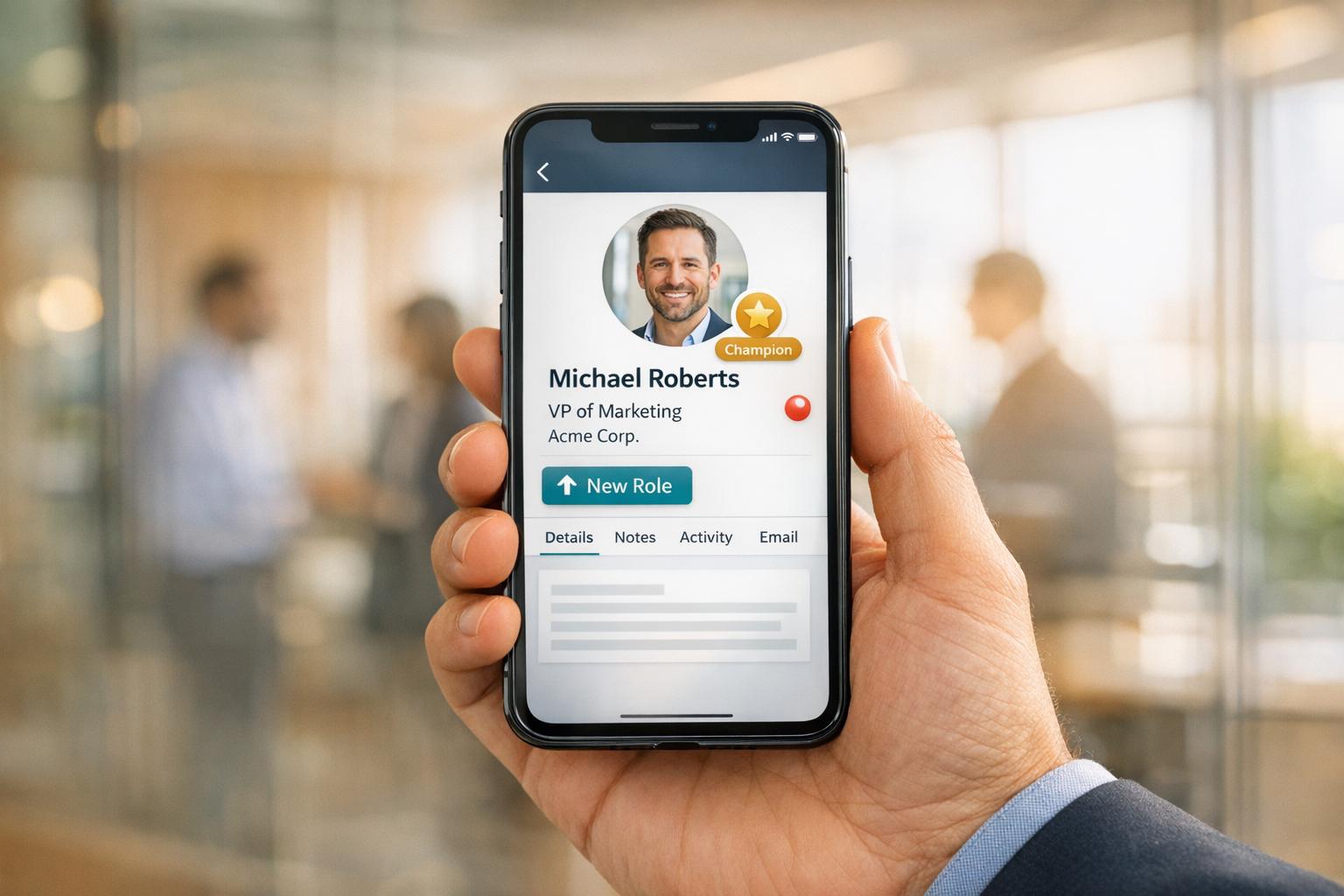
Former customers who switch jobs make the best leads. Why? They already know your product, trust your brand, and understand the value you bring. Deals with these "champions" have 114% higher win rates, 54% larger deal sizes, and close 30–50% faster than cold leads. Plus, 20–30% of your CRM contacts change jobs every year, and decision-makers often spend 70% of their budgets in their first 100 days at a new role. If you're not tracking these moves, you're missing out on major opportunities.
Here’s what you need to know:

Champion Tracking ROI: Key Performance Metrics and Benefits
Champion tracking is all about keeping tabs on past buyers, power users, and internal advocates when they switch jobs. Why? So you can reconnect with them as warm leads at their new companies [1][3]. Unlike cold outreach, these individuals already know your product, trust your team, and understand its value.
It combines relationship insights with timely trigger events. When a former champion moves to a new role, it signals a great opportunity. You can spot these signals in your CRM through markers like high product usage, strong NPS scores, or even their participation in case studies [1][2][3]. By staying alert to these CRM cues and key events, you can reach out at just the right moment, turning past relationships into fresh opportunities.
Timing matters. The best window to reconnect is 2 to 4 weeks after they start their new role [1][3]. Reaching out in their first week is too soon - they’re still settling in. Wait too long, though - say, beyond three months - and you risk losing the chance to competitors. This sweet spot is when champions are assessing their new tech stack and hunting for quick wins.
Former customers already know your value, which means you can skip the lengthy process of building credibility [1]. When they step into a new role with decision-making power, they’re often looking for low-risk, high-impact solutions. A tool they’ve used and trust? That’s an easy win.
Plus, B2B buying is notoriously complicated. In fact, 77% of B2B buyers describe their last purchase as either complex or difficult [1]. Champions who’ve already navigated this process can simplify it in their new roles. They know how to pitch your product internally, understand the ROI, and can confidently guide their team through implementation.
The long-term benefits of champion tracking add up fast. On average, professionals change jobs every 3.9 years, and for younger workers (ages 25-34), it’s every 2.8 years [1]. This means your database of champions can be a consistent source of new opportunities. Companies with advanced champion tracking systems can see a 35% boost in net revenue retention and a 45% drop in customer churn [4]. These kinds of improvements can make a huge impact on your sales performance.
| Metric | Champion-Led Deals | Cold Outbound Deals |
|---|---|---|
| Win Rate | 114% Higher [1] | Baseline |
| Deal Size | 54% Larger [1] | Baseline |
Up next, we’ll dive into how HubSpot’s tracking tools can help you identify these champions and make the most of these opportunities.
To build on the benefits of champion tracking, you can use HubSpot’s tools to locate former customer champions. While HubSpot doesn’t have a built-in feature for champion flags, you can create a system using contact properties, deal history, and engagement data to identify high-value former customers.
Start by examining engagement signals in your CRM. Focus on individuals who have shown strong product involvement, such as logging in 50+ times per quarter, participating in case studies, serving on advisory boards, or referring others. These actions indicate they genuinely believe in your product.
Next, review closed-lost deals, particularly those lost due to budget or timing issues, as these leads remain warm. Avoid focusing on deals lost because of product fit. If a decision-maker previously completed a demo, trial, or proof of concept, they already understand your solution. When they move to a new company with a refreshed budget, that familiarity gives you an edge.
It’s also important to classify contacts by their functional roles rather than job titles. Decision-makers like HR leaders, program managers, and strategic executives often have budget authority. Use AI tools or manual tagging to group these high-value personas for more precise outreach.
To prioritize your efforts, implement a scoring system. For example:
This scoring system ensures your outreach targets the warmest opportunities first.
To organize champions effectively, create custom HubSpot properties like Job Change Date, Previous Company, New Company, and Champion Score. Additionally, set up a Closed Lost Tier dropdown property to segment contacts into priority levels:
Build an Active List that filters contacts based on criteria such as "Associated Deal Stage = Closed Lost", recent close dates (within the past 24 months), high product usage, positive NPS scores, or case study participation.
You can also integrate tools like KeepSync to track LinkedIn updates. This tool can auto-populate custom job change properties in HubSpot, ensuring you stay updated when champions move to new companies. For high-value champions, consider adding a human-in-the-loop step - for instance, sending a Slack alert to the original account owner so they can personalize the outreach before it’s sent.
By clearly tagging and tracking champions, you’ll be ready to automate job change alerts and engage with them at the right time.
| Champion Scoring Signal | Points | Rationale |
|---|---|---|
| Former champion / power user | +40 | Strongest relationship and product knowledge |
| Deal lost to timing/budget | +30 | Situational blockers likely removed |
| New company matches ICP | +25 | Higher likelihood of organizational fit |
| Promotion to VP/Director+ | +20 | Greater budget authority and decision power |
| New company uses HubSpot | +15 | Confirms technical compatibility |
| Participated in Case Study | +10 | Publicly verified advocate |
This structured system helps you track champions, automate alerts, and engage proactively when opportunities arise.
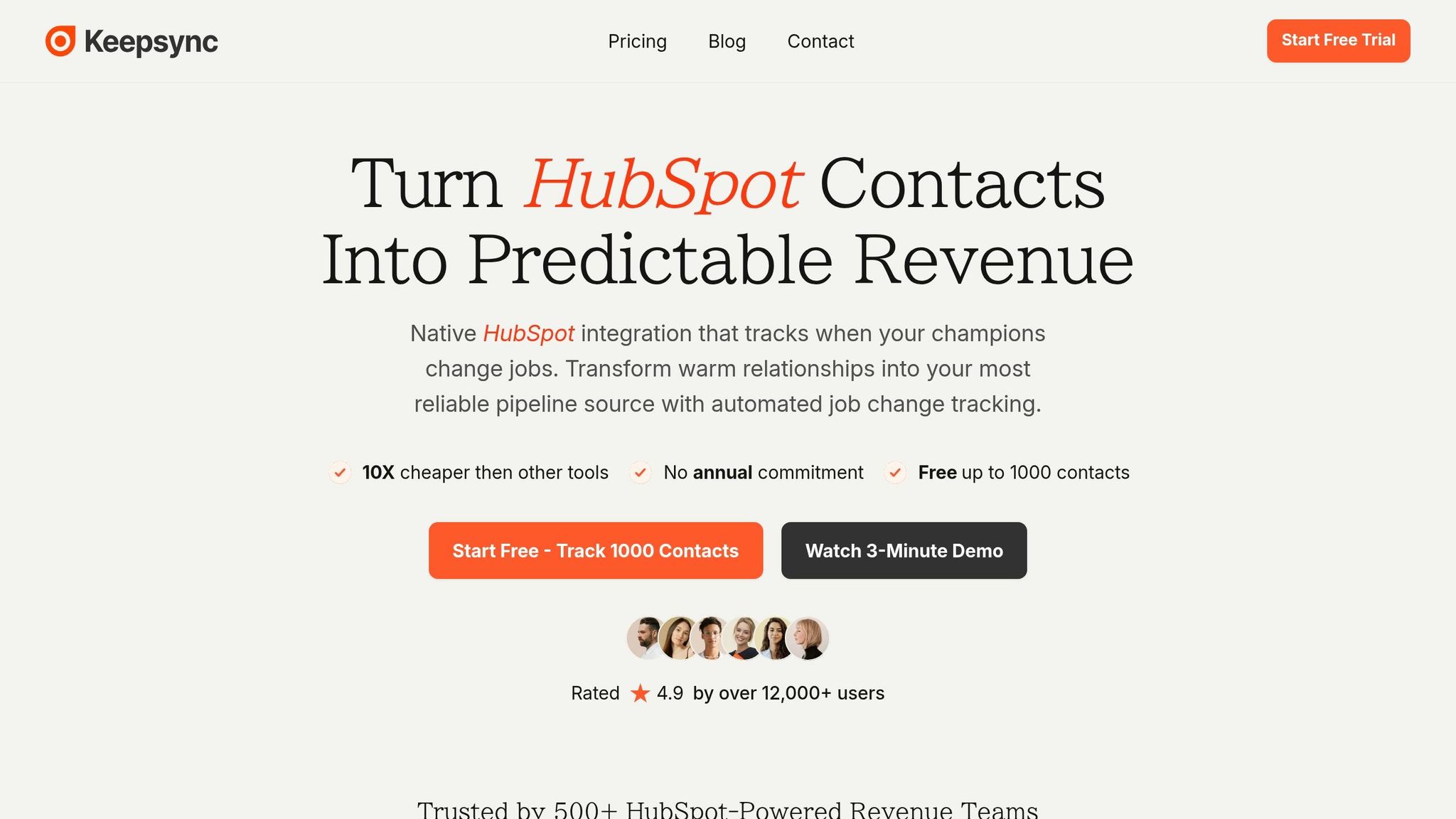
After tagging your champions in HubSpot, the next logical step is automating the process of tracking job changes - and that’s exactly where KeepSync comes in. Let’s face it, manually checking LinkedIn profiles or company websites for updates isn’t practical, especially when you’re managing hundreds or even thousands of contacts. KeepSync, a HubSpot-native tool, takes care of this by automating job change detection and re-engagement workflows.
How does it work? KeepSync scans your HubSpot contacts weekly, pulling data from over 30 sources, such as company websites and press releases. This weekly monitoring gives you a massive edge - 30 times faster than tools that update monthly or quarterly. With a 94% accuracy rate, achieved through automated algorithms and human verification, KeepSync ensures you’re always ahead of the game when a champion moves to a new role [5].
When a job change is identified, KeepSync enriches the contact record with verified data, including the new work email (boasting 97%+ deliverability), direct phone numbers, and company details like technographics [5]. Real-time alerts are sent through Slack, email, or directly inside HubSpot, so your sales team can act instantly. For example, you might see an alert like: "Champion Jane Doe now at Acme Corp – past deal: $50K ARR." [7]
"The ROI was immediate. Within 45 days, we had closed two deals from former customers who moved to bigger companies."
- Sarah Kim, Director of Sales, Velocity Commerce [5]
KeepSync doesn’t just notify you - it handles the follow-up too. It automatically creates new leads or deals in HubSpot, routes them to the right sales rep, and triggers personalized outreach sequences. All of this happens without a single manual step.
Setting up KeepSync is quick and easy - no technical expertise required [5]. Here’s how it works:
Once connected, KeepSync automatically syncs with your existing HubSpot contacts and starts its weekly monitoring. Since it’s a native integration, all updates - like job changes and enriched contact details - flow directly into your CRM. This means no manual data entry, no missed updates, and no extra effort from your team.
"With 1,500+ customers, manually tracking job changes was impossible. We were leaving money on the table every month. Now it's automated and integrated into our HubSpot workflows."
- Julia Chen, VP Sales Operations, Nexus Software [5]
If you’re curious to try it out, KeepSync offers a Starter plan ($79/mo) that tracks up to 1,000 contacts per month with weekly monitoring and email alerts [5][6]. For larger teams, the Team plan ($149/month or $1,490/year) covers up to 5,000 contacts and includes Slack alerts, API access, and contact enrichment features [5][6].
Once everything is up and running, KeepSync connects detection to action seamlessly. Its monitoring engine scans over 30 premium data sources every week, going beyond social media to include company websites, news outlets, and professional directories [7][8]. This comprehensive approach ensures you catch job changes that might otherwise slip through the cracks.
When a job change is detected, KeepSync automatically updates HubSpot records, creates new leads or deals with context-rich information, and routes the opportunity to the right sales rep - all in real time [5].
For your most critical champions, you can even add a personal touch. When a Tier 1 champion moves, KeepSync sends a Slack alert to the original account owner, giving them a chance to craft a personalized outreach message before an automated sequence kicks in. This combination of automation and human input helps maximize response rates.
"Before this, we were completely blind to job changes. Our reps would manually check LinkedIn maybe once a month... Now we're first to reach out every time."
- Marcus Rodriguez, RevOps Manager, Streamline Analytics [5]
Why does this matter? The numbers speak for themselves: deals involving former champions have 114% higher win rates and 54% larger deal sizes compared to cold outreach opportunities [9]. By automating job change detection and follow-ups, KeepSync ensures you’re the first to act, giving you a head start on high-value opportunities before competitors even notice.
When KeepSync notifies you of a job change, the next step is turning those alerts into meaningful outreach. This is where automation pairs with a personal touch, transforming job change notifications into high-value conversations. Why focus on former champions? They boast 3–6X higher close rates compared to standard leads[5]. And with KeepSync's weekly updates, you gain a 30X speed advantage over tools that only refresh monthly or quarterly. This allows you to reach out and congratulate champions as soon as they land their new role.
Start by setting up a lead scoring model that prioritizes your top opportunities. Here’s a breakdown of scoring adjustments:
For Tier 1 champions, route the alert directly to the original account owner via Slack. For instance:
"🔥 Jane Doe just joined Acme Corp as VP of Sales."
This gives your rep the chance to send a personalized message before triggering automated workflows. Reassign leads as needed to maintain continuity in the relationship.
To ensure leads align with your Ideal Customer Profile, set a minimum company size threshold (e.g., 100+ employees)[2].
Once these workflows are in place, you’re ready to launch a targeted outreach strategy that makes the most of these automated triggers.
After your workflows capture a job change, use these proven tactics to re-engage champions and maximize the opportunity. A three-step email sequence works best, balancing a friendly tone with clear business value:
Before reaching out, dive into their HubSpot history. Review their past activity, the products they used, and the results they achieved. This context allows you to personalize your outreach with specific "name-drops" and relevant details. Complement your email sequence with a LinkedIn connection request to ensure your message gets noticed across platforms[2].
For your most valuable champions, include a human touch. Use Slack to send AI-generated, tailored messages to your reps for review before sending. This ensures your outreach strikes the perfect balance between timeliness and personalization.
"The ROI was immediate. Within 45 days we had closed two deals from former customers who moved to bigger companies. Our SDRs love it because these are actual warm leads, not cold calls."
- Sarah Kim, Director of Sales, Velocity Commerce[5]
When champion tracking strategies are implemented, they reveal how effectively these efforts contribute to revenue growth. By focusing on the right metrics, champion tracking transforms into a strategy that drives measurable results. Without proper tracking, businesses risk missing out on nearly 89% of job changes within their CRM [5], leaving a major gap. Tools like KeepSync's pipeline analytics help you measure both the revenue you're capturing and the opportunities slipping through the cracks.
Start with win rates - deals involving former champions close at a rate of 39%, compared to the SaaS industry average of less than 19% [10]. Then, look at conversion efficiency: former advocates convert at a rate that's 6.3X higher from first touch to closed-won compared to cold outbound leads [10]. Another critical metric is champion coverage; on average, CRMs fail to track 78% of former champions who make qualified job changes [10].
Don’t forget about churn prevention value. When a key decision-maker or product owner leaves a current account, KeepSync alerts your Customer Success team, allowing them to take proactive steps to retain MRR [5]. You can also estimate incremental revenue by using a baseline close rate of 15% on warm job-change opportunities, giving you a clearer picture of potential monthly gains [5]. On average, automated job change tracking delivers an ROI ranging from 10X to 79X within the first 12 months [5].
The data paints a clear picture. Here’s how deals involving champion engagement compare to traditional approaches:
| Metric | Former Champion Deals | Cold Outbound / SaaS Avg |
|---|---|---|
| Win Rate | 39% [10] | <19% [10] |
| Conversion Efficiency | 6.3X higher [10] | 1X (Baseline) |
| Revenue Influence | 36% of new customers in 2024 had a previously closed-lost opportunity [10] | N/A |
These differences add up quickly. Closing deals at 39% instead of 19% essentially doubles your pipeline efficiency without increasing lead volume. For instance, a team subscribing to KeepSync's Team Plan at $149/month can see substantial returns - just one additional deal per quarter from re-engaged champions could easily offset the subscription cost. This data underscores how champion tracking not only simplifies engagement but also delivers tangible revenue results.
Champion tracking turns past customer relationships into fresh opportunities. When former customers move to new roles, they often become some of the most promising leads, offering conversion rates far superior to traditional cold outreach efforts [7]. KeepSync simplifies this process with an impressive 94% accuracy rate and weekly data updates [5]. It works seamlessly by automating workflows, sending Slack notifications, and enriching contact records with verified emails - all without requiring manual input.
The results are hard to ignore. Sarah Kim, Director of Sales at Velocity Commerce, shared:
"The ROI was immediate. Within 45 days we had closed two deals from former customers who moved to bigger companies. Our SDRs love it because these are actual warm leads, not cold calls." [5]
With automated champion tracking, conversion rates can soar up to 6.3X higher, and ROI can range from 10X to 79X in the first year [5][10]. Additionally, when a key stakeholder exits a current account, KeepSync promptly notifies your Customer Success team, enabling them to act quickly and reduce the risk of churn. This approach not only generates new revenue but also strengthens your ability to retain existing clients.
True champions are individuals who have previously used or supported your product and have since moved on to a company that aligns with your ideal customer profile (ICP). These champions carry their positive experiences with your product into their new roles, opening the door to promising sales opportunities. By focusing on their past interaction and loyalty to your solution, you can identify valuable leads who already trust your offering. These connections can pave the way to securing new accounts or growing relationships with existing ones.
During the first three months of a new executive's role, roughly 70% of budgets are allocated. This window is a prime opportunity to connect and rebuild relationships, ensuring your outreach aligns with their fresh priorities and goals.
To evaluate ROI from champion tracking in HubSpot, focus on key metrics such as pipeline value growth, deal closures, and revenue generated from re-engaged contacts. Leverage dashboards to keep an eye on re-engaged contacts, their conversion rates, and the revenue attributed to them. For a clear picture of its impact, compare pipeline growth and deal closures from before and after implementing champion tracking. This will help you assess its performance over time.