
Digital Marketing
·
April 10, 2026
How SaaS Companies Handle Billing Disputes & Chargebacks
Learn how SaaS billing disputes happen, what triggers chargebacks, and how both sides can resolve them faster.

Automate champion tracking with HubSpot and KeepSync to detect job moves, enrich CRM records, trigger workflows, and re-engage former advocates for faster deals.


When key advocates, or "champions", of your product switch jobs, they bring their trust and preference for your solution to their new roles. This creates a powerful sales opportunity. Tracking these job changes can boost your pipeline, as former champions are 3x more likely to convert than cold leads and deals involving them have a 49% win rate.
To capitalize on this, sales teams need a structured system. Tools like HubSpot and KeepSync enable automatic tracking of champions’ career moves, ensuring timely outreach. By integrating LinkedIn data, setting up workflows, and automating alerts, you can stay ahead of these changes and focus on high-value opportunities.
Key insights:
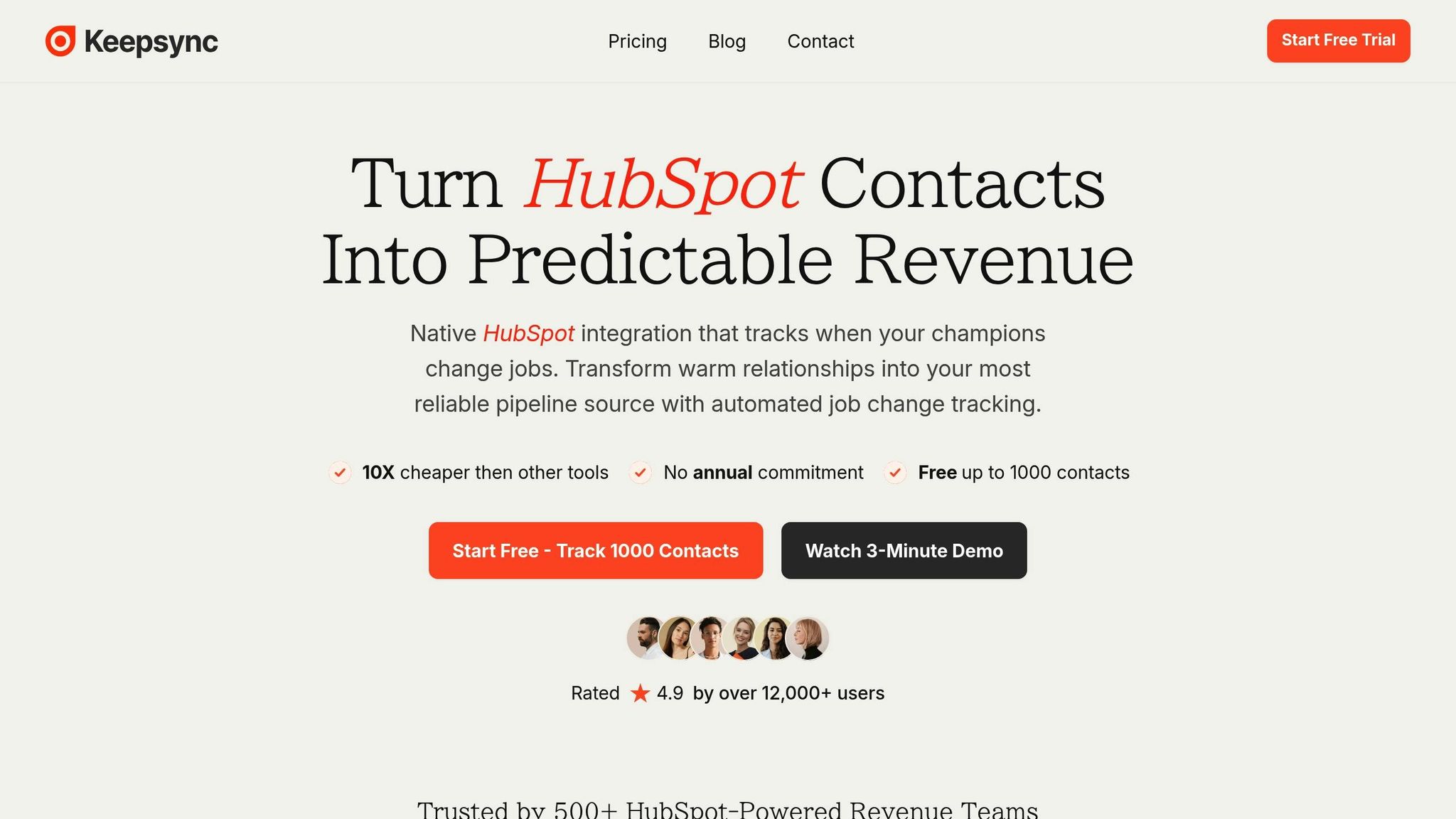

Champion Tracking Setup Guide: HubSpot and KeepSync Integration Workflow
Tracking champions effectively requires setting up specific configurations in both HubSpot and KeepSync. This process ensures you can stay informed about your champions' career moves, helping you maintain those critical sales opportunities. The key lies in laying a strong foundation in your CRM.
Before integrating any tracking tools, make sure your HubSpot CRM is well-organized. Start by ensuring that each contact in HubSpot has a LinkedIn Profile URL. This URL acts as the unique identifier for tracking job changes [6].
Next, create a static list in HubSpot for the champions you want to monitor. Use filters to include only contacts with a LinkedIn Profile URL and specific lifecycle stages, such as Customer or Power User [6].
To maintain clean data during job transitions, add custom properties to your CRM:
These fields will help you capture details about your champion's previous role [6]. Additionally, enable "Data enrichment access" in HubSpot's Users & Teams settings to ensure you can update records effectively [8].
Once your HubSpot CRM is ready, integrate KeepSync to receive dynamic job change alerts. Use KeepSync's native integration to connect it with HubSpot. Select the property containing LinkedIn URLs so KeepSync can monitor profile data [5].
KeepSync works by comparing a contact's LinkedIn company with the primary company listed in HubSpot. It checks LinkedIn profiles every 25 days, giving you updates within a one-month timeframe [6]. Depending on your plan, KeepSync can monitor up to 20,000 contacts per month with the Agency plan or 5,000 contacts with the Team plan.
Set up field mapping by aligning HubSpot properties (like Job Title or Company Name) with KeepSync fields [5]. Use the "Replace" option for job titles and "Fill empty values only" for names. This approach ensures you keep current data while protecting manually entered information [8].
To refine tracking, apply filters based on your Ideal Customer Profile (ICP). This ensures KeepSync only creates records or tasks for champions who move to companies that match your ICP [5].
After mapping your fields, configure alerts to keep your team informed about job changes.
KeepSync offers flexible alert options, including Slack, email, or direct updates in HubSpot as timeline events or tasks. For high-value champions, you can set up automatic HubSpot tasks assigned to the contact owner when a job change is detected. This makes it easier to take quick action [5].
Enable automatic contact enrichment to update email addresses, phone numbers, and company details when a champion switches roles. KeepSync uses a layered AI approach with a 94% accuracy rate for verified contact information [2].
For larger lists, you can route AI-generated outreach drafts to Slack for manual review before sending them via HubSpot sequences. This adds an extra layer of quality control for important relationships [2].
"When a customer moves to a new company, they bring their positive experience with your product along with them. They're your best advocates, already familiar with your value proposition and potentially positioned to champion your solution at their new organization."
– Taimoor Tariq, Lead at Clay Club Berlin [2]
You can also create workflows to track champions who have moved jobs within the last 3, 6, or 12 months. This helps you focus on recent movers who are more likely to be open to new opportunities at their current companies [7].
When KeepSync detects a job change, it triggers automated workflows in HubSpot to engage champions in their new roles. This process runs smoothly without requiring manual effort, ensuring your team connects with these individuals while the opportunity is still fresh.
By using webhooks, you can seamlessly trigger HubSpot workflows as soon as KeepSync identifies a job change. This real-time data transfer updates contact properties with new titles and company information, setting the stage for personalized outreach [9][10].
Start by setting "Received a webhook" as the enrollment trigger [9][13]. This ensures the workflow begins as soon as KeepSync sends a job change notification. Add if/then branches to qualify the new company before proceeding. For instance, you might only move forward if the company has over 100 employees [2]. Use "Format data" actions to standardize details like contact names and phone numbers - capitalize names or clean up formatting - before initiating any outreach [11].
"Rather than starting with cold prospecting, this approach begins with your existing customers, the people who already know and trust your product" [2].
To avoid hitting API limits, set rate limits for webhook updates [9]. HubSpot also has a built-in safeguard: it retries failed webhooks for up to three days, ensuring data stays consistent even if there are temporary outages [9].
Finally, integrate lead routing into the workflow to assign champions to the right sales reps as soon as the process kicks off.
Automated lead routing ensures champions are matched with the appropriate sales reps based on their new roles or companies. Configure workflows to assign follow-up tasks to the correct account manager as soon as a champion is identified at a new target account [11].
Automatically align contact and company lifecycle stages. For example, if a champion moves to a new company, you can classify that company as a "Sales Qualified Lead" based on the champion's presence [11]. Conversely, if they join a company that doesn’t meet your Ideal Customer Profile, workflows can update their lifecycle stage to "Other" and mark them as non-marketable [11].
Enable re-enrollment for champions with each job change [12]. This ensures continuous engagement and allows your team to act on real-time insights, amplifying sales effectiveness.
Tracking the results of champion-focused initiatives helps validate and fine-tune proactive sales strategies. Tools like HubSpot reports and KeepSync analytics make it possible to measure how champion tracking influences both pipeline movement and revenue growth.
HubSpot allows you to create custom views that focus specifically on champion-tracked contacts. By leveraging the Lead Status property, you can follow a contact's journey from "Brand New Lead" to "Connected/Replied" and ultimately to "Open Opportunity/Deal." This setup helps you see how many champions successfully convert at each stage of the sales funnel [15].
Advanced filters, such as the "Intent signals active" property, can segment contacts who recently switched jobs [14][4]. Additionally, HubSpot events can connect job changes to specific deals, offering a clear view of how these changes influence your pipeline. For deeper insights, track Tracked Page Views (Last 30 Days) to determine whether a champion's new company has been visiting your website after your outreach [4].
"The lead status contact property tracks exactly where a lead is from the first moment they're identified until they become an opportunity." - Aditya Shah, HubSpot [15]
You can also create owner-based reports, such as "Connected/Replied Leads by Owner" or "Open Opportunities by Owner", to keep sales reps accountable and identify top performers in re-engaging past contacts [15]. Funnel reports are another useful tool - they let you measure conversion rates between key stages, such as the percentage of job change alerts that lead to meetings or closed deals [16][18].
Once these views are in place, you can move on to analyzing the return on investment.
Using the custom views as a foundation, KeepSync's pipeline analytics can help you evaluate the ROI of champion tracking. These tools allow you to compare performance metrics from before and after implementing your strategy. Focus on crucial data points such as opportunities generated from job change alerts, champion outreach response rates, and revenue attributed to these efforts [17].
HubSpot's revenue attribution reports can also highlight deals influenced by KeepSync-enriched data [17]. To measure responsiveness, monitor the time it takes for job change detections to turn into converted deals [18]. Comparing deal velocity for champion-sourced opportunities versus cold outbound leads can provide a clear picture of how much faster these deals move through the pipeline.
Re-engagement rates are another important metric. Create reports that track "Connected/Replied Leads" specifically tied to the "Job started" intent signal [4][15]. HubSpot’s 30-day backfill of intent signals makes it easier to identify ROI opportunities right after you begin tracking a new company [4]. Plus, with workflow logs available for 90 days and enrollment history for six months, there’s plenty of historical data to draw from [12].
Champion tracking turns job changes into immediate sales opportunities. Former customers are three times more likely to convert compared to cold leads [1]. When these champions move to new companies, they often carry their trust and preference for your product with them.
Automation makes the process simple and efficient. KeepSync integrates with HubSpot, monitoring your contacts weekly across more than 30 data sources with an impressive 94% accuracy rate. It alerts your team the moment a champion changes roles. By tapping into HubSpot's intent signals, you get access to 30 days of job change history, ensuring no opportunity slips through [4]. This system aligns sales, marketing, and customer success teams, giving everyone a unified view of key contacts [3].
"When champions move roles, they often bring their product preferences with them; if they love your products, reps may have a considerably easier time selling to them again." - LeadIQ [3]
These tools and insights offer a clear path to action.
First, create a targeted list in HubSpot that includes all current and former customers, focusing on primary contacts and frequent users. Then, set up KeepSync to monitor this list and define qualification criteria - like notifying your team only when a champion joins a company with over 100 employees.
Next, automate workflows to enrich contact profiles and guide outreach efforts. Use historical HubSpot data to craft personalized messages. To keep the process human-centered, implement a system where AI-generated outreach drafts are sent to sales reps via Slack for review before sending. Start small by testing KeepSync's quick 5-minute setup and Starter plan ($79/mo), which supports up to 1,000 contacts, before scaling up.
Champion tracking is all about identifying and nurturing relationships with key individuals - often decision-makers or influencers - within your target organizations. These "champions" are the people who advocate for your solution internally, helping to pave the way for successful deals.
But what happens when a champion moves to a new role or company? That’s where tracking becomes crucial. Keeping tabs on these transitions allows sales teams to maintain those valuable connections. A former champion in a new position can quickly become a warm lead, opening doors to fresh opportunities.
By staying proactive in managing these relationships, sales teams can streamline sales cycles, boost win rates, and reduce risks tied to changes within an organization. It’s a strategy that not only strengthens connections but also lays the groundwork for long-term growth and consistent revenue.
To connect KeepSync with HubSpot for tracking job changes, start by linking your HubSpot contacts to their LinkedIn profiles. This step allows KeepSync to pull in updated job details and enrich your contact data.
Next, set up contact segments within HubSpot. For instance, you could create one segment to monitor incoming data and another to track updates. These segments are essential for organizing and identifying changes effectively.
After your segments are in place, configure KeepSync to automatically detect job changes and send alerts. From there, you can build HubSpot workflows to respond to these alerts. For example, you might notify your sales team, update contact properties, or even automate follow-ups and personalized outreach. These workflows ensure you maintain strong connections with your contacts during their career transitions and keep your records current.
Sales teams can gauge the effectiveness of champion tracking by examining key performance metrics tied to engagement and outcomes. For example, evaluating the revenue or pipeline growth linked to contacts monitored during job changes or role transitions can offer a clear picture of the strategy's success. Metrics such as reduced sales cycles, increased win rates, and better response rates from these contacts also serve as strong indicators of how well champion tracking is working.
Another important metric to consider is the number of contacts successfully re-engaged or converted after they’ve switched jobs. This showcases the team's ability to capitalize on timely outreach and maintain strong relationships. Tools like HubSpot and KeepSync can simplify this process by automating tracking and delivering real-time insights. This ensures teams stay connected with their most valuable contacts and transform opportunities into tangible results.