
Digital Marketing
·
April 10, 2026
How SaaS Companies Handle Billing Disputes & Chargebacks
Learn how SaaS billing disputes happen, what triggers chargebacks, and how both sides can resolve them faster.

Champion silence often stems from job changes, shifting priorities, or decision paralysis. Use automated tracking and fast re-engagement to prevent stalled deals.


When your champion in a sales deal suddenly stops responding, it’s easy to assume the worst. But often, the reasons have little to do with your product or pitch. Here’s the reality:
The key to preventing this? Automate tracking to detect job changes early, re-engage champions quickly, and monitor pipeline metrics for warning signs. Tools like KeepSync can help you stay ahead by identifying shifts in real time and keeping deals on track.

Why Sales Champions Stop Responding: Key Statistics and Solutions
When champions go silent, it’s not a random occurrence. Their unresponsiveness typically stems from specific, identifiable reasons that often have little to do with your product or pitch. Many sales teams miss these cues because they’re focused on the wrong factors. The real causes? Organizational changes, shifting priorities, and psychological hurdles. Let’s break down how job transitions, internal dynamics, and decision-making challenges contribute to this silence.
Here’s a startling fact: 94% of stalled opportunities are linked to undetected job changes [5]. Your champion may have left the company, taken on a new role in a different department, or been promoted to a position where they’re no longer directly involved with your solution. Unfortunately, most CRMs fail to catch these changes - missing 78% of them when teams rely on manual tracking [5].
With job titles changing at a rate of 65.8% annually and email addresses expiring at about 3.6% per month, it’s estimated that 10% to 25% of a typical B2B database becomes outdated due to these undetected shifts [6][8]. For example, in 2022, Andres Angulo, an Account Executive at Apollo, closed a major deal by leveraging a job change alert. He noticed his champion had moved to a new company as the Global Director of Sales Operations. Angulo quickly engaged the new team with a trial, and by the time his champion settled into their role, the team was already seeing results [8].
"If your team is trying to engage with these out-of-date contacts, not only are they wasting time but potentially getting lots of bounces." - Andres Angulo, AE, Apollo [8]
With the median employee tenure at 3.9 years - and just 2.8 years for workers aged 25–34 [3] - your champion could leave before your deal closes. In fact, 80% of salespeople have reported losing or delaying deals because a key decision-maker or champion changed roles [8]. While job changes are trackable, other challenges like shifting priorities require more proactive strategies.
When companies restructure, priorities shift, and purchasing committees often change. This can bring in new stakeholders who may not see the same value in your solution [6]. Even if your champion remains at the company, their focus may shift due to new leadership or a revised strategic direction.
Here’s the reality: More than 40% of B2B deals stall because internal stakeholders fail to align [6]. During reorganizations, champions often face uncertainty about their roles, leaving them unmotivated to push for new processes or technologies [10]. What was once a top priority may suddenly become less important after a leadership change. New executives, who are 10x more likely to introduce new vendors, often begin evaluating alternatives within their first 90 days - potentially derailing your deal [6].
"Too many deals stall or vaporize because the organization lacks alignment on the problem. In a world of competing priorities, there may also be disagreement about whether a problem is worth solving." - Ralph Grimse, Partner, The Brevet Group [4]
The challenge is compounded by how quickly B2B contact data becomes outdated - decaying at rates between 22% and 70% annually [6]. Stakeholders you identified early in the process may no longer be relevant by the time you’re ready to close. If your strategy relies on a single champion, you’re vulnerable. When their focus shifts during a reorganization, your deal risks falling into what sales teams call "ICU" [9].
Even without structural changes, psychological barriers can prevent champions from moving forward. Sometimes, they go silent because they’re overwhelmed by internal risks and choose to stick with the status quo. In fact, 77% of B2B buyers describe their last purchase as complex or difficult [3]. For enterprise deals over $250,000, the average involves 19 external stakeholders, while typical B2B buying groups include 7 to 13 stakeholders [6][11]. When internal consensus becomes hard to achieve, champions may disengage to avoid risking their professional reputation.
This phenomenon, known as decision paralysis, occurs when the perceived risks of making a wrong choice outweigh the potential benefits of change. Champions may abandon a project rather than stake their professional standing on a complex implementation [3]. To make matters worse, detractors within the organization can actively work against the champion, making the internal battle too costly to continue [1].
"A true champion isn't just a fan of your product; they are personally invested in the outcome it delivers. Their success becomes tied to your success." - Salesmotion [1]
When champions struggle to build internal consensus, they may withdraw to avoid friction [6]. Their silence doesn’t mean they’ve lost faith in your solution - it’s often a sign they’re overwhelmed by internal challenges. Without the right support from your sales team, they’re likely to take the easiest route: doing nothing at all.
Understanding why champions go silent is just the beginning. The real game-changer? Automation. By proactively addressing potential delays and missteps, automation ensures your champions stay engaged, preventing deals from stalling or slipping away. Too often, sales teams wait until it’s too late - reacting only after momentum is lost. Automated systems can catch early warning signs and trigger immediate action, keeping deals on track.
Relying on manual LinkedIn checks isn’t enough - 89% of job changes go unnoticed this way, giving competitors a head start [12]. Tools like KeepSync solve this by monitoring over 30 data sources weekly, offering 30× faster detection with 94% accuracy through AI verification. Setup takes less than five minutes via HubSpot integration. When a champion transitions, KeepSync identifies three key revenue opportunities:
For example, Lattice generated $6.7M in pipeline with a 40× ROI, while UserTesting closed over $1M in new business within a year [12].
"Before this, we were completely blind to job changes. Our reps would manually check LinkedIn maybe once a month, and we'd constantly hear about champions moving to new companies weeks after the fact. Now we're first to reach out every time."
– Marcus Rodriguez, RevOps Manager, Streamline Analytics [12]
Considering the average champion tenure is just 2.5 years [12], early detection of job changes is crucial. Once identified, the next step is immediate re-engagement.
Speed matters. Once a job change is detected, re-engaging within 2–3 weeks is critical to maintain momentum. Real-time alerts via Slack or email ensure your team acts quickly, reaching out to high-value champions before competitors. Smart routing can automatically assign these leads to the right sales rep in HubSpot, while personalized outreach sequences kick off immediately. These alerts should include enriched data - like verified emails, direct phone numbers, and updated company details - to eliminate time-consuming manual research.
As Sarah Kim, Director of Sales at Velocity Commerce, noted:
"Within 45 days we had closed two deals from former customers who moved to bigger companies. Our SDRs love it because these are actual warm leads, not cold calls."
[12]
Warm leads from former champions convert three times faster than cold outreach, and 36% of closed-lost deals eventually convert when the timing improves [12]. By triggering alerts when champions depart, you can act fast to protect recurring revenue and reignite lost opportunities.
Job changes aren’t the only sign of disengagement. Monitoring pipeline metrics can reveal early red flags. Pay attention not just to decision-makers, but also to power users and admins who’ve implemented your product - they’re three to six times more likely to close deals [12]. Analyzing historical data can help identify these patterns [7].
Before re-engaging, confirm that their new company aligns with your Ideal Customer Profile (ICP) - factors like employee count or tech stack can help you avoid chasing poor-fit leads [7]. Use Slack-integrated approval workflows to ensure AI-generated outreach is personalized and high quality, and sync HubSpot with LinkedIn tools to avoid duplicate messaging [7].
Companies leveraging automated job tracking have reported an ROI of 10–79× within 12 months. The secret? Acting quickly when changes happen - before your competitors can [12]. By using automated systems, you can keep champions engaged and maintain a strong, healthy sales pipeline.
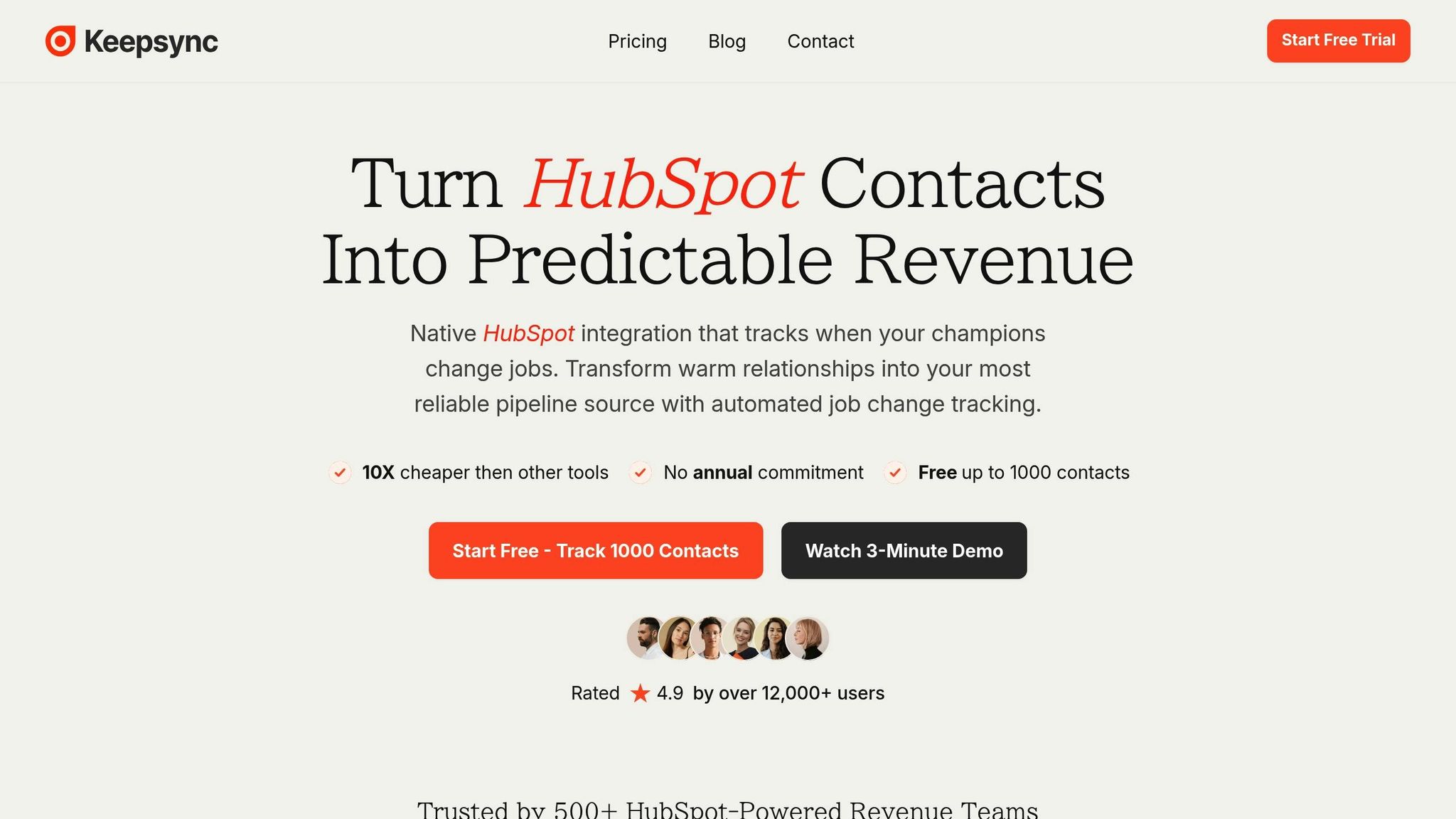
KeepSync turns your HubSpot CRM into an active early warning system, designed to catch champion disengagement before it impacts your sales pipeline. By monitoring over 30 data sources weekly - like company websites and press releases - the platform offers detection that's 30 times faster, with an impressive 94% accuracy rate. Best of all, setup is a breeze. It takes less than five minutes via HubSpot's native integration, and tracking kicks off immediately [12].
When a champion changes roles, KeepSync doesn’t just notify you - it enriches the contact record with updated details, including verified email addresses (97%+ deliverability), phone numbers, and technographics. This eliminates the need for tedious manual updates. Alerts are sent via Slack, email, or directly in HubSpot, and automated workflows ensure the right sales rep is notified for immediate, personalized follow-up.
KeepSync seamlessly integrates with HubSpot workflows and external automation tools like n8n, Clay, and Make through webhooks and APIs. With over 500 revenue teams powered by HubSpot already using the platform - and a stellar 4.9/5 rating from 12,000+ users [12] - KeepSync has become a trusted choice for scaling sales teams.
"With 1,500+ customers, manually tracking job changes was impossible. We were leaving money on the table every month. Now it's fully automated and integrated into our HubSpot workflows. Set it and forget it."
– Julia Chen, VP Sales Operations, Nexus Software [12]
KeepSync’s features are designed to save time, reduce manual effort, and ensure your team has the tools to stay ahead.
KeepSync offers pricing options that grow with your team, starting with a Starter plan ($79/mo) perfect for testing the platform with real data. The pricing is straightforward, with no hidden fees or forced annual contracts.
| Plan | Monthly | Annual | Contacts/Month | Key Features |
|---|---|---|---|---|
| Starter | $79/mo | $79/mo | 1,000 | Weekly monitoring, email alerts, webhooks, email support |
| Team | $149 | $1,490 | 5,000 | Everything in Starter plus Slack alerts, API access, email/phone enrichment, priority support |
| Agency | $399 | $3,990 | 20,000 | Everything in Team plus white-label capabilities and a dedicated customer success manager |
If you opt for an annual plan, you’ll get two months free compared to monthly billing. Need more contacts? No problem - additional contacts are just $0.02 each on the Team plan or $0.015 on the Agency plan. Plus, KeepSync offers a money-back guarantee if detection accuracy ever dips below 90% [12]. And with the ability to cancel monthly, there’s no long-term commitment required.
Champions often go silent due to external factors like job changes, shifting priorities, or internal restructuring. These changes are responsible for most cases of radio silence, and without proper tracking, you might not even realize it until it’s too late. Automation plays a crucial role here. For example, reaching out within the first 30 days of a champion's job transition can lead to 3-5x higher response rates compared to waiting 90 days [2]. Early detection makes all the difference.
To stay ahead, you need tools that monitor and alert you to these changes in real time. By tracking contacts weekly across 30+ data sources, you can identify shifts before your competitors even notice. Automated alerts give you a 24-48 hour advantage to reestablish contact, keeping your sales momentum intact. Why is this so important? Former customers are 5x more likely to convert than cold prospects [5], and deals involving former champions boast a 39% win rate - double the SaaS average of 19% [5].
KeepSync brings this strategy to life by turning your HubSpot CRM into a proactive system. It tracks job changes, enriches contact records, and triggers personalized engagement - all in real time. Timing is everything in sales, and knowing about a champion’s move as it happens can be the difference between a stalled deal and a closed-win. By configuring your CRM to track and respond to these changes, you ensure you’re always one step ahead. Automated insights and personalized outreach aren’t just helpful - they’re essential for converting opportunities and maintaining strong B2B relationships.
To find out if your champion has switched jobs, keep an eye on updates to fields like Job Title and Company Name in your CRM. You can set up real-time alerts using tools like workflows or integrations such as KeepSync. This way, you’ll always be in the loop and ready to act quickly when changes happen.
Building relationships with multiple advocates within an organization is essential. Relying on just one person can be risky - they might leave, lose their influence, or become unavailable. By connecting with a range of individuals, such as influencers, decision-makers, and internal users, you create a stronger foundation. This approach reduces dependency on a single contact, keeps progress steady even if circumstances shift, and helps you better navigate internal dynamics. A broader network also boosts your chances of successfully closing the deal.
When your champion suddenly goes quiet, the first step is to investigate potential reasons, such as job changes or internal role shifts, that might explain their disengagement. Tools like LinkedIn or internal updates can help you track these transitions. Once you have clarity, reach out with a personalized message that references your shared history to re-establish the connection.
At the same time, it's smart to cultivate relationships with multiple advocates within the organization. This way, you're not overly dependent on a single point of contact. If one person becomes unresponsive, you’ll still have others to help maintain progress and keep the conversation moving forward.