
Digital Marketing
·
April 10, 2026
How SaaS Companies Handle Billing Disputes & Chargebacks
Learn how SaaS billing disputes happen, what triggers chargebacks, and how both sides can resolve them faster.

Track usage, support trends, NPS, and engagement and centralize alerts in HubSpot to detect at-risk accounts and reduce churn.


Keeping customers is cheaper than finding new ones. Did you know retaining a customer costs 5–25x less than acquiring one? Plus, just a 5% increase in retention can boost profits by 25–95%. For B2B SaaS, where acquisition costs are high, focusing on retention is key.
To prevent churn, track these four signals:
Tools like HubSpot and KeepSync centralize these signals, helping teams act fast. Automating alerts and workflows ensures quick responses, reducing churn and improving customer loyalty.
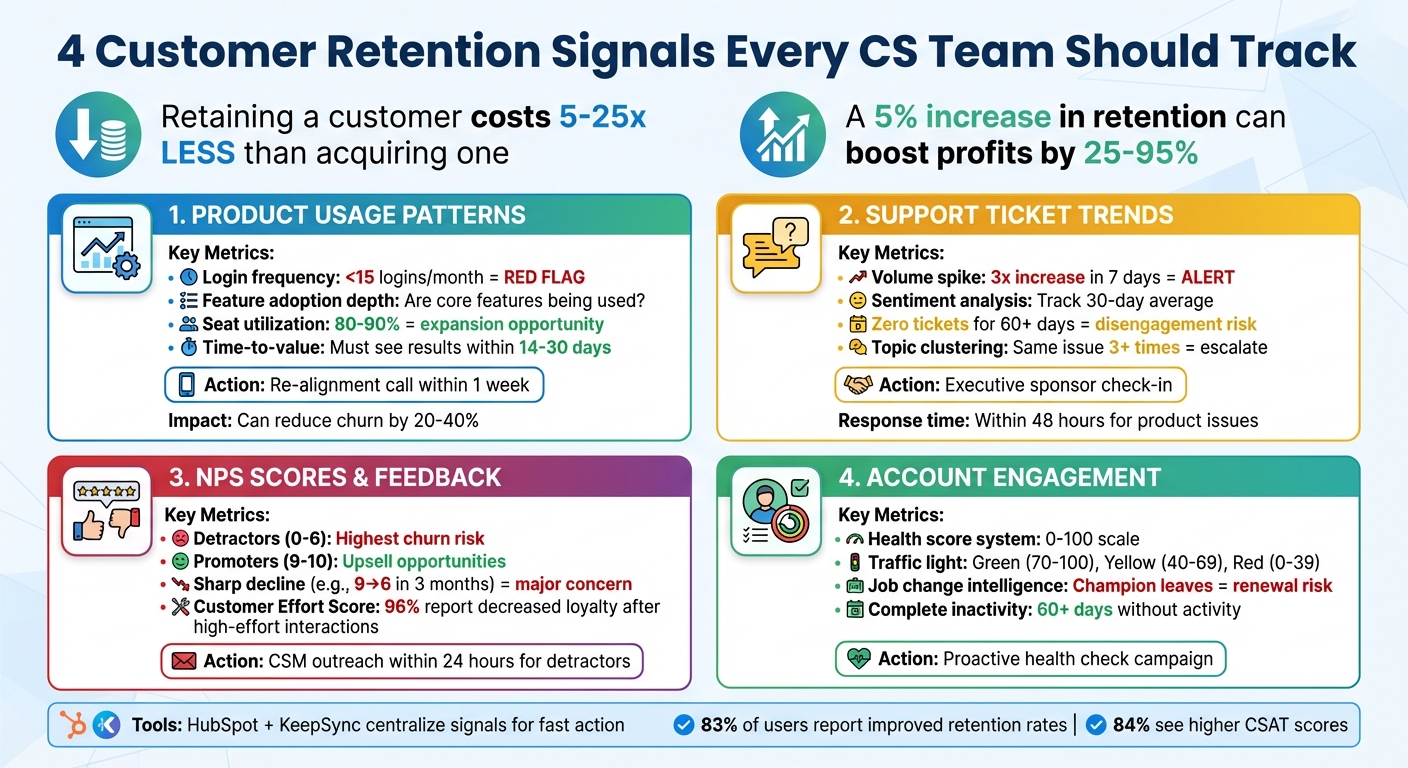
4 Critical Customer Retention Signals and Action Thresholds for CS Teams
Certain signals can help distinguish thriving accounts from those at risk. These indicators give Customer Success (CS) teams the insights they need to act quickly - whether to prevent churn or uncover opportunities for growth. By focusing on these signals, CS teams can make well-timed, data-driven decisions.
Login frequency is often the first indicator of trouble. For tools meant to be used daily, a drop in logins - say, from 20 to fewer than 15 per month - can signal disengagement [9].
Feature adoption depth adds another layer to the story. It’s not just about logging in; it’s about whether users are completing key actions, like running reports in an analytics tool or finishing projects in a management platform. If core features are underused, the account may be vulnerable to competitors [9].
Seat utilization highlights both risks and opportunities. For accounts nearing 80–90% of their licensed seats, it’s time to discuss expansion. On the flip side, if only one person on a team is using the product, it may indicate a lack of buy-in across the organization, putting the account at higher risk of churn [9][7].
Time-to-value (TTV) is critical during onboarding. Customers who don’t see meaningful results within the first 14–30 days are more likely to churn. Monitoring usage and addressing issues early can reduce churn by 20–40% [9]. Tools like HubSpot can help by setting up multi-factor thresholds - such as combining low logins with poor feature adoption - to trigger alerts for immediate follow-up.
A 3× increase in support tickets within seven days is a red flag, often pointing to onboarding struggles or issues following a product update. This should prompt an executive sponsor to step in [5].
Sentiment analysis of support interactions can also reveal at-risk accounts. By tracking the average sentiment over 30 days, rather than isolated conversations, teams can detect declining satisfaction [10].
A lack of activity - zero tickets for 60+ days - is another warning sign. While it might suggest self-sufficiency, it could also indicate disengagement. A proactive health check within a week can help re-engage these accounts [5].
Topic clustering is useful for identifying widespread product issues. If multiple accounts report the same problem more than three times, escalate it to the product team for resolution within 48 hours [10]. Addressing these issues promptly can help prevent churn.
Net Promoter Score (NPS) is a direct measure of loyalty and future revenue potential. Detractors (scores of 0–6) are at the highest risk of churn, while Promoters (scores of 9–10) often indicate opportunities for upselling or expansion [1][4].
A sharp decline in NPS - like dropping from a 9 to a 6 in three months - signals a significant shift in sentiment. Correlating these drops with churn rates can help predict revenue loss before it happens. Automating workflows in tools like HubSpot ensures CSMs can respond to detractors within 24 hours [1][2].
Customer Effort Score (CES), which measures how easy it is for customers to resolve issues, is even more predictive of loyalty than standard satisfaction scores. High-effort interactions often lead to disloyalty, with 96% of customers reporting decreased loyalty after such experiences [4].
Building on product usage and support trends, customer health scores offer a comprehensive view of engagement. These scores combine quantitative data - like logins and feature adoption - with qualitative insights [6][7]. Weighting the metrics by their impact (e.g., prioritizing value realization over simple logins) can provide a clearer picture [2][7].
A traffic light system - Green (healthy), Yellow (monitor), and Red (at-risk) - can help teams quickly prioritize where to focus their efforts [6][2].
CS teams are shifting from activity-based metrics to measures that reflect whether customers are achieving their goals. As Lincoln Murphy, a Customer Success expert, puts it:
"If churn is a major issue in your business today... it's critical to view churn for what it is: a symptom of a deeper, underlying disease." [6]
Another critical factor is job change intelligence. When your primary contact or "champion" leaves their company, your renewal could be at risk. Tools like KeepSync can provide timely alerts, ensuring you can address these transitions before they impact retention.
| Signal Category | Key Metric | Action Threshold | Recommended Response |
|---|---|---|---|
| Product Usage | Login frequency | <15 logins/month | Re-alignment call within 1 week [9] |
| Support Tickets | Volume spike | 3× increase in 7 days | Executive sponsor check-in [5] |
| NPS Score | Detractor identified | Score 0–6 | CSM outreach within 24 hours [1][2] |
| Account Engagement | Complete inactivity | Zero activity for 60+ days | Proactive health check campaign [5] |
HubSpot’s Customer Success Workspace serves as a centralized hub where teams can bring together metrics from various sources into a single 0–100 health score for each account [3][8]. Key data points like logins, feature usage, and milestone completions can be synced directly into custom properties within HubSpot [7].
These health scores are built on four key factors: product usage, customer feedback, account health, and engagement [8]. With Service Hub Enterprise, teams can create up to 10 distinct health scores, allowing for tailored metrics based on product lines or customer lifecycle stages [8][11]. To keep the scores current, decay rates can be applied, giving more weight to recent customer activity over older data [8].
KeepSync simplifies this process with a quick, 5-minute HubSpot integration. It requires no technical expertise and monitors over 30 data sources with a 94% accuracy rate for detecting job changes, updating weekly [14]. These job change alerts prompt teams to reconnect with key contacts, ensuring that when a product owner leaves, immediate action is taken to protect monthly recurring revenue [14].
This centralized approach lays the groundwork for seamless automation and more efficient workflows.
Once data is centralized, automated workflows can take over to streamline responses. For example, workflows can be triggered by changes in health scores or KeepSync’s job change alerts. These workflows can automatically create "Renewal-Risk" tickets, notify CSMs via Slack when a health score drops into the "Red" zone, assign tasks to team members, and even update deal stages [8][12][14]. A simple traffic light system - Green (70-100) for healthy accounts, Yellow (40-69) for accounts needing attention, and Red (0-39) for at-risk accounts - helps teams prioritize their efforts effectively [8].
For critical stakeholder changes, Slack alerts can ensure the customer success team responds within 2-3 weeks [14]. If a key contact departs, these alerts can trigger a "re-engagement" playbook automatically [14].
In October 2026, Michal Kierul, CEO of InTechHouse, shared how implementing a 120/60/30-day automated renewal cadence - integrating product usage, NPS, and ticket data into health scores - led to a 17% increase in on-time renewals and a 25% reduction in last-minute discounts over two quarters [13]. Setting early triggers at 120, 90, and 60 days before contract expiration gives teams enough time to reinforce value before renewal discussions begin [13].
To assess the success of these systems, track metrics like Net Revenue Retention (NRR), Customer Lifetime Value (CLV), and Revenue Churn Rate [1]. Start by establishing a baseline - record current churn rates, average renewal timelines, and the time customer success teams spend on manual account reviews [13].
In 2026, Savage Growth Partners reduced churn by 22% in just one quarter by automating their renewal workflows. CEO Jensen Savage described how shifting from manual outreach to a sequenced workflow - where marketing sent value reminders and account managers received context-rich notifications - streamlined the process [13]. Similarly, SurveyStance saw a 15% drop in churn after implementing automated renewal systems. Natalie Nicole, Head of Customer Success and Experience at SurveyStance, remarked:
"Automating the process allowed for renewals to flow naturally and has decreased churn by more than 15% since implementation." [13]
Evaluate the effectiveness of playbooks by analyzing "At-Risk" signals and identifying which interventions yield the best results [12]. Additionally, monitor whether proactive signal tracking reduces the frequency of last-minute discounts during renewal negotiations [13]. According to a survey, 83% of Service Hub users reported improved customer retention rates, while 84% noted higher CSAT scores, highlighting the measurable benefits of centralized signal tracking [3].
Retention signals serve as crucial early indicators to help prevent customer churn. Keeping an eye on product usage trends, support ticket patterns, NPS scores, and account engagement offers a well-rounded picture of customer health. As Customer Success Expert Lincoln Murphy puts it:
"If churn is a major issue in your business today... it's critical to view churn for what it is: a symptom of a deeper, underlying disease." [6]
The importance of these early warnings is backed by data. For example, 83% of HubSpot Service Hub users report better retention rates, and 84% see increased customer satisfaction scores [3]. This shows how data-driven retention strategies can lead to tangible results, supporting both profit growth and cost efficiency.
In practice, tools like HubSpot's Customer Success Workspace and KeepSync's automated job change tracking empower teams to respond to these signals in real time. Whether it’s setting up health score systems, automating alerts when key contacts change roles, or initiating renewal playbooks at the right time, these tools make proactive management achievable.
Moving from reactive problem-solving to proactive relationship management is now a must for modern Customer Success teams. By consolidating retention signals and automating responses, you can turn raw data into actionable insights. This not only protects revenue but also lays the groundwork for lasting customer loyalty and steady growth.
Tracking how customers use your product is crucial for understanding their interaction with key features and determining if they’re finding value in it. When you notice low engagement early, your customer success team can step in, offer support, and make adjustments to enhance the user experience.
This doesn’t just help prevent churn - it also boosts customer satisfaction and loyalty, creating a win-win situation for both your customers and your business.
Net Promoter Score (NPS) is a powerful way to identify accounts that might be at risk. Since it reflects customer satisfaction and loyalty, a low score often points to dissatisfaction or unmet expectations. This gives your team a chance to step in and resolve issues before they escalate into churn.
By monitoring NPS trends over time, you can uncover patterns and focus on customers who might need additional attention. Taking action early doesn’t just help you keep those customers - it also builds stronger, more lasting relationships.
Automating alerts can play a big role in keeping your customers happy and loyal. By setting up real-time notifications for critical signals - like drops in product usage or unresolved support tickets - your team can step in quickly to resolve issues before they escalate into customer churn.
This kind of proactive strategy helps Customer Success teams focus on what really matters: tackling high-priority tasks, improving customer relationships, and ensuring satisfaction. When you address problems early, you not only build trust but also create a foundation for long-lasting loyalty.