Digital Marketing
·
April 10, 2026
How SaaS Companies Handle Billing Disputes & Chargebacks
Learn how SaaS billing disputes happen, what triggers chargebacks, and how both sides can resolve them faster.

Compare HubSpot's Breeze Intelligence with third-party enrichment tools for accuracy, real-time updates, technographics, and cost trade-offs.


Struggling with outdated CRM data? This article breaks down how HubSpot's built-in data enrichment tools stack up against third-party solutions like ZoomInfo and KeepSync. Here's the takeaway:
KeepSync monitors your HubSpot contacts weekly across 30+ sources with 94% accuracy. Get alerts when champions change jobs, decision-makers move, or key contacts leave. Starts at $79/month for 1,000 contacts.
Quick Comparison:
Feature
HubSpot Native Tools
Third-Party Tools (e.g., KeepSync)
Data Focus
Firmographics, buyer intent
Technographics, verified contacts
Update Frequency
Monthly
Real-time or event-triggered
Accuracy
Moderate
High (multi-source validation)
Match Rates
60–70%
85%+
Cost
Included in plans
Additional subscription required
Key Insight: HubSpot's tools are great for basic enrichment, but if your sales team needs deeper insights and real-time updates, third-party solutions are worth considering. Read on to decide which approach fits your CRM goals and budget.

HubSpot’s Breeze Intelligence leverages AI and large language models to build detailed contact and company profiles. It pulls data from public sources and third-party vendors, enriching records automatically when they’re created, through monthly updates, or manually for up to 100 records at a time [7][2][5].
The enriched data is displayed in an Intelligence Tab on each record, providing key firmographic details like annual revenue, employee count, and industry classification [6]. You can also monitor website visitor activity over the past 30 days and identify which companies are visiting your site [6]. Another handy feature is form shortening, which hides fields that can be auto-filled with enriched data, making it easier for prospects to complete forms [7]. Together, these tools simplify data management and improve efficiency.
Standard enrichment includes essential details like job title, seniority, LinkedIn URL, location, revenue range, employee count, industry, and even web technologies and social media handles [7]. If you’re using a Starter, Professional, or Enterprise subscription across HubSpot’s Marketing, Sales, Service, Data, Content, or Operations Hubs, this standard enrichment doesn’t use HubSpot Credits. However, advanced features like Buyer Intent tracking and Smart Properties require credits - 10 credits per enriched record [12].
HubSpot’s native tools integrate seamlessly with its CRM, syncing data in real time without requiring additional API configurations [7]. This enriched data can be immediately used to trigger workflows, improve lead scoring, and segment lists for targeted campaigns [7].
"At BC Solutions, we chose Breeze largely due to our reliance on the rest of the HubSpot ecosystem, and we've been impressed with the results unlocked through marketing data enrichment." - Michael Welch, Author
Standard enrichment, included in paid plans, ensures records are refreshed monthly at no extra cost [5][7]. Unlike many third-party tools that charge per record or require separate subscriptions, HubSpot’s built-in features save time and money. Teams using these tools often save 2-3 hours daily on manual research and see a 15-25% boost in lead qualification accuracy thanks to more complete customer profiles [9].
HubSpot also offers unified governance with built-in privacy controls. These include opt-out mechanisms that comply with GDPR and CCPA regulations [11]. If a contact opts out of HubSpot’s commercial dataset, the "Enrichment opt-out" property updates automatically, and Super Admins are notified [7]. However, while these features cover many needs, they don’t address every use case, as explained below.
While HubSpot’s enrichment tools provide useful firmographics, they lack depth in areas like technographics (detailed software stack information), verified direct dial numbers, and buying-committee role mapping. These gaps can lead to inaccurate lead scoring, inefficient territory assignments, and missed opportunities for personalized outreach [10][12].
"HubSpot's native enrichment provides a good baseline but misses technographics, intent, verified contacts, and deeper firmographics needed for accurate scoring and routing." - Stan Rymkiewicz, Head of Growth, Default
Another challenge is refresh latency. Monthly updates may not be quick enough for industries where job roles and company details change frequently [11][12]. Additionally, match rates tend to be lower compared to specialized providers, particularly for regions outside North America or niche markets [10].
Finally, credit limitations can be a hurdle. While standard enrichment is included, advanced features consume credits rapidly. Professional plans come with 3,000 credits per month, and Enterprise plans with 5,000, but at 10 credits per record, these can deplete quickly [12]. Credits don’t roll over, and additional packs cost approximately $10.00 for 1,000 credits [12]. Users should also note that HubSpot is retiring its legacy "Insights" feature by March 17, 2026, pushing all users toward the credit-based Breeze Intelligence model [12].
Third-party platforms go beyond HubSpot's core features by offering technographic insights and real-time buying signals. For instance, tools like ZoomInfo and Apollo access databases with over 400 million verified contacts, giving you a detailed look at a prospect's technology stack - everything from ERP systems to analytics platforms and advertising tools [15].
These tools also track intent data, which helps identify when companies are actively in the market. Indicators like funding announcements, hiring spikes, or competitor contract lapses can signal buying opportunities, enabling sales teams to act on these hidden cues [14][15]. Unlike HubSpot's monthly refresh cycle, many third-party tools provide real-time updates and let you customize refresh schedules - weekly for intent data or quarterly for phone numbers - helping to counteract the 2.1% monthly decay rate in B2B contact information [1].
Another standout feature is waterfall enrichment, where platforms like Default pull data from multiple sources - such as Apollo, Harmonic, and Clearbit - simultaneously. This approach improves data accuracy and fill rates, especially for niche industries or regions outside North America. Additionally, tools offer smart lead-to-account matching and automated routing rules, ensuring leads are assigned to the best sales rep for the job [15]. This level of precision is essential when using a CRM for field sales, where geographic routing and lead-to-territory matching directly impact daily productivity. Many also specialize in tracking job changes, which we'll explore in the next section.
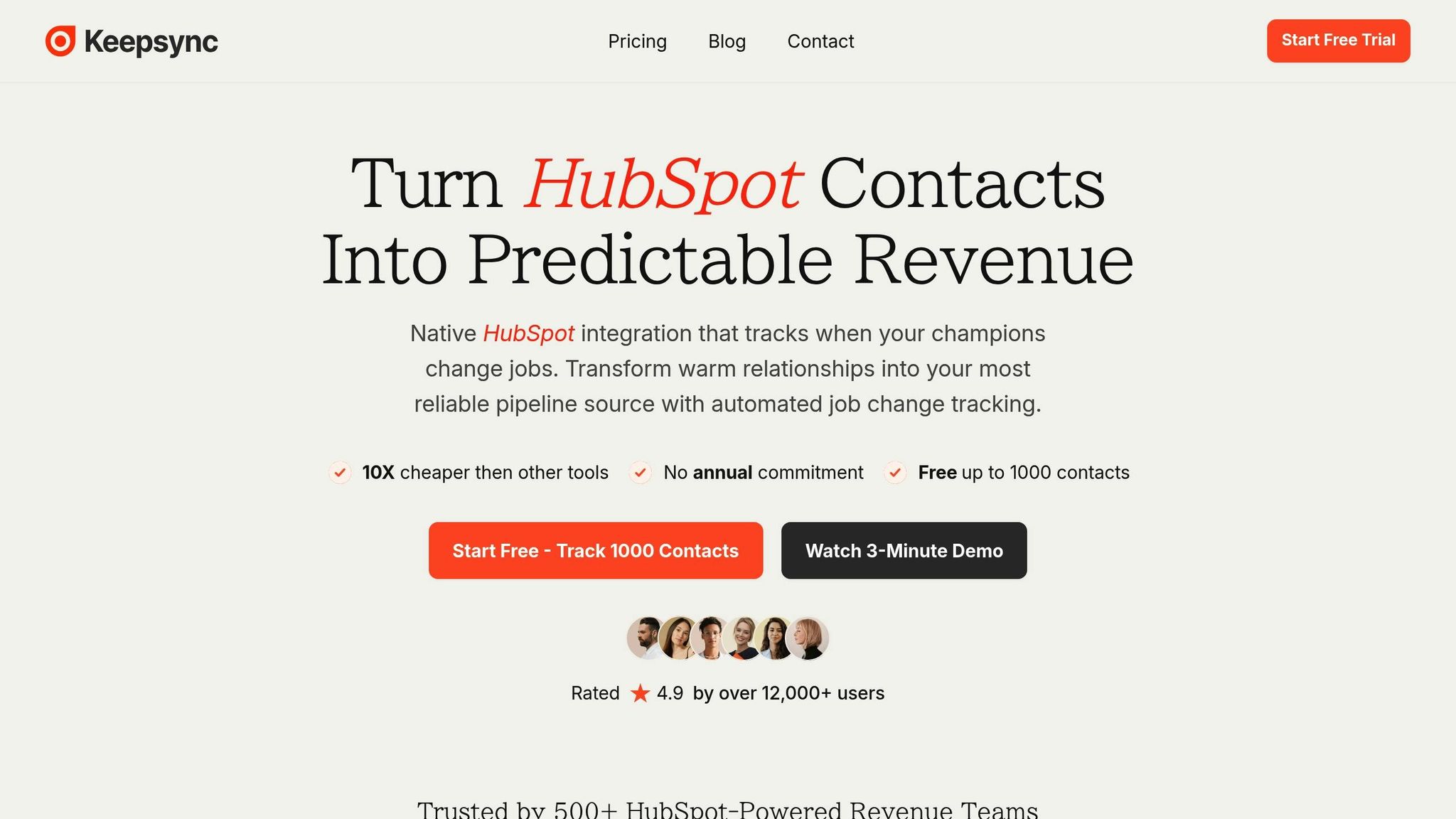
KeepSync is a specialized tool for automated job change tracking, boasting 94% accuracy. It monitors HubSpot contacts weekly across more than 30 sources. When a key contact - like a former champion - moves to a new company or a contact from a closed-lost deal changes roles, KeepSync sends real-time alerts via Slack, email, or directly within HubSpot. These alerts include enriched contact details, such as verified email addresses, phone numbers, and updated company information, so your sales team can follow up right away.
KeepSync integrates seamlessly with HubSpot, taking just five minutes to set up. It works with your existing workflows to trigger automated outreach sequences, assign leads based on territory, and track pipeline performance to measure response rates and ROI. The platform is particularly useful for tracking former champions, contacts from closed-lost deals, and even competitors' customers who may now hold decision-making authority.
Pricing starts at $79/month for 1,000 contacts and scales up to $149/month for 5,000 contacts, making it a cost-effective way to manage job changes. This is especially critical since over 20% of emails in a typical contact list become outdated each year due to role changes [16].
While HubSpot's Breeze provides basic firmographic data, third-party tools offer richer insights like verified direct-dial numbers, detailed technographic profiles, and behavioral signals to enhance your CRM data. These added layers of information can significantly improve the health of your sales pipeline.
"This is a must-have for midsize to enterprise businesses with large contact databases. Marketing, sales operations, demand generation, and sales teams will benefit massively from this integration." - Sam Balter, Content Director, ZoomInfo
Poor-quality data can have a serious financial impact - companies lose at least 20% of their annual revenue due to data issues. Additionally, 24% of CRM admins report that less than half of their database is accurate or complete [1]. Third-party tools help solve these problems by routinely cleaning up databases, removing duplicates, and refreshing outdated records to keep your data reliable [13].
For businesses exploring AI, high-quality data is essential. A staggering 67% of CRM users worry their data isn't ready for machine learning initiatives [1]. Third-party tools also excel in compliance; for instance, Cognism provides 100% GDPR and CCPA-compliant data for the European market, often outperforming native tools in this area [15]. With advanced automation, multi-source coordination, and a focus on accuracy, third-party enrichment tools are critical for modern sales teams looking to boost efficiency and maintain reliable data.
HubSpot's native tools and third-party solutions each bring distinct strengths to data enrichment. Here's a quick look at how they compare:
Feature
HubSpot Native (Insights/Breeze)
Third-Party Tools (e.g., KeepSync)
Basic firmographics & buyer intent
Technographics, verified contacts, job changes
Monthly (Continuous enrichment option)
Real-time or event-based (e.g., job change alerts)
Reliable for companies; limited for contacts
High, via multi-source validation
60–70% coverage
85%+ through waterfall enrichment
Native; no integration required
Requires API/CRM extension integration
Foundational scoring & form shortening
Advanced routing, account-based marketing, outbound prospecting
HubSpot's native tools handle the basics, offering 60–70% record coverage with minimal setup. On the other hand, third-party solutions, leveraging waterfall enrichment, can push match rates to over 85% by combining data from multiple sources [3][18]. This makes them a better fit for businesses with more complex sales and CRM requirements.
Expanding on the table above, let’s break down the advantages and limitations of each approach.
HubSpot's native features are perfect for businesses looking for a straightforward solution to gather company data. These tools are included in most subscriptions and automatically populate key fields like industry and employee count, making lead capture easier. However, they fall short when it comes to detailed contact-level data or advanced functionality, which can limit their use for outbound campaigns or account-based strategies.
Third-party tools, such as KeepSync, shine in areas like verified contact details, real-time job change alerts, and buyer intent signals. These capabilities are particularly useful for proactive sales efforts, such as tracking key contacts who move to new roles or analyzing a prospect’s tech stack. While they require API integration and additional subscription costs, they bring a level of depth and precision that goes beyond what HubSpot’s native tools can offer.
Automating data enrichment can deliver impressive results, with companies often achieving a 300% ROI and sales teams reclaiming nearly 21% of their time previously spent on manual data entry [17]. For businesses focused on basic lead capture and form optimization, HubSpot's native tools provide a solid starting point. But for those aiming to enhance outbound sales or adopt account-based marketing strategies, third-party tools are often a smarter investment.
HubSpot's built-in tools are ideal for inbound lead management and basic qualification tasks. For example, if your sales strategy involves website visitors filling out forms, HubSpot's form shortening feature can simplify the process by auto-filling known fields. This small tweak typically boosts conversion rates [2][19].
Take GRAPHISOFT Italia as an example. They used HubSpot's native lead scoring, enriched with additional data, to trigger sales notifications when leads reached specific thresholds. The result? They managed to quadruple their MQLs and double new leads year-over-year [20].
Another success story comes from SpinWeb, which leveraged HubSpot's native lead intelligence to segment and target the most engaged prospects. By focusing on enriched data to identify leads with the right company size and industry fit, they saw their sales pipeline grow ninefold [20]. These tools also streamline lead routing based on firmographics, eliminating the need for extra integrations [5][20].
While these native features work well for straightforward lead management, more complex sales scenarios often require advanced tracking tools.
For sales processes that involve deeper, relationship-based strategies, basic enrichment tools may fall short. This is where KeepSync steps in, offering advanced monitoring capabilities. KeepSync tracks HubSpot contacts weekly across more than 30 data sources, identifying job changes that HubSpot's native tools might miss [21]. For example, when a former customer advocate moves to a new role, KeepSync updates their email and company details in HubSpot. This allows sales teams to trigger personalized outreach within the crucial first 2–3 weeks of their new position [21].
"Within 45 days we had closed two deals from former customers who moved to bigger companies. Our SDRs love it because these are actual warm leads, not cold calls."
KeepSync specifically targets three revenue opportunities:
Without automated tracking, 89% of job changes go unnoticed by sales teams, missing out on valuable opportunities. Warm relationships, like those tracked by KeepSync, tend to convert three times faster than cold outreach, making this tool a game-changer for optimizing CRM workflows and driving sales efficiency [21].
These examples highlight how advanced data tracking can elevate CRM performance and unlock new sales opportunities.
Choosing the best enrichment approach boils down to three main factors: contact volume, data needs, and budget.
Start by analyzing your database. Take a sample of 500 random contacts and check which fields are consistently missing or outdated [3]. For instance, if you're lacking basic details like industry or company size, HubSpot's built-in Breeze Intelligence might be enough to cover those gaps. It comes included with Professional plans (1,000 credits per month) and Enterprise plans (5,000 credits per month) at no extra charge [3].
Your team size is another key consideration. Smaller teams handling inbound leads may find HubSpot's native features sufficient. But larger teams, especially those that rely on verified direct-dial numbers or real-time updates on job changes, may need more advanced tools. HubSpot’s free enrichment features don’t include these, and high-volume teams can quickly burn through the native credits, leading to extra costs of $500–$1,500 per credit pack [3].
Complexity of data is also a factor. If missing information is holding back your sales efforts - like lacking technographic data, funding details, or international coverage - third-party tools become essential. As Valentin Wallyn, Founder and CEO of Findymail, explains:
"Think of Breeze as a solid baseline. Specialized enrichment platforms go deeper and are often more reliable for outbound use cases"
.
Automation needs also play a role. If your workflows require intricate automation, specialized tools are better suited. Keep in mind that B2B contact data decays at an average rate of 2.1% per month [1]. Addressing these gaps proactively ensures your sales team stays effective.
By combining native and specialized tools, you can make the most of both. While native tools provide foundational data, third-party platforms add depth and precision.
For example, you can use HubSpot's native features to populate basic firmographics across all records. Then, layer on specialized tools to enhance data for high-value accounts and trigger timely sales actions [10][23].
To manage costs, consider a tiered enrichment strategy. For active deals and priority accounts, update data monthly. For less critical contacts, refresh their information annually or only when they re-engage [3]. This ensures data quality without overspending.
Proper integration is crucial. Match records using unique identifiers to avoid duplicates [23]. Use "fill blanks only" or "append" rules to safeguard manually verified data from being overwritten [10][23]. Stan Rymkiewicz, Head of Growth at Default, emphasizes this point:
"Enrichment only creates value when it fuels workflows - triggering qualification updates, routing changes, and sales activation in real time"
.
For tracking job changes, using UserGems alternatives for HubSpot like KeepSync can be a game changer. It monitors HubSpot contacts weekly across over 30 data sources with 94% accuracy. When a contact switches roles, it updates their email and company details automatically, triggering personalized outreach workflows during the critical first 2–3 weeks of their new position.
This hybrid approach can significantly improve both efficiency and ROI [17].
Choosing between native and specialized solutions for data enrichment isn’t an either-or decision - it’s about combining the strengths of both. For example, HubSpot’s native Breeze Intelligence provides monthly updates to basic firmographic data. On the other hand, specialized tools offer deeper insights, like verified phone numbers, technographic details, and real-time job change alerts. Together, these approaches address the challenges of data decay and quality issues effectively.
Consider this: B2B contact data deteriorates at a rate of 2.1% every month [1], and poor data quality can cost companies an average of $12.9 million annually [24]. Without automated enrichment, sales teams often waste 10–15 hours each week on manual research [3]. That’s valuable time better spent closing deals.
A hybrid strategy balances cost and performance. HubSpot’s native features ensure baseline accuracy, while specialized tools add precision and timeliness, especially for high-value accounts. This layered approach ensures your sales team has access to the right data at the right time without breaking the budget.
To maintain data integrity, match records using unique identifiers and apply smart overwrite rules [3][23]. When enrichment integrates seamlessly with automated workflows - updating lead scores, routing changes, and triggering timely outreach - you’ll unlock tangible ROI. This method not only streamlines your CRM but also boosts sales efficiency.
Start by auditing your database to identify gaps. From there, build an enrichment stack that fits your needs. The right mix of tools can transform your CRM from a simple contact list into a powerful revenue-driving asset.
HubSpot Breeze Intelligence covers basic firmographic enrichment well — industry, company size, and buyer intent signals. However, if your team needs verified direct-dial numbers, real-time job change alerts, technographic data, or match rates above 85%, third-party tools fill critical gaps. The best approach for most teams is using both: HubSpot for baseline data, plus a specialized tool like KeepSync for job change tracking and deeper contact enrichment.
To make sure your manually verified CRM fields stay untouched by enrichment tools, adjust your CRM settings to give priority to manual data. Platforms like HubSpot often let you create rules that safeguard verified information. Take time to check these settings regularly, protect critical fields, and mark manual entries to avoid accidental overwrites. By pairing thoughtful configuration with consistent data management, you can keep your verified data secure while still taking advantage of enrichment automation.
To make the most of HubSpot enrichment and job-change alerts, bring in third-party tools that can update contact records with real-time job updates. Then, set up automated workflows in HubSpot to create notifications or tasks whenever there's a change in job details. This strategy ensures your team can act quickly with accurate information, making it easier to reconnect with contacts and boost conversion rates. Combining enrichment tools with automation helps keep your CRM data fresh and ready for action.
{"@context":"https://schema.org","@type":"FAQPage","mainEntity":[{"@type":"Question","name":"Do I need third-party enrichment if I already have HubSpot Breeze Intelligence?","acceptedAnswer":{"@type":"Answer","text":"<p><strong>HubSpot Breeze Intelligence</strong> covers basic firmographic enrichment well — industry, company size, and buyer intent signals. However, if your team needs verified direct-dial numbers, real-time job change alerts, technographic data, or match rates above 85%, third-party tools fill critical gaps. The best approach for most teams is using both: HubSpot for baseline data, plus a specialized tool like KeepSync for job change tracking and deeper contact enrichment.</p>"}},{"@type":"Question","name":"How can I prevent enrichment tools from overwriting my manually verified CRM fields?","acceptedAnswer":{"@type":"Answer","text":"<p>To make sure your manually verified CRM fields stay untouched by enrichment tools, adjust your CRM settings to give priority to manual data. Platforms like <strong>HubSpot</strong> often let you create rules that safeguard verified information. Take time to check these settings regularly, protect critical fields, and mark manual entries to avoid accidental overwrites. By pairing thoughtful configuration with consistent data management, you can keep your verified data secure while still taking advantage of enrichment automation.</p>"}},{"@type":"Question","name":"What’s the best way to combine HubSpot enrichment with job-change alerts?","acceptedAnswer":{"@type":"Answer","text":"<p>To make the most of HubSpot enrichment and job-change alerts, bring in third-party tools that can update contact records with real-time job updates. Then, set up automated workflows in HubSpot to create notifications or tasks whenever there's a change in job details. This strategy ensures your team can act quickly with accurate information, making it easier to reconnect with contacts and boost conversion rates. Combining enrichment tools with automation helps keep your CRM data fresh and ready for action.</p>"}}]}