
Digital Marketing
·
April 10, 2026
How SaaS Companies Handle Billing Disputes & Chargebacks
Learn how SaaS billing disputes happen, what triggers chargebacks, and how both sides can resolve them faster.

Compare five tools that keep HubSpot contact records current—job-change alerts, data enrichment, and email verification to reduce churn.


Want to keep your HubSpot CRM accurate and updated? These five tools can help you track job changes in HubSpot, reconnect with leads, and reduce churn. With 25% of contacts changing jobs annually, outdated data can cost your business revenue. These tools automate updates, identify high-intent leads, and notify you of key changes, ensuring your CRM stays reliable.
Here’s a quick overview of the tools covered:
Quick Comparison
| Tool | Key Feature | Starting Price | Contact Limits |
|---|---|---|---|
| KeepSync | Job change tracking (94% accurate) | Free; Paid from $149/month | Free: 1,000; Paid: Up to 20,000 |
| HubSpot Extension | Email engagement tracking | Free; Paid from $15/month | No limits on contacts |
| UserGems | Warm lead tracking | $2,750/month | Up to 30,000 (Core Plan) |
| Apollo.io | Data enrichment (275M contacts) | Free; Paid from $49/month | Varies by plan |
| Hunter | Email verification | Free; Paid plans vary | Free: 100 verifications |
Each tool offers unique strengths - whether you need job change alerts, enriched data, or email verification. Choose one that fits your team’s needs and budget to keep your CRM effective.

HubSpot Contact Tracking Tools Comparison 2026
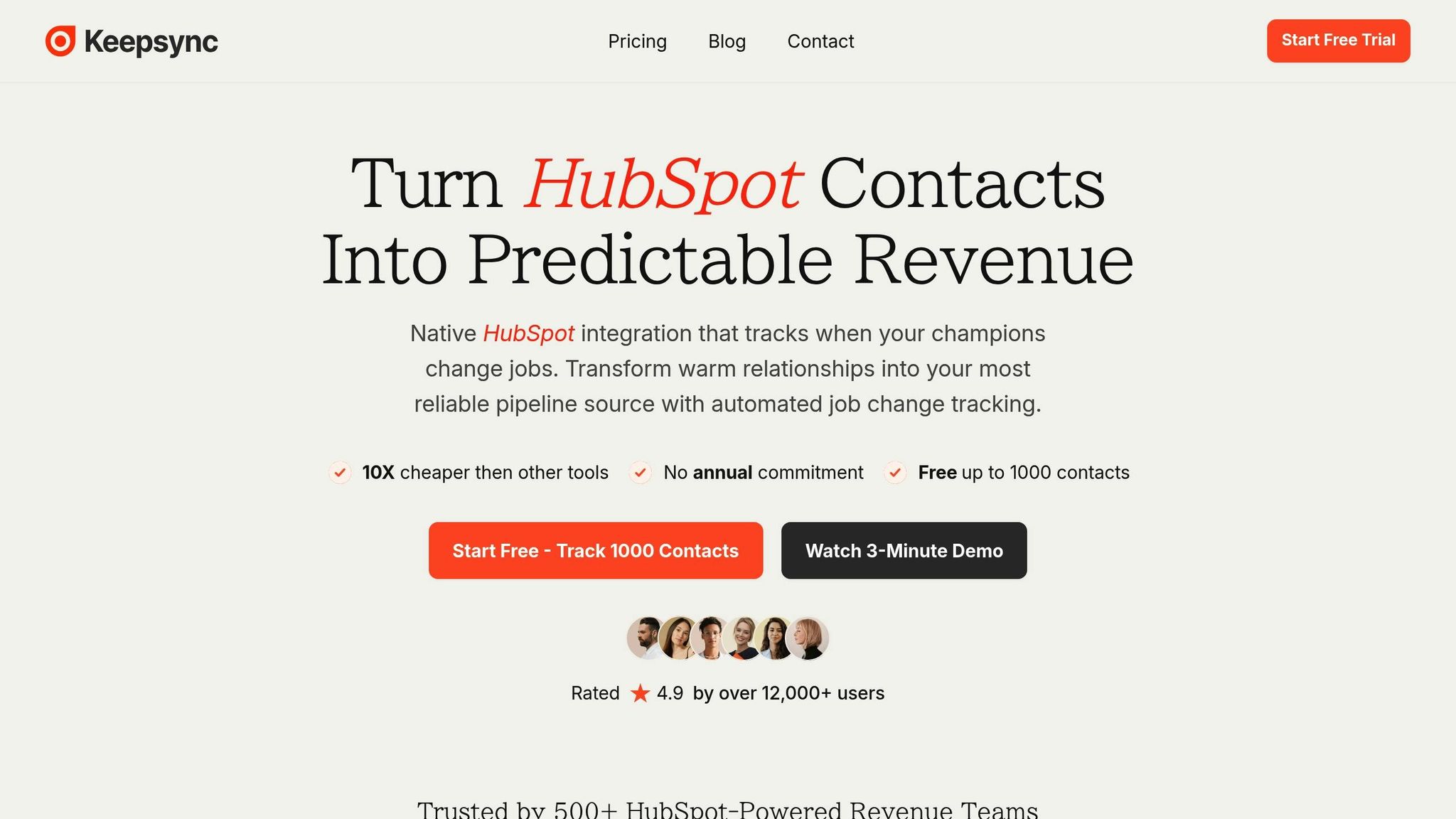
KeepSync is a HubSpot-integrated tool designed to monitor job changes with an impressive 94% accuracy. By scanning over 30 data sources weekly, it keeps you updated when a contact in your CRM changes roles. Alerts are sent in real time via Slack, email, or directly within HubSpot, so you can quickly seize new opportunities.
Here’s how it compares to other job change tools for HubSpot regarding integration, accuracy, notifications, and pricing.
Getting started with KeepSync is quick and hassle-free - it takes less than five minutes to set up [3]. The native integration pulls in your HubSpot contact data and begins monitoring right away. You can manage contact, company, and deal information directly within the platform. Plus, email conversations automatically sync to the relevant contact’s timeline, and new leads are added when they email your shared inbox [3].
Instead of relying on outdated, static databases, KeepSync verifies contact details in real time every time it scans. You can flag specific contacts manually or upload a CSV file, and the system will keep their employment status up to date [4].
KeepSync offers multiple ways to stay informed. Alerts are sent via Slack, email, or HubSpot whenever a contact’s job status changes. If you’re on a paid plan, you can also use webhooks and API access to integrate these alerts into your custom workflows.
KeepSync provides affordable job change tracking with flexible, month-to-month billing and no long-term commitments [4]. Here’s an overview of the pricing:
The Starter plan’s 1,000-contact limit makes it a great option for small teams trying out the platform. For larger teams, the Team plan supports 5,000 contacts, while the Agency plan accommodates up to 20,000. If you need more, additional contacts can be added at the rates mentioned above.
The HubSpot Sales Chrome Extension connects your HubSpot CRM directly to Gmail, LinkedIn, and other websites you browse. With over 1,000,000 users, it’s a popular choice for tracking email engagement and managing contacts - all without leaving your browser [7].
Getting started with the extension is quick and straightforward. Open Chrome, head to the Web Store, add the extension, and log into HubSpot. If the HubSpot icon doesn’t show up in your address bar after installation, pin it to your Chrome toolbar. This gives you easy access to your activity feed and settings [5][7]. Once installed, you’re ready to explore how its tracking tools can enhance your engagement insights.
The extension tracks email engagement using a one-pixel tracking image embedded in your emails [8]. It’s reliable, but there are a few limitations to consider. For instance, it may not work with customized Gmail layouts, and contacts with privacy restrictions or no legal basis for data processing won’t be tracked. Additionally, while emails with attachments over 50 MB won’t log to your CRM, they’ll still send and deliver as usual [6].
You’ll receive real-time desktop notifications when someone opens your email [6][8], clicks a link (if you’re using a paid Sales Hub seat) [5][6], or schedules a meeting through your link [5]. The extension also alerts you when known leads revisit your website or view shared documents [5]. All this activity is logged in a centralized feed, creating a chronological history of emails sent, opens, and engagement times [6].
The free version offers essential features like email open tracking, CRM access within Gmail, email templates, snippets, and a meeting scheduler [7]. For more advanced tools - such as link click tracking, bulk sequence enrollment, and Salesforce integration - you’ll need a Sales Hub Professional or Enterprise plan [5][7]. Pricing depends on the HubSpot plan you select.
There are no limits on the number of contacts you can manage with the extension [6][9]. However, features vary by plan. Free users can track email opens, while paid users gain access to full tracking capabilities, including link click tracking [6][8]. Keep in mind, if your HubSpot account has data privacy settings enabled, only contacts with a legal basis for data processing will be tracked [6].
Building on the capabilities of KeepSync and HubSpot's extension, UserGems offers a powerful solution for tracking job changes and seamlessly integrating this data into your CRM. It specializes in keeping tabs on job movements among key contacts, ensuring your sales team stays ahead of potential opportunities. The platform identifies when contacts transition to new companies, providing warm outbound prospects with a 95% match rate and verified email addresses that bounce less than 5% of the time [13].
Getting started with UserGems is fast and straightforward. The initial connection takes less than a minute, with full implementation wrapped up in under an hour. Most businesses are fully operational within a week [10][12]. A dedicated Customer Success Manager assists during this process, helping to customize tracking properties in HubSpot and define the lists of contacts and companies to monitor [10]. Once set up, the platform’s AI uses your CRM data to generate an Ideal Customer Profile, enabling you to receive top-tier leads right away [10].
UserGems stands out with its rapid and precise updates, refreshing tracked contact data every 2–4 weeks - much faster than traditional databases [14]. The platform combines proprietary algorithms with human verification to ensure accuracy in identifying job changes [13][14]. When a contact moves to a new role, the system links their new record to the old one in HubSpot, retaining historical data like past product usage and NPS scores [12][13]. During testing, UserGems successfully identified 4,000 accurate job changes [14].
UserGems keeps you informed with notifications via email, Slack, and HubSpot tasks whenever a contact changes jobs [11][13]. It also integrates seamlessly with HubSpot workflows, allowing you to enroll contacts into sequences or trigger custom actions. For example, the "UG - No Longer at Company" property can alert account owners or remove departing contacts from marketing campaigns [11]. Beyond job changes, the platform highlights other valuable signals, such as internal promotions, past champions joining new companies, and referrals to accounts that match your Ideal Customer Profile, helping you prioritize outreach [12].
UserGems offers flexible pricing tailored to your team’s size and needs. The Core plan starts at $2,750 per month ($33,000 annually) and includes 3 admin users, 20 end users, and up to 30,000 tracked records [16]. The Advanced plan is priced at $5,750 per month ($69,000 annually) for 90,000 records and 45 end users, while the Elite plan costs $10,000 per month ($120,000 annually) for 180,000 records and 100 end users [16]. Each plan includes a revenue guarantee and a money-back promise [16]. One-time implementation fees range from $3,000 to $10,000, and startups with fewer than 80 employees can request a specialized Starter package [16].
The number of contacts you can track depends on your pricing tier, ranging from 30,000 records on the Core plan to 180,000 records on the Elite plan [16]. UserGems is designed for team-wide use across sales, marketing, and customer success, rather than for individual users [12][13]. In the first month, you can expect thousands of job-change leads, with a monthly growth rate of 2%–4% [13]. The platform recommends monitoring five key groups: customer account contacts, product users, contacts from closed-lost opportunities, contacts from open opportunities, and contacts from churned accounts [13][15].
Apollo.io provides access to a massive database of 275 million verified B2B contacts and offers automated data enrichment to keep your HubSpot CRM up to date [22]. This is a key part of job change tracking for mid-market teams looking to maintain data hygiene. One of its standout features is its ability to tackle data decay - a common issue where as much as 20% of CRM data becomes outdated every quarter. Apollo.io automatically updates stale records without requiring manual effort [20]. Its "Apollo Refresh" feature is particularly useful, as it tracks when key contacts change jobs (or use Champify alternatives for HubSpot) and sends alerts so your sales team can reconnect with them at their new companies [20]. This integration ensures your CRM stays current while complementing other advanced tracking tools.
Setting up Apollo.io with HubSpot is designed to be quick and straightforward. With just a few clicks for authentication, the integration process is smooth. For paid plans, syncing begins after a 6-hour window [37,38]. This delay allows your team to fine-tune sync settings, map custom fields, and define push conditions, such as verifying email statuses. To enable two-way syncing of contacts, accounts, deals, and activities - including emails, tasks, notes, meeting summaries, and phone calls - you’ll need Super Admin permissions in HubSpot and CRM Edit or Admin access in Apollo [37,38,40].
Apollo.io maintains an impressive level of accuracy through its "living data network", which relies on more than 2 million contributors to verify contact details from multiple sources [19]. This approach results in an exceptionally low invalid phone number rate - less than 1% - and allows the platform to enrich over 100,000 leads daily for its users [41,43].
Mark Turner, VP of Revenue Operations at Built In, shared, "Apollo enriches everything we have: contacts, leads, accounts… and we don't really have to touch it, it just works." [19]
The platform tracks over 30 data points, including buying intent, employee trends, and job changes, offering users a comprehensive view of their prospects [19].
Apollo.io goes beyond job change notifications by identifying duplicate records for merging and providing real-time deal alerts [39,43]. It also automatically logs errors caused by sync failures due to HubSpot property restrictions, ensuring transparency and troubleshooting support [18]. Additionally, users can configure the system to hide records pulled from HubSpot within Apollo’s interface, helping sales teams focus on fresh leads [17].
Apollo.io operates on a credit-based system, where 1 credit is used for a verified email, 8 credits for a phone number, and 1–8 credits for data enrichment [21]. This model is scalable and transparent, catering to teams of all sizes.
The number of leads you can pull from Apollo’s database in a single action depends on your plan, ranging from 25 records on the Starter plan ($79/mo) to 10,000 on the Organization plan [21]. For example, Jay Filiatraut, Founder of GTM Ops, reported a significant boost in SDR performance using Apollo, achieving the same results with one SDR that previously required three [21].
Sylvain Giuliani, Head of Growth and Operations at Census, shared their experience: "We benchmarked ZoomInfo versus Apollo, Clearbit, Lusha, and Seamless, and ultimately Apollo won on all fronts, especially in enrichment. Higher quality than ZoomInfo, greater breadth than Clearbit. And we cut our costs in half." [19]
Hunter is all about keeping your email data accurate and your CRM clean. By combining email verification with contact discovery, it integrates seamlessly with HubSpot to help prevent data decay - a common issue in B2B email databases, which can deteriorate by about 2% every month. Over a year, this can leave a third of your CRM data outdated. Trusted by over 6,000,000 professionals, Hunter ensures your data stays fresh and reliable [24].
Connecting Hunter to HubSpot is quick and straightforward, requiring no technical expertise [24]. Simply navigate to the Leads > Integrations section in Hunter, select HubSpot, and click Connect. After entering your HubSpot credentials and authorizing the integration, you can choose between automatic or manual lead syncing via the "Sync this lead" button. Once integrated, Hunter updates the HubSpot Activity Log with key events like email sends, bounces, opens, link clicks, replies, and unsubscribes [23].
Hunter’s Email Verifier is designed to minimize bounce rates. It performs eight detailed checks - including syntax, gibberish detection, MX record validation, SMTP testing, and catch-all tests - to ensure that valid emails have a bounce rate of less than 1% [26].
"After switching to Hunter, we saw a 15-20% improvement in being able to determine whether an address is valid or invalid."
This improvement was highlighted by Siddhartha Jain, Head of GTM Engineering and Finance at Clazar [26]. However, a key limitation to note is that Hunter does not update existing contacts in HubSpot. If a contact already exists, it will display an "Error ❌ Contact already exists" message instead of modifying the record [23].
Hunter offers Starter plan ($79/mo) that includes HubSpot integration and up to 100 email verifications per month [25]. The platform operates on a credit-based system, where finding an email costs 1.0 credit and verifying one costs 0.5 credit. Paid plans provide higher credit limits, making them ideal for bulk tasks or API usage. Hunter has received high ratings across platforms, scoring 4.6/5 on Capterra, 4.4/5 on G2, and 4.7/5 on the Chrome Web Store [25].
Starter plan ($79/mo)’s 100 monthly verifications work well for small teams trying out the integration, while paid plans are tailored for larger operations with higher credit needs [26].
"The email verifier is also a game changer for our team. ... Before we had Hunter in place I was spending a long time guessing emails."
Sean Gallagher, Commercial Account Executive at Lattice, shared this experience [25]. Additionally, Hunter allows you to enable automatic deal creation in HubSpot whenever a new lead syncs. If you already have leads in Hunter before setting up the integration, you can push them to HubSpot in bulk using the "Synchronize X leads" button [23].
Next, check out the feature comparison table to see how Hunter measures up against other tools.
Here's a side-by-side breakdown of five popular tools to help you choose the best contact tracking solution for your HubSpot setup. The table below highlights key factors like integration time, tracking accuracy, alert options, pricing, and contact volume limits.
| Tool | Integration Setup Time | Tracking Accuracy | Alert Types | Pricing (USD) | Contact Volume Limits |
|---|---|---|---|---|---|
| KeepSync | 5 minutes | 94% (multi-source + human verification) | Real-time alerts via Slack, email, or HubSpot; job changes, new hires | Free: $79/month; Team: $149/month; Agency: $399/month | Free: 1,000 contacts; Team: 5,000 contacts; Agency: 20,000 contacts |
| HubSpot Sales Chrome Extension | Minimal / Quickest | High (automatic updates) | Real-time activity, email opens/clicks | Free; Paid from $15/month per seat | 1,000,000 contacts |
| UserGems | Standard | Job change tracking | Job change notifications | Custom pricing | Not specified |
| Apollo.io | Standard | Contact and company data enrichment | Email activity, engagement alerts | Starter plan ($79/mo) available; Paid plans vary | Varies by plan |
| Hunter | Quick (no technical expertise needed) | <1% bounce rate (8-point verification) | Email sends, bounces, opens, clicks, replies, unsubscribes | Free: 100 verifications/month; Paid plans with higher credits | 100 monthly verifications (free); Higher on paid plans |
This comparison highlights the unique strengths of each tool for HubSpot users. For instance, the HubSpot Sales Chrome Extension is known for its speed and ability to handle large contact volumes, with users reporting a 69% increase in closed deals within six months of implementation [28].
KeepSync stands out for its transparent pricing, no-contract approach, and its focus on automated job change detection from over 30 data sources. Meanwhile, Hunter's precise email verification helps maintain clean contact lists, and both UserGems and Apollo.io excel in data enrichment, catering to teams of various sizes and workflows.
Contact tracking tools have revolutionized the way HubSpot users manage their sales pipelines. By automating data entry and keeping contact details up-to-date, these tools save time and ensure accuracy. Considering that 25% of contacts change jobs annually and that former customers are three times more likely to convert than cold leads, automated tracking isn’t just helpful - it’s a game-changer [2].
When integrated into your CRM, these tools provide a reliable, centralized database while protecting revenue through accurate data [1][27]. But choosing the right tool for your needs is key.
For startups, tools with real-time alerts and easy integrations can help build momentum. Larger enterprises, on the other hand, may benefit from features like advanced data intelligence and AI-powered lead scoring. It’s also worth noting that some tools perform better in specific regions, so geographic compatibility should factor into your decision [29].
Once you’ve selected a tool, start small with high-impact workflows. For example, automated job change alerts or lead routing for former customers can deliver quick wins without overwhelming your team [27]. Considering that 70% of newly appointed executives allocate budgets within their first 100 days, timely outreach can make all the difference [1].
To ensure a smooth experience, evaluate tools based on how well they integrate with your existing setup, their data accuracy, and how easy they are to implement. With the right approach, you’ll streamline HubSpot data management and set your team up for success [27].
HubSpot integrates with various tools using native connections and automated workflows, keeping data updates smooth and notifications instant. Take KeepSync, for instance - it helps sales teams by automatically tracking when prospects or customers change jobs. This information is immediately updated in HubSpot, simplifying pipeline management and keeping everything current.
On top of that, HubSpot’s built-in features, like email integration and call tracking, make it easy to log communications, monitor engagement, and manage contact data directly within the CRM. These integrations ensure contact details are always accurate and up-to-date, eliminating the need for manual updates and improving sales automation and lead tracking.
Using contact tracking tools to monitor job changes can make a big difference in how you manage relationships and drive sales. These tools help keep your CRM data accurate and current, which is critical for staying on top of opportunities and maintaining strong connections. By automatically detecting when key contacts switch jobs, they open doors for new opportunities, help you reconnect with past customers, and reduce the risk of losing revenue due to outdated information.
Another advantage is the real-time alerts these tools provide. When a contact lands a decision-making role or joins a new company, your team can act fast, increasing the chance of closing deals and building stronger partnerships. Plus, they take the hassle out of manually tracking job changes, freeing up your team to focus on more strategic priorities.
Integrating these tools with your CRM can also boost pipeline management, helping you target the right people at the right time. This ensures your sales and marketing efforts remain timely and backed by solid data, leading to better customer retention and more revenue growth.
Choosing the best contact tracking tool starts with understanding your business objectives and what features will support your sales and marketing efforts. Key functionalities to consider include job change tracking, data enrichment, and automation. Opting for tools that integrate smoothly with your CRM - like HubSpot - can simplify your processes and cut down on repetitive tasks.
Another critical factor is the tool’s data accuracy and adherence to privacy laws. Features such as real-time updates and automated data refreshes can help keep your contact information up-to-date. Lastly, think about your budget and whether the tool can grow alongside your business. A good tool should offer measurable returns, such as better lead engagement and a more efficient sales pipeline.