
Digital Marketing
·
April 10, 2026
How SaaS Companies Handle Billing Disputes & Chargebacks
Learn how SaaS billing disputes happen, what triggers chargebacks, and how both sides can resolve them faster.

Intent data finds in-market companies while job change data reconnects former champions — combined they speed engagement, raise conversions, and improve HubSpot workflows.

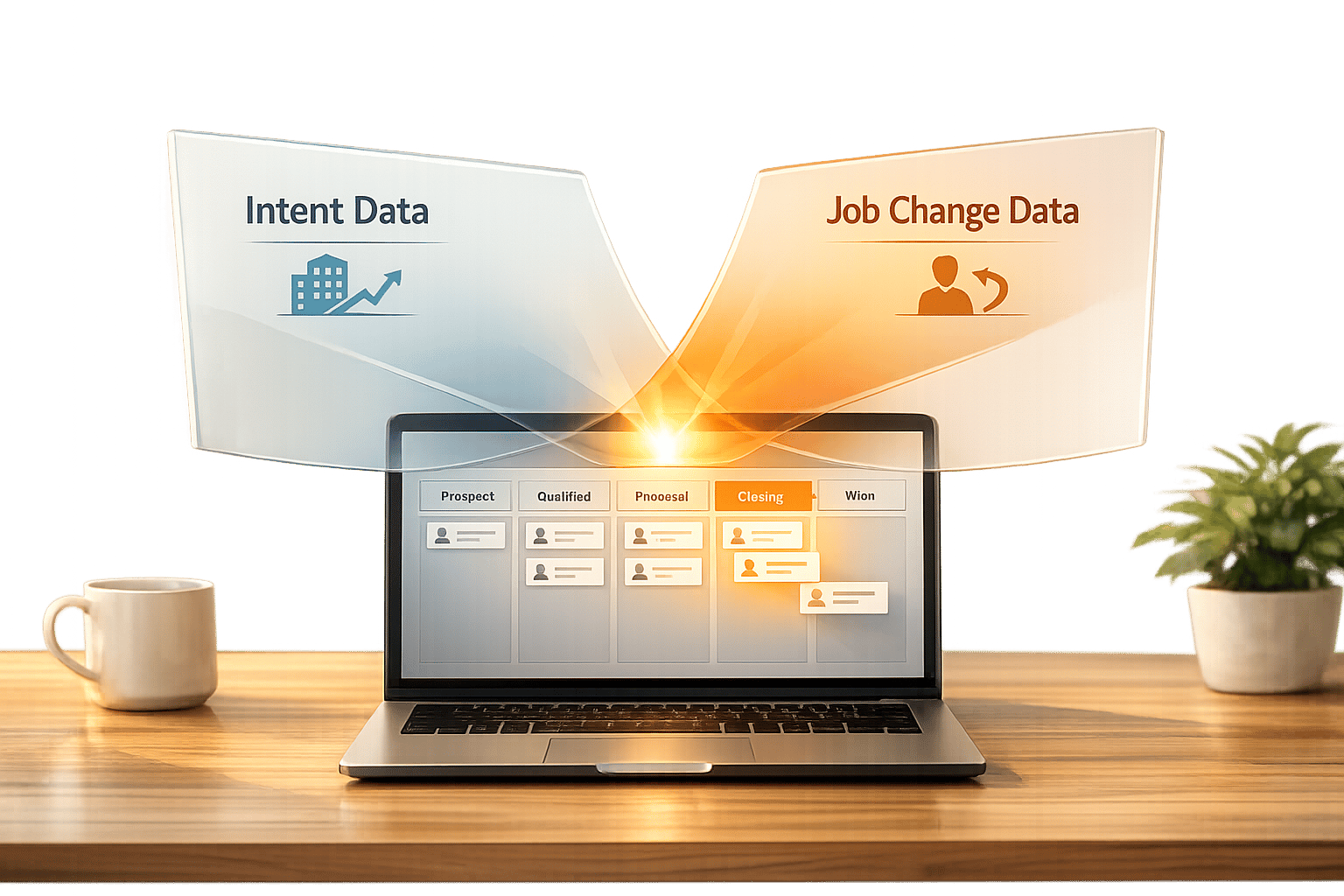
When it comes to B2B sales, intent data and job change data serve different purposes, but both can significantly improve your results.
Both data types can be integrated into tools like HubSpot to automate workflows, prioritize leads, and improve outreach timing. Combining them often leads to faster engagement and higher conversion rates, making them even more effective together.
| Feature | Intent Data | Job Change Data |
|---|---|---|
| Focus | Company research behavior | Individual role changes |
| Timing | Tracks ongoing interest | Highlights specific events |
| Primary Use | Spot in-market accounts | Reconnect with warm contacts |
| Sources | Web activity, content platforms | LinkedIn, email domains |
| Best For | Broad targeting | Personalized outreach |
Key takeaway: Use intent data to find companies ready to buy and job change data to connect with the right individuals at the right time. Together, they maximize sales efficiency and ROI.

Intent Data vs Job Change Data: Complete Comparison for B2B Sales
Intent data refers to behavioral signals that indicate when a company is actively researching a product, service, or topic that aligns with your business. These signals include actions like page views, content downloads, and time spent on specific pages, all hinting at potential buying interest.
This data can come from two main sources: first-party data (collected directly from your own properties, such as website visits tracked through your CRM) and third-party data (gathered from external platforms like review sites or analyst networks). First-party data highlights direct interest in your brand, while third-party data often captures prospects earlier in their research journey - sometimes even before they know about your company.
In B2B sales, intent data provides a broader view by linking anonymous website activity to specific company domains. Let’s explore how this data is collected and processed.
Intent data is captured using tracking codes and reverse-IP lookup technology. For example, HubSpot collects intent signals from a wide network of websites [4]. When employees from a company visit these sites - or your own site - the tracking code records their behavior and matches their IP address to a known organization.
HubSpot organizes intent signals into two categories: visitor intent (tracking actions like viewing pricing or product pages) and research intent (monitoring spikes in activity on certain topics) [4]. Research intensity is measured month-over-month, with levels defined as follows:
Other signals, such as funding announcements, leadership changes, or mergers, can also provide timely opportunities for outreach [3]. Additionally, engagement signals - like interactions with marketing emails or form submissions - are tracked and displayed as events on company or contact records in HubSpot. These signals can trigger automated workflows or help filter prospect lists, creating a solid foundation for effective outreach strategies.
Intent data enables sales teams to focus on engaged prospects rather than relying on cold outreach. By identifying companies actively researching your category, you can prioritize accounts with higher conversion potential - making it especially useful for account-based marketing efforts.
It also fosters better collaboration between sales and marketing. With shared visibility into which accounts are showing interest, marketing teams can nurture high-intent accounts with targeted content, while sales teams can time their outreach based on activity spikes. For instance, if a target account’s research level shifts to "High", HubSpot can automatically assign a task to a sales rep or enroll key contacts in a follow-up sequence [3].
Finally, intent data enhances personalization in outreach, which can significantly improve conversion rates. For example, if a prospect is researching "CRM integrations", tailoring your pitch to highlight that capability - rather than delivering a generic sales message - can increase your chances of a positive response [1]. This level of precision not only boosts results but also strengthens your overall CRM strategy for more effective B2B sales.
Job change data tracks real-time professional movements - like new hires, promotions, departures, and role changes - by integrating these updates into your CRM. While intent data focuses on showing interest through research activity, job change data zeroes in on individuals actively transitioning roles. This creates a prime opportunity for personalized outreach.
Why does this matter? New executives often spend 70% of their budget within the first three months of starting a new role [2]. That short window is a goldmine for sales teams looking to engage decision-makers actively exploring solutions. Plus, past buyers are five times more likely to convert into closed-won revenue compared to cold leads [2]. When a former advocate moves to a new company, they become one of the most promising prospects for your pipeline.
Job change data comes from various sources: monitoring LinkedIn profiles, analyzing email signature changes for domain updates, scraping leadership pages, and reviewing public SEC filings [12]. In tools like HubSpot, this often involves comparing a contact’s LinkedIn profile with their listed company to spot mismatches [10]. Once detected, these movements can trigger automated CRM actions.
Tracking job changes involves monitoring multiple data sources, with verification handled through waterfall enrichment models. For instance, when someone updates their LinkedIn profile or their email domain changes, the system flags this as a potential role shift. It then enriches the contact record with details like the new company, updated job title, and verified contact info.
In HubSpot, these updates appear as specific signals - like "Job started" or "Job ended" events [3]. These signals can automatically trigger workflows, such as routing leads to sales reps or creating tasks for follow-up. For example, if a former customer transitions to a new company, HubSpot can assign that lead to a rep for immediate action [11].
Additionally, the system links old and new contact records to maintain context from past deals. This ensures that your outreach is not only timely but also informed by historical interactions.
Timing is everything, and job change data helps you reach out during the optimal window - typically 30–60 days after a job change [12]. The results speak for themselves: outreach tied to job changes converts 2–4× better, with response rates of 15–25%, compared to just 5–8% for cold emails [12].
This data also breathes new life into previously closed-lost opportunities. For instance, when a champion from a failed deal takes on a new role, they’re 3× more likely to respond to your outreach [12].
As Taimoor Tariq from Clay Club Berlin explains:
"When a customer moves to a new company, they bring their positive experience with your product along with them. They're your best advocates." [11]
Beyond outreach, job change tracking enhances lead routing and keeps your CRM clean. Automated workflows can flag outdated records when someone leaves a company and create enriched new ones, ensuring your team focuses on current opportunities while reducing the risk of churn.
A real-world example of this comes from Blinkist’s B2B division in late 2026. They used GPT-4o and LinkedIn models to track job changes among their customers. When a change was detected, the system analyzed historical HubSpot data to identify which products the contact had used. It then generated personalized outreach referencing those specific features. With human approval through Slack before sending, this approach turned former customers into warm leads at their new companies [11].
Let’s dive into how intent data and job change data each play a distinct role in shaping your sales strategy.
Intent data focuses on tracking company research behavior, while job change data zeroes in on personnel shifts within organizations.
Intent data provides ongoing insights into research activity, while job change data pinpoints specific opportunities - usually within a 30–90 day window after key personnel transitions [5].
| Aspect | Intent Data | Job Change Data |
|---|---|---|
| Data Type | Behavioral (e.g., spikes in research, web activity) | Event-based (e.g., changes in personnel or roles) |
| Timing | Tracks ongoing interest (30-day trends) | Highlights trigger events (e.g., new executive hire) |
| Sources | Content platforms, web activity, reverse-IP tracking | Professional networks, databases, press releases (30+ sources) |
| HubSpot Fit | Lead scoring, account-based campaigns, segmentation | Workflows, real-time alerts, automated deal creation |
| Primary Goal | Spot "In-Market" accounts ready to buy | Identify "Warm" individual champions with existing connections |
Intent data shines when it comes to timing, helping you engage accounts during their research phase - right when they’re weighing their options and consulting internally [1]. It answers a critical question: When is this company ready to make a purchase?
On the other hand, job change data provides relationship-driven insights. For instance, a former advocate who moves to a new company is 3–6× more likely to close a deal compared to a cold prospect [13]. It addresses a different question: Who can I connect with right now to leverage an existing relationship?
When used together, these two data types supercharge engagement and conversion. Sales teams that combine intent and job change data report 50–60% faster time to first engagement and 2× higher meeting conversion rates compared to traditional outreach methods [5]. As Orestas Nariunas from A-Leads puts it:
"Job change alerts alone identify opportunity, intent data alone highlights interest, but only together do they deliver relevance at the moment of maximum receptivity." [5]
For example, intent data might reveal that a company is actively researching CRM solutions. At the same time, job change data could show that a former advocate has recently joined the company as their new VP of Sales. This transforms what could have been a cold pitch into a warm, highly relevant conversation.
When it comes to B2B sales, intent data and job change data are game-changers. Intent data pinpoints accounts actively researching solutions, while job change data connects you with individuals already familiar with your product. Together, they refine lead prioritization and make HubSpot CRM even more actionable.
HubSpot leverages various signals to provide actionable insights, including news events like funding rounds or mergers, website visits, and third-party research activity. These signals can trigger automated workflows, update lead scores, or create targeted lists [3][7].
For instance, intent data helps you zero in on companies actively researching your solution. HubSpot’s "Research Level" categorization makes this easier - accounts with a "High" research level show a 160% or greater spike in activity [4]. By using HubSpot's "Buyer Intent" settings, you can automate the process of adding these highly engaged companies to your CRM based on specific visitor or research criteria.
While intent data focuses on identifying active interest, job change data provides a different but complementary layer of insight.
Job change data tracks when key contacts - like champions or decision-makers - move to new roles. Tools like KeepSync integrate with HubSpot to monitor these transitions, enabling immediate lead creation, smart routing, and automated outreach sequences [13].
The results speak for themselves. Lattice added $6.7M to its pipeline with a 40X ROI by tracking HR transitions, while Cobalt secured $1.7M - 8% of new logos - by re-engaging former champions [13]. Sarah Kim, Director of Sales at Velocity Commerce, shared her experience:
"The ROI was immediate. Within 45 days we had closed two deals from former customers who moved to bigger companies. Our SDRs love it because these are actual warm leads, not cold calls" [13].
Job change data isn’t just for sales - it’s also a valuable tool for Customer Success teams. For example, you can set up alerts when a key product owner leaves a customer account, allowing your team to re-engage early and reduce churn risk [13].
Without systematic tracking, sales teams miss 89% of job changes. KeepSync solves this by monitoring contacts weekly with 94% accuracy, far outperforming the monthly or quarterly updates offered by other solutions [13]. When a former advocate joins a new company that matches your ideal customer profile, they can be automatically enrolled in a "Former Champion" sequence, referencing their prior experience with your product and increasing the likelihood of a warm, productive conversation.
Intent data is great for casting a wide net. It helps identify companies actively researching products or services, giving sales teams a chance to engage early. However, these signals can sometimes be misleading or lack the personal touch needed to connect on an individual level [5][4].
Job change data, on the other hand, shines when it comes to timing. It flags key role changes, especially during the first 90 days - a critical window when new executives allocate about 70% of their budget [2]. Plus, past buyers are 5× more likely to convert. That said, this data focuses on a more specific audience and requires constant CRM updates due to a 3% monthly decay rate [2][6].
| Data Type | Advantages | Limitations |
|---|---|---|
| Intent Data | High-volume insights that spot companies researching and ready to buy [5] | Signals can be noisy and lack personal context [4] |
| Job Change Data | Pinpoints precise timing with 5× higher conversions from past buyers and 94% accuracy through weekly updates | Narrower focus and needs frequent updates due to data decay [6] |
When it comes to measuring ROI in HubSpot, the focus often falls on pipeline growth, sales cycle efficiency, and improved response rates. Each type of data - intent data and job change data - plays a distinct role in driving sales performance. For example, job change data speeds up conversions, with warm leads converting 3x faster than cold ones. Meanwhile, intent data zeroes in on accounts actively researching solutions, ensuring efforts are directed where they matter most.
The numbers speak for themselves. Job change tracking delivers an impressive ROI, ranging from 10x to 79x within a year. Past buyers are 5x more likely to convert into closed-won revenue, and when job change signals are combined with intent data, the results are even stronger: 50–60% faster time to first engagement and 2x higher meeting conversion rates [2][5][13].
KeepSync's Pipeline Analytics simplifies ROI tracking in HubSpot. Its built-in dashboard provides clear insights by monitoring ROI by source, tracking response rates, and identifying top-performing customer segments. Additionally, the Pipeline Impact Calculator helps estimate incremental revenue from job change signals. For example, with a 60% match rate and a 15% close rate on warm opportunities, teams can project meaningful revenue gains [13].
"The ROI was immediate. Within 45 days we had closed two deals from former customers who moved to bigger companies." – Sarah Kim, Director of Sales, Velocity Commerce [13]
Choosing the right data type depends on your team’s size, the strength of your database, and your sales strategies. If your primary goal is to grow your top-of-funnel pipeline, intent data can be a game-changer. It helps you pinpoint companies actively researching solutions in your industry, making it perfect for broad account targeting and educational outreach efforts [9].
However, if you already have a robust database filled with past customers, closed-lost deals, or product champions, job change data might be the better choice. Why? Contacts who move to new companies tend to convert at much higher rates [6]. This creates a small but incredibly valuable window for personalized outreach, allowing you to reconnect with champions who are now in a position to make purchasing decisions.
For small to mid-sized teams using HubSpot, KeepSync is a budget-friendly option tailored to the HubSpot ecosystem. Unlike enterprise-level tools that require annual commitments ranging from $15,000 to $72,000, KeepSync delivers weekly updates with 94% accuracy at a fraction of the cost. Its seamless HubSpot integration triggers automated workflows as soon as a champion changes jobs. This ensures your team can act quickly during the crucial first 30–90 days when new decision-makers are evaluating vendors [13].
Combining intent data and job change data can create a powerful synergy. Teams that integrate both signals often see 50–60% faster initial responses and double their meeting conversion rates [5]. Job change alerts are also invaluable for churn prevention. They allow Customer Success teams to act quickly when key product owners leave a customer account, providing an opportunity to re-engage before the account churns [13].
"There is new and untapped revenue waiting to be discovered in your existing database and your team needs to be leveraging it." – Andres Angulo, AE, Apollo [6]
It’s not about choosing between data types - it’s about understanding how each serves your sales strategy. Intent data identifies companies actively researching solutions, making it perfect for top-of-funnel prospecting. Meanwhile, job change data helps you reconnect with former champions - who are five times more likely to convert than cold leads - fueling relationship-driven growth [2].
The real magic happens when you combine the two. Leading B2B teams merge these insights to get ahead of the competition. Imagine knowing who just started a new role while also understanding what their company is actively researching. This approach enables you to deliver timely, relevant outreach, speeding up engagement by 50–60% and doubling your meeting conversion rates [5].
If you’re a HubSpot user, automation is your secret weapon. With nearly 30% of the corporate workforce changing jobs every year, your CRM data can quickly become outdated without proper tracking [8]. Automated tools integrated with HubSpot can trigger workflows as soon as a contact changes jobs, ensuring you reach out within their first 90 days - a critical window for meaningful engagement. This automation not only saves time but ensures you never miss a chance to connect.
Looking to seize new revenue opportunities? KeepSync tracks over 30 data sources weekly with 94% accuracy and integrates seamlessly with HubSpot. And the best part? You can get started for $79/mofor up to 1,000 contacts. Try it with real data and see results in just a few weeks [13].
Using intent data alongside job change data creates a powerful strategy for identifying and pursuing top-tier sales opportunities. Intent data reveals when a company or individual is actively researching products or services, signaling interest and potential buying intent. Job change data, on the other hand, highlights when key decision-makers or influencers have recently stepped into new roles - often a period when they’re more receptive to exploring fresh solutions.
When these insights are combined, sales teams can zero in on prospects who are not only showing interest but are also in a position to make impactful decisions. For instance, imagine a company displaying strong intent signals while a decision-maker there has just started a new role. That’s the perfect moment to approach them with a customized pitch. This method allows you to prioritize leads effectively, engage at the right time, and increase your chances of closing deals, leading to better ROI and a healthier sales pipeline.
Intent data is all about capturing digital breadcrumbs that point to a company’s interest in specific products or services. Think of actions like visiting a website, downloading a whitepaper, or searching for certain keywords - these are clear signs that a company might be actively researching or evaluating solutions. This kind of information is typically gathered using tracking tools or sourced from third-party data providers.
Job change data, on the other hand, focuses on updates to professional profiles. For example, when someone changes their job title, takes on a new role, or moves to a different company, platforms like LinkedIn often reflect these updates. Tools such as KeepSync can automatically track these changes, offering sales and marketing teams a heads-up when key contacts transition into new roles or organizations.
Both types of data are incredibly useful for businesses. They help companies pinpoint potential prospects and prioritize leads, making it easier to connect with the right people at the right moment.
The first 90 days in a new role are a prime opportunity for sales outreach. During this period, individuals are often looking to make their mark and are more receptive to fresh ideas, tools, and partnerships that can help them succeed. This openness creates a unique window where they're much more likely to engage with outreach efforts.
Reaching out early can result in higher response rates, quicker decisions, and shorter sales cycles. By positioning your solution as a valuable resource during this critical time, you increase the likelihood of building a strong connection and closing the deal.