
Digital Marketing
·
April 10, 2026
How SaaS Companies Handle Billing Disputes & Chargebacks
Learn how SaaS billing disputes happen, what triggers chargebacks, and how both sides can resolve them faster.

Use job-change signals to prioritize warm leads that convert faster and cost less than cold outreach; automate CRM updates and real-time alerts for SDR teams.


Focusing on warm leads from job changes is 5x more effective than cold outreach. When someone familiar with your product moves to a new role, they’re more likely to engage and purchase quickly. New executives spend 70% of their budget within the first 3 months, making this a prime window for outreach. But with 30% of the workforce changing jobs annually, tracking these moves manually is impossible.
Automation tools like KeepSync solve this problem. They monitor job changes, update CRM data, and notify SDRs in real-time, enabling faster and more targeted outreach. This approach not only shortens sales cycles by 63% but also lowers costs compared to traditional cold outbound methods.
Quick Takeaways:
Switching from cold outbound to job change tracking can transform your sales strategy, delivering higher response rates and better results with less effort.
It's no secret that past buyers are far more likely to convert than cold leads - 5 times more likely, in fact [1]. Why? Because they already know and trust your product. When you connect with someone who has previously used your solution, you're not starting from scratch. There's no need to build credibility from the ground up, unlike with cold prospects who require extensive explanations before you can even have a meaningful conversation.
So, what exactly makes job change leads such a strong opportunity? It all comes down to familiarity and timing.
A job change lead is considered "warm" when it stems from an existing relationship. These leads typically fall into three main categories:
The key thing these individuals share is their firsthand experience with your product. They don’t need a demo to understand its value - they already know what it can do. When someone steps into a new role, they’re often tasked with evaluating vendors and building out their tech stack. This is the perfect time for them to implement a solution they already trust, especially since it’s a low-risk way to deliver immediate results.
Timing is everything here. People in new roles are actively making decisions, but this openness doesn’t last forever. Six months into the job, they’re likely locked into their choices, making them far less receptive. This is why 89% of previous customers don’t come back on their own [1]. Proactive outreach during this critical window is essential.
HubSpot takes advantage of these warm leads by using automated tools to monitor job changes. Through Intent Signals, HubSpot tracks events like "Job started" and "Job ended", which show up on a contact’s activity timeline whenever a change in their employment status is detected. Most of this data comes from LinkedIn updates, but HubSpot cross-references it with other sources to ensure accuracy.
When a contact changes companies, HubSpot updates their record with the new employer's details and even backfills the last 30 days of data [6], so you won’t miss any recent transitions. To access this feature, you’ll need HubSpot Credits and Data Enrichment permissions, which are available across various subscription plans.
HubSpot’s system continuously scans for profile updates and automatically refreshes contact records with new job details, including their previous role and company. It also triggers instant alerts for SDR teams, ensuring they can act quickly. This automation makes it easier than ever to capitalize on job change leads, setting your team up to convert these opportunities into tangible results.
Cold outbound strategies hinge on sheer volume, yet a staggering 98 out of every 100 calls go unanswered[10]. To achieve even modest results, this method demands an overwhelming number of attempts, which quickly drives up costs. These inefficiencies expose the deeper flaws inherent in cold outbound practices.
When you dig into the details, the challenges of cold outbound become even clearer. One of the biggest hurdles is the amount of time sales development representatives (SDRs) spend on non-revenue-generating tasks. On average, SDRs lose 15–20 minutes per account on research and manual data entry instead of focusing on selling[7].
Even when outreach happens, generic templates often fall flat. Prospects typically ignore these unsolicited and impersonal interruptions[7][8]. Without tailored messaging, cold emails can see reply rates as dismal as 1–5%[11]. Adding to the frustration, CRM contacts frequently become outdated, further reducing effectiveness.
Structural obstacles make matters worse. Around 40–44% of sales professionals report difficulty reaching decision-makers, while 44–49% cite overcoming initial rejection as a major challenge[9]. As a result, roughly 35% of sales reps experience conversion-to-appointment rates hovering between just 2–5%[9].
Cold outbound doesn’t just waste time - it also inflates operational costs and erodes ROI. For example, sending emails to invalid or outdated addresses increases bounce rates, hurting sender reputation and reducing overall email deliverability[8].
Another issue is timing. Cold outreach often targets prospects at random moments when they’re not ready to engage. Compare this to job change leads, which offer a smarter alternative. New executives, for instance, allocate 70% of their budget within their first 100 days[1], and sales teams that connect during this window close deals 63% faster[2].
Ultimately, cold outbound requires far more time, money, and effort for significantly lower returns. By contrast, focusing on job change leads enables precise, impactful engagement that drives quicker and more efficient conversions.

Job Change Leads vs Cold Outbound: Performance Metrics Comparison
When it comes to lead generation, the numbers tell a compelling story. Past buyers are 5 times more likely to convert into closed-won revenue compared to cold leads. Adding to that, targeting prospects based on job changes can boost response rates by 300–400% [1][14].
| Metric | Job Change Leads (Warm) | Cold Outbound |
|---|---|---|
| Conversion Rate | 5x higher likelihood of closed-won revenue [1] | Around 10% conversion rate [12] |
| Response Rate | 300–400% increase via timing-based signals [14] | Low; 90% of outreach often fails [12] |
| Sales Cycle | 40% shorter cycles [14] | Longer; requires extensive education and trust-building [5] |
| Data Freshness | Real-time triggers (e.g., promotions, new hires) [1][5] | Often relies on outdated, static databases [1] |
| Personalization | High; leverages past relationships and new roles [1] | Low; typically generic or AI-generated [13] |
| Cost per Meeting | $30–$50 (with high-intent signals) [15] | $150–$500 (due to low conversion rates) [15] |
From this comparison, it’s clear that job change leads not only perform better but also cost significantly less. For example, the cost per meeting for job change leads falls between $30–$50, whereas cold outbound can range from $150–$500 [15]. These savings, paired with higher response rates, make job change leads a game-changer for SDR teams.
The benefits go beyond just numbers; they reshape how sales development reps (SDRs) work. Cold outreach often requires time-consuming tasks like manual research and data entry, with little to show for the effort. In contrast, job change tracking provides SDRs with valuable context - such as a prospect's previous challenges and objections - making outreach more efficient and relevant.
For instance, a 7-person SDR team using job change tracking achieved a 20% reply rate and created 47 opportunities in just 30 days [13]. Compare this to traditional cold outreach, where response rates are often minimal, and the difference is stark.
Moreover, engaging leaders who are stepping into new roles can dramatically shorten the sales cycle. Deals close 63% faster when sales teams connect with executives early in their tenure [2]. And here’s the kicker: new executives typically allocate 70% of their budget within their first 100 days [1]. This makes job change leads a golden opportunity for SDRs to strike while the iron is hot, focusing on meaningful conversations rather than chasing unresponsive contacts.
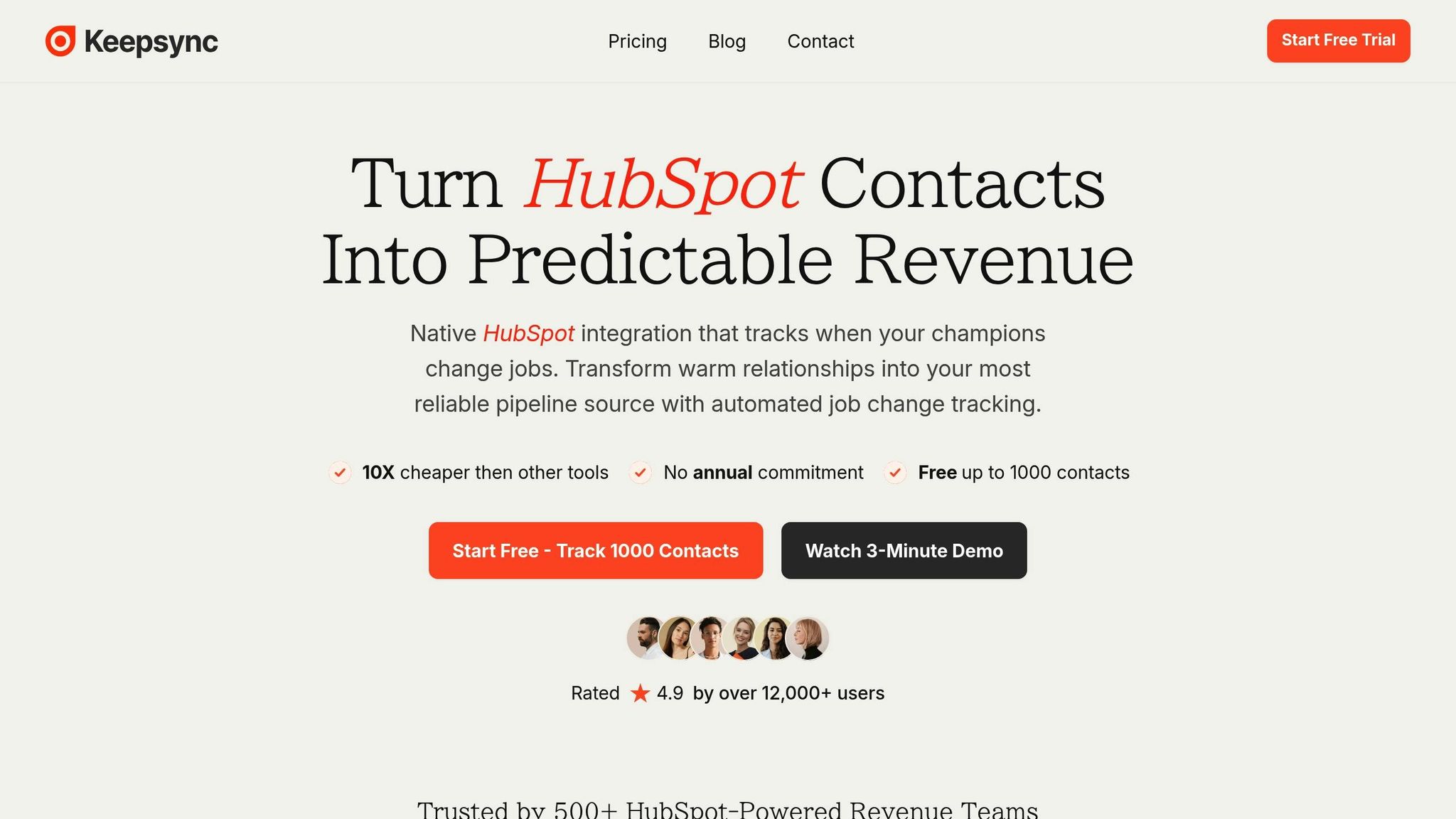
KeepSync works seamlessly with HubSpot to track job changes across 30+ data sources, boasting an impressive 94% accuracy. Setup is quick - just 5 minutes - and the system sends real-time alerts via Slack, email, or directly into HubSpot. This allows SDRs (Sales Development Representatives) to connect with contacts during the critical first days of their new roles, a time when they're most open to outreach [1]. With this setup, SDRs gain a foundation for using customized playbooks that offer immediate, actionable strategies.
Successful SDR teams rely on targeted playbooks designed for different job change scenarios. Here are two key examples:
KeepSync also allows you to filter alerts by factors like company size (e.g., 100+ employees), seniority level, and ICP (Ideal Customer Profile) alignment. This ensures SDRs focus their efforts on the most valuable leads [1][3].
KeepSync integrates with HubSpot in two main ways to streamline job change tracking:
For high-value accounts, you can set up a Slack-based approval process. This allows reps to review and refine AI-generated outreach messages before they're sent, ensuring high-quality communication while reducing time spent on research [3].
To measure success, track metrics like engagement, pipeline growth, and revenue [1]. Using HubSpot's custom objects, you can build dashboards to analyze key data points - such as "Count of Replies" and "Sum of Deal Amount" by "Intent Type." This helps identify which job change scenarios deliver the best results.
Automating the "Lead Status" property in HubSpot (with labels like "Attempted to Contact", "Connected", and "Open Opportunity") provides real-time updates on how job change leads move through your sales funnel [4]. Engaging decision-makers early in their new roles has been shown to close deals 63% faster [2]. These insights help you prioritize leads effectively and continually refine your outreach strategies.
Shifting from cold outreach to tracking job change leads reshapes how SDR teams operate. Warm leads don't just feel better - they perform better, with conversion rates that are significantly higher [1]. Plus, deals tend to close 63% faster during job transitions [2]. Cold outreach, on the other hand, often means starting from square one, spending valuable time educating prospects who may not even realize they need a solution. Job change tracking flips the script, reconnecting with previous advocates who already know your product's value and are ready to make an impact in their new roles.
Automation plays a key role in making this shift seamless. With KeepSync’s integration into HubSpot, manual tasks become a thing of the past. Boasting 94% accuracy across more than 30 data sources and real-time alerts, your team can stay focused on meaningful conversations instead of chasing stale contact details. Automated workflows ensure no job change signal goes unnoticed, eliminating unnecessary admin work while keeping your CRM up-to-date and actionable.
These real-time alerts give you a head start on critical opportunities. New executives typically allocate the majority of their budgets within the first three months of stepping into a new role. And here’s the kicker: most previous customers don’t come back on their own after changing jobs [1]. Proactively tracking these transitions is the key to reclaiming that revenue potential.
KeepSync takes the hassle out of tracking job changes by automatically detecting when prospects switch roles and updating this information directly in your CRM. No more tedious manual research - real-time job change alerts ensure your sales development reps (SDRs) can respond quickly and effectively. Prospects with new positions are tagged and prioritized, helping your team focus on warm leads instead of wasting time on cold outreach.
With KeepSync, SDRs can launch personalized outreach campaigns that align with a prospect’s recent role change, boosting response rates and speeding up the sales process. By automating these updates and workflows, your team spends less time on data entry and more time building genuine relationships. The result? A more efficient pipeline and a noticeable boost in ROI.
Job-change leads are considered "warm" because they signal a timely shift in a prospect's role, responsibilities, or decision-making power. When someone gets promoted, moves to a new company, or transitions into a different position, they often gain access to new budgets and may have an immediate need for tools or solutions to excel in their new role. This creates a golden opportunity for SDRs to craft outreach that speaks directly to their current priorities, rather than leaning on generic pitches.
There’s also an added advantage when prospects have previously interacted with your product or brand in another role. In these cases, your outreach feels more like picking up where you left off rather than starting from scratch. Tracking job changes can also uncover chances for upselling, cross-selling, or opening doors to new accounts - especially when these align with your ideal customer profile. All of this makes job-change leads far more effective at sparking meaningful conversations and driving conversions compared to traditional cold outreach.
Job-change leads are a goldmine for sales teams because they represent warm prospects - decision-makers who’ve recently stepped into new roles. Why does this matter? These individuals often bring fresh budgets and a willingness to revisit or implement solutions they’ve used successfully in the past. For Sales Development Representatives (SDRs), this means skipping the usual lengthy discovery process and engaging with prospects who are primed to evaluate vendors. The result? Faster conversations and stronger, more meaningful connections.
Targeting job-change leads isn’t just about speed - it’s about results. Outreach tied to these timely transitions can supercharge pipeline generation, increasing it by 10% to 50%. Even better, these leads are up to three times more likely to turn into qualified opportunities compared to cold outreach. By zeroing in on these high-intent prospects, SDR teams can close deals faster and improve win rates across the board.