
Digital Marketing
·
April 10, 2026
How SaaS Companies Handle Billing Disputes & Chargebacks
Learn how SaaS billing disputes happen, what triggers chargebacks, and how both sides can resolve them faster.

Outdated CRM records cost revenue and waste sales time. Learn how automated enrichment and job-change tracking stop lead decay and improve forecasting.


Outdated CRM data is costing businesses millions. Every year, contact information becomes obsolete as people switch jobs, change emails, or abandon phone numbers. This "lead decay" results in wasted time, missed revenue, and inefficient sales efforts.
Key takeaways:
The solution? Tools like KeepSync automate data updates, track job changes, and enrich CRM records, ensuring your database stays accurate and your team focuses on what matters - closing deals.

The True Cost of Lead Decay: Revenue Loss and Wasted Time Statistics
When your CRM is bogged down with outdated data, the effects ripple through both your finances and your team's efficiency. The numbers paint a clear picture of how quickly bad data can drain resources and revenue.
Outdated CRM data is a direct hit to revenue. On average, companies lose 12% of their annual revenue due to poor data quality[9]. For a business pulling in $10 million annually, that’s a staggering $1.2 million lost every year. This underscores how widespread the issue is for organizations relying on outdated CRM systems.
Here’s a practical breakdown: imagine a database of 50,000 contacts with an annual decay rate of 22%. That’s 11,000 leads lost each year[4]. If each lead could generate $50 in potential pipeline, you’re looking at $550,000 in missed opportunities. Marketing budgets also take a hit - about 30% of marketing spend never reaches its target audience[9]. For a company with a $500,000 marketing budget, that’s $150,000 wasted.
Sales Development Representatives (SDRs) face their own challenges, wasting 2,920 hours annually chasing dead numbers. That’s equivalent to the workload of 1.5 full-time employees, costing around $146,000 in salaries[1]. These losses aren’t just financial; they also eat away at productivity, as detailed below.
Beyond revenue, outdated CRM data grinds team efficiency to a halt. Sales reps spend 27.3% of their time - about 546 hours per year per rep - on tasks like chasing bad leads, dialing disconnected numbers, or fixing data errors[5]. That’s over a quarter of their working hours wasted on activities that don’t generate revenue.
Stale email lists compound the problem by driving up bounce rates, which can damage your sender reputation and even lead to domain blacklisting[10]. Once blacklisted, even legitimate emails may be flagged as spam, crippling your outreach efforts. In fact, HubSpot reports that 73% of phone numbers in their system are invalid, resulting in a painfully low 4.2% connect rate[1]. That means reps might need to make 100 calls to connect with just four prospects.
Inaccurate CRM data also wreaks havoc on forecasting. When your pipeline is cluttered with outdated deals, your revenue projections become unreliable. As Jordan Rogers, RevOps Leader at RevenueTools, puts it:
"70% of revenue leaders lack confidence in their CRM data... When leaders don't trust the data, they override the system with gut feel, which defeats the purpose of having a CRM"[10].
This lack of trust often leads sales teams to abandon the CRM altogether, opting instead for external spreadsheets that provide limited visibility into the pipeline[12].
The consequences extend to team dynamics. Poor data quality fuels tensions between sales and marketing. Marketing might celebrate high lead generation numbers, while sales struggles with outdated or misaligned leads[11]. This disconnect wastes time in meetings and strains cross-functional relationships, all because the data can’t be trusted. Clearly, outdated CRM data doesn’t just hurt your bottom line - it disrupts your entire operation.

Catching lead decay early can save you from wasting marketing dollars and missing out on valuable opportunities. By keeping an eye out for specific warning signs and comparing them to healthy benchmarks, you can ensure your HubSpot CRM stays a dependable tool for driving revenue and efficiency.
One of the biggest red flags is high email bounce rates. When hard bounces start to rise, it’s often a sign that contacts have left their roles or their email addresses are no longer active [14][2]. A bounce rate above 5% is a serious issue, as well-maintained databases typically keep this number below 2% [2].
Another indicator is declining engagement. Check HubSpot properties like "last marketing email open date" or "recent sales email replied date." If there’s been no activity for over 90 days, those leads are likely decaying [14][7]. According to Valentin Wallyn, CEO of Findymail, "Email addresses decay at a rate of 22.5% each year, closely followed by phone numbers at 18%" [7].
Data inconsistencies also signal trouble. For example, variations in job titles like "CEO", "C.E.O.", or "Chief Executive Officer" make segmentation harder [8]. Similarly, inconsistent phone number formats and duplicate records - where the same person is listed multiple times - can disrupt your ability to track engagement accurately [8][14].
To tackle these issues, head to Data Management > Data Quality in HubSpot. The Data Quality Command Center identifies anomalies, formatting problems, and records with high "no data" rates [13]. You can even set up a weekly digest to receive alerts about new issues, helping you address them before they escalate [13].
Spotting these problems early allows you to set clear standards for healthy CRM data, making it easier to differentiate between records that are thriving and those that are falling behind.
The gap between a well-maintained CRM and one that's deteriorating is stark, especially when you look at the numbers. Without regular upkeep, CRM accuracy can drop from 97% down to as low as 75-78% after just 12 months. In extreme cases, this accuracy can plummet to 9%, particularly when priorities shift or account histories become outdated [2][3].
| Metric | Healthy Data | Decaying Data |
|---|---|---|
| Email Bounce Rate | < 2% | > 5% [2] |
| Data Accuracy | ~97% (post-cleanup) | < 80% (after 12 months) [2] |
| Engagement Window | Activity within 30-60 days | No engagement for > 90 days [7] |
| Job Title Consistency | Standardized (e.g., "CEO") | Multiple variations (e.g., "C.E.O.") [8] |
| Record Integrity | Single unique record per contact | High percentage of duplicates [13] |
To stay ahead, create active lists in HubSpot to filter for contacts whose "Last marketing email open date" exceeds 90 days. This will help you quickly identify segments that need attention [14]. Use HubSpot’s "Fix and automate" feature to correct errors like inconsistent capitalization or phone number formats in real time, keeping your data aligned with the benchmarks above [13].
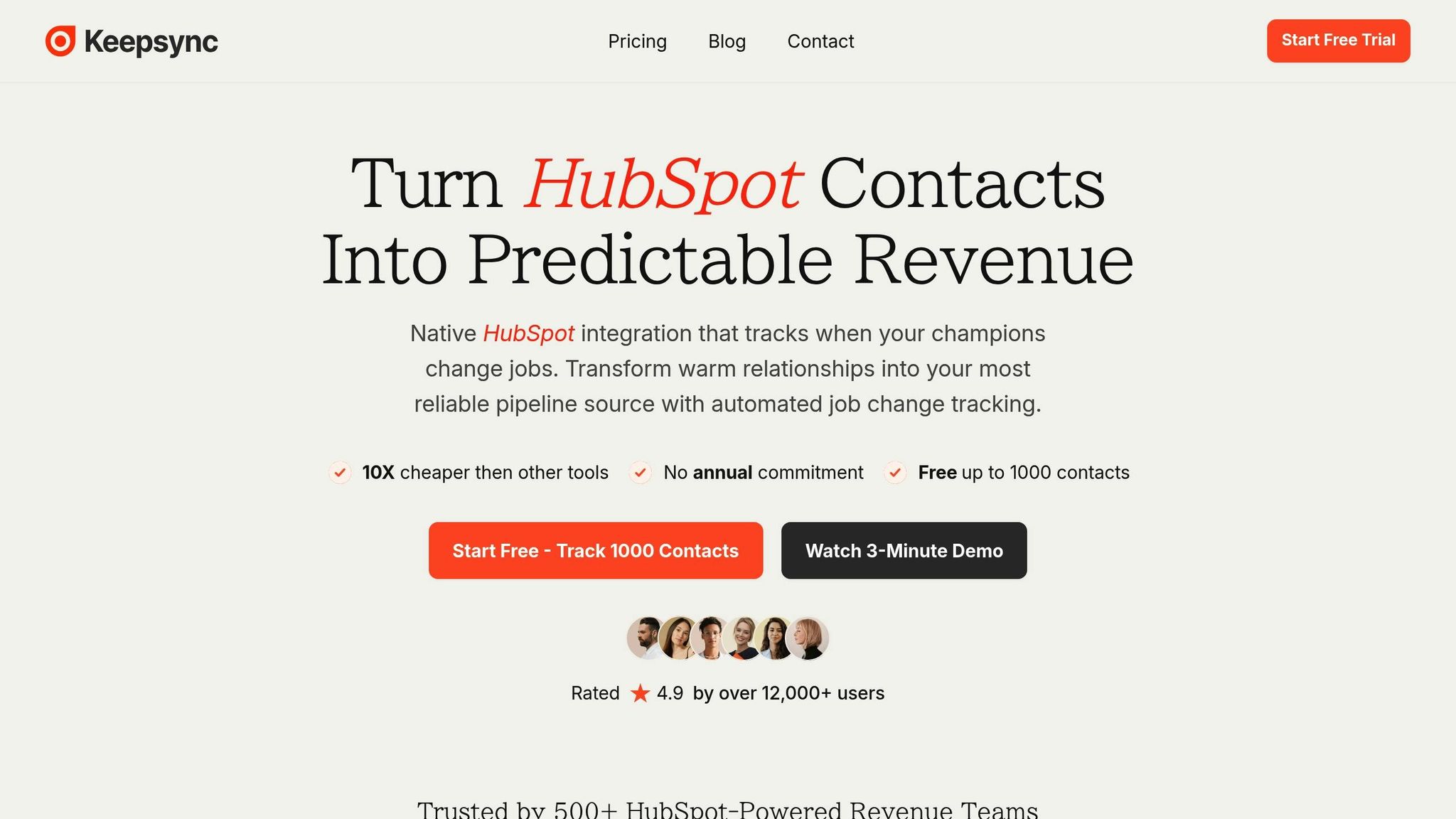
When lead decay starts to creep into your CRM, KeepSync steps in to keep your HubSpot contact data fresh and accurate, ensuring your team stays ahead of the curve.
KeepSync uses data from over 30 sources to monitor job changes with an impressive 94% accuracy, thanks to a triple-verification process that even includes human checks for executive-level moves. Every week, it updates your HubSpot contacts and sends real-time alerts through Slack, email, or directly within HubSpot. The whole process is seamless, thanks to a 5-minute native integration that ensures your team is notified of changes well before traditional data refresh cycles kick in[16].
"Before this, we were completely blind to job changes. Our reps would manually check LinkedIn maybe once a month... Now we're first to reach out every time."
- Marcus Rodriguez, RevOps Manager, Streamline Analytics[16]
Each alert is packed with valuable updates: a new work email with over 97% deliverability, direct phone numbers, updated company technographics, and even buying committee mapping. Since manual tracking can miss up to 89% of job changes, KeepSync’s automation ensures no opportunity slips through the cracks, setting the stage for smooth enrichment and workflow integration.
When contacts change jobs, KeepSync doesn’t just stop at tracking - it enriches your HubSpot records with verified, up-to-date information. It creates new leads or deals with full context, automatically routes them to the right sales representative, and kickstarts personalized outreach. This also supports automated lead scoring and updates deal stages seamlessly[16].
"The ROI was immediate. Within 45 days we had closed two deals from former customers who moved to bigger companies."
- Sarah Kim, Director of Sales, Velocity Commerce[16]
On top of keeping your records current, KeepSync ensures you maintain connections with valuable contacts.
High-value contacts like former champions, power users, and decision-makers from closed-lost deals often hold untapped potential. KeepSync tracks their career moves, as these individuals are 3–6 times more likely to close deals compared to cold leads. Additionally, around 36% of closed-lost opportunities can convert when acted on quickly[16]. With automated alerts, your team can re-engage these contacts while the relationship is still warm.
KeepSync also helps prevent churn by notifying Customer Success teams when a key product owner or admin leaves a customer account. This ensures proactive engagement to retain the account[16].
"With 1,500+ customers, manually tracking job changes was impossible... Now it's fully automated and integrated into our HubSpot workflows."
- Julia Chen, VP Sales Operations, Nexus Software[16]
KeepSync simplifies CRM data maintenance, helping your team stay on top of lead updates and boosting your return on investment (ROI). Here's how to get started.
Getting started with KeepSync is straightforward. Begin by installing the app from the HubSpot App Marketplace and authorizing access. Once connected, KeepSync immediately scans your contacts and sets up weekly monitoring across 30+ data sources to catch job changes as they happen.
During setup, you'll configure field mapping to sync KeepSync's enriched data - like updated job titles, new work emails, and company details - with your HubSpot properties. You can even map custom fields[18]. For example, if a contact's phone number changes, that update will automatically reflect across related deal records, saving your team from manual updates.
To stay informed about your data's health, activate the Data Quality digest. This feature sends weekly email updates summarizing recent data changes[13]. With automated monitoring in place, your team can focus on higher-value tasks while KeepSync handles the heavy lifting. Once your system is set up, you can take things further by automating lead routing with workflows.
With enriched data flowing into your CRM, you can create automated workflows to act on updated contact details in real time. Using HubSpot's workflow builder, set triggers based on enriched properties like "Job title", "Company size", or "Industry"[19]. For instance, if KeepSync updates a contact's job title to "VP of Sales" at a large company, a workflow can route that lead to your enterprise sales team and automatically launch a tailored outreach sequence.
You can also track former champions by creating workflows that enroll contacts when KeepSync flags a job change for high-value leads, such as past clients. These workflows can reassign the contact to their original account manager, send a Slack notification, and initiate a warm re-engagement email. Additionally, enable Automatic enrichment for new records and Continuous enrichment for monthly updates to keep your database current[19]. With lead routing automated, you're ready to assess the impact of these enhancements.
To measure how accurate CRM data contributes to your bottom line, track metrics tied to enriched contacts. HubSpot's Property Insights can help you monitor key fields like work email, direct phone, and job title fill rates[13]. Create a custom segment in HubSpot using the "Has been enriched" property to isolate contacts updated by KeepSync[17]. Use this segment to build reports comparing response rates, meeting bookings, and closed deals between enriched and non-enriched contacts. This will help you quantify the revenue impact of maintaining clean data.
Don't forget to regularly check the "CRM syncs" tab in your app settings[18]. This dashboard highlights whether your data is syncing correctly, flagging any disruptions that could affect your pipeline. With HubSpot's incremental sync engine scanning for updates every 5 minutes[18], you can quickly address issues and ensure your team always has access to the most up-to-date information.
Lead decay isn't just a minor inconvenience - it directly impacts your revenue. With 73% of phone numbers in databases disconnected[1] and B2B contact data deteriorating by about 30% annually[10], delays in addressing this issue only increase costs.
Tackling lead decay is crucial for protecting your revenue pipeline and enhancing team efficiency. Automated data maintenance can reclaim 15–25% of your sales team's productive hours[20], ensuring leads are routed properly and allowing for personalized outreach that converts prospects into customers. Plus, clean data enables more precise forecasting - AI models built on reliable data can cut forecast errors by up to 50%[6].
As Jordan Rogers, a RevOps leader, emphasizes:
"CRM data hygiene isn't merely administrative. It's the foundation that every revenue-critical function depends on: forecasting, lead routing, territory design, pipeline reporting, and marketing attribution."
– Jordan Rogers, RevOps Leader[10]
KeepSync offers an affordable, HubSpot-native solution to combat lead decay before it costs you deals. With 94% accuracy across 30+ data sources, automated job change tracking, and verified contact enrichment, KeepSync ensures your CRM stays current. Pricing starts at $79/month for up to 1,000 contacts and $149/month for 5,000 contacts, making it an accessible option for growing revenue teams.
The "1-10-100 rule" drives the point home: verifying a record at entry costs $1, cleaning it later costs $10, and doing nothing could cost you $100 in lost opportunities[15]. Investing in automated data maintenance now safeguards your hard-earned deals and lets your team focus on what they do best - selling.
To keep your HubSpot CRM data accurate and reliable, it's a good idea to clean it every 3 to 6 months. This regular maintenance helps prevent data decay and ensures your records remain up-to-date. On top of that, scheduling a more thorough cleanup once a year can help you get rid of outdated or irrelevant records. While the exact timing depends on your business needs and the quality of your leads, sticking to a quarterly or biannual review is a smart way to keep your CRM running smoothly.
The fastest way to spot lead decay in HubSpot is by leveraging the Data Quality Command Center. This tool helps you keep an eye on the freshness of your CRM data. Additionally, running data tests on your records for enrichment can reveal outdated or incomplete details. By using these methods, you can quickly identify issues with data quality and take steps to ensure your lead information stays current and reliable.
To gauge the ROI of automated data enrichment, start by setting clear, measurable objectives. Keep an eye on cost savings and revenue gains as key indicators. For example, look at how much you're saving by reducing bad data issues, like bounced emails or missed sales opportunities, and how automation shortens sales cycles. Track metrics such as improved data accuracy, higher conversion rates, and time saved through automation. These numbers provide a solid way to measure how enriched CRM data contributes to both efficiency and revenue growth.