
Digital Marketing
·
April 10, 2026
How SaaS Companies Handle Billing Disputes & Chargebacks
Learn how SaaS billing disputes happen, what triggers chargebacks, and how both sides can resolve them faster.

Why CRM contacts go stale—job moves, manual errors, and poor tracking—and how automated updates plus HubSpot workflows keep records accurate.


Outdated CRM data is costing businesses time, money, and opportunities. Here’s why it happens and how to fix it:
The Fix? Tools like KeepSync automate updates, track job changes in real-time, and integrate seamlessly with platforms like HubSpot. This saves time, prevents errors, and ensures your team focuses on the right opportunities.
Key Stats:
Stop wasting resources on outdated data. Automate updates and keep your CRM working for your team.

The True Cost of Stale CRM Data: Key Statistics and Impact
Keeping your CRM data fresh is no small feat. To understand how to tackle the problem, it’s important to first explore the main reasons why contact information in your CRM becomes outdated.
Job changes are a major culprit when it comes to outdated CRM data. When someone switches roles, multiple pieces of information - like their work email, job title, company, and phone number - can instantly become irrelevant. Studies show that around 15% to 20% of professionals change jobs annually [2]. This trend is even more pronounced in industries like tech, where the average tenure is just two to three years [2]. Here’s how fast key data points can expire:
"By the time you get around to your outreach or follow up, a huge chunk of those contacts are going to be outdated."
Without tools that automatically track professional changes via platforms like LinkedIn, sales teams are stuck trying to manually update records - an impossible task when their main focus is selling. This is where manual processes introduce even more headaches.
Manual data entry is another weak link in maintaining CRM accuracy. Human errors, like typos or swapped fields, can lead to mismatched information that disrupts segmentation and personalization [1][7]. For example, a rushed entry might accidentally replace a phone number with an email address, creating confusion.
Inconsistent input formats also create issues. A title like "CEO" might appear in various forms - C.E.O., Chief Executive Officer, or Founder/CEO - making it harder to organize and search [1]. On top of that, about 37% of employees admit to fabricating CRM entries just to bypass mandatory fields or meet activity quotas [5].
Consider this: sales reps spend roughly 5.5 hours per week on manual data entry [5]. And the cost of errors adds up quickly. It takes $1 to prevent a mistake, $10 to fix it later, and $100 if that mistake leads to a business failure [6]. These problems are compounded when engagement tracking is also lacking.
Even when contact data is accurate, poor engagement tracking can undermine the reliability of your CRM. Without clear insights into how contacts are interacting with your outreach, lead scoring becomes unreliable. For example, if you don’t track whether someone opened your email or clicked a link, it’s hard to tell if they’re still interested or have moved on [1].
This lack of visibility wastes resources. Marketing teams may spend their budgets targeting unresponsive leads, while sales reps chase contacts who are no longer engaged. Worse yet, email providers like Gmail or Outlook might flag your campaigns as spam if your emails repeatedly hit inactive addresses. A marketing email with an open rate below 15% can trigger spam warnings [10].
By monitoring details like "Last marketing email open date" or "Time of last session", you can identify inactive contacts before they hurt your sender reputation [8][10]. Proper engagement tracking not only streamlines lead scoring but also safeguards the health of your CRM, keeping your sales team focused on the right opportunities.
Even the most accurate database won’t stay that way for long without regular updates. B2B data typically decays at a rate of about 2.1% per month - or roughly 22.5% each year [3][4][9]. In industries with high turnover, like tech and startups, decay rates can soar to 30% to 40% annually [2].
Here’s a startling fact: within six months, half of your CRM records could already be outdated [5]. Companies that don’t prioritize regular updates often see significant revenue losses - 44% of businesses report losing over 10% of their annual revenue due to outdated CRM data [7].
Automated updates are key to staying ahead of decay. Without them, your database becomes less effective over time, dragging down your pipeline performance and overall return on investment.
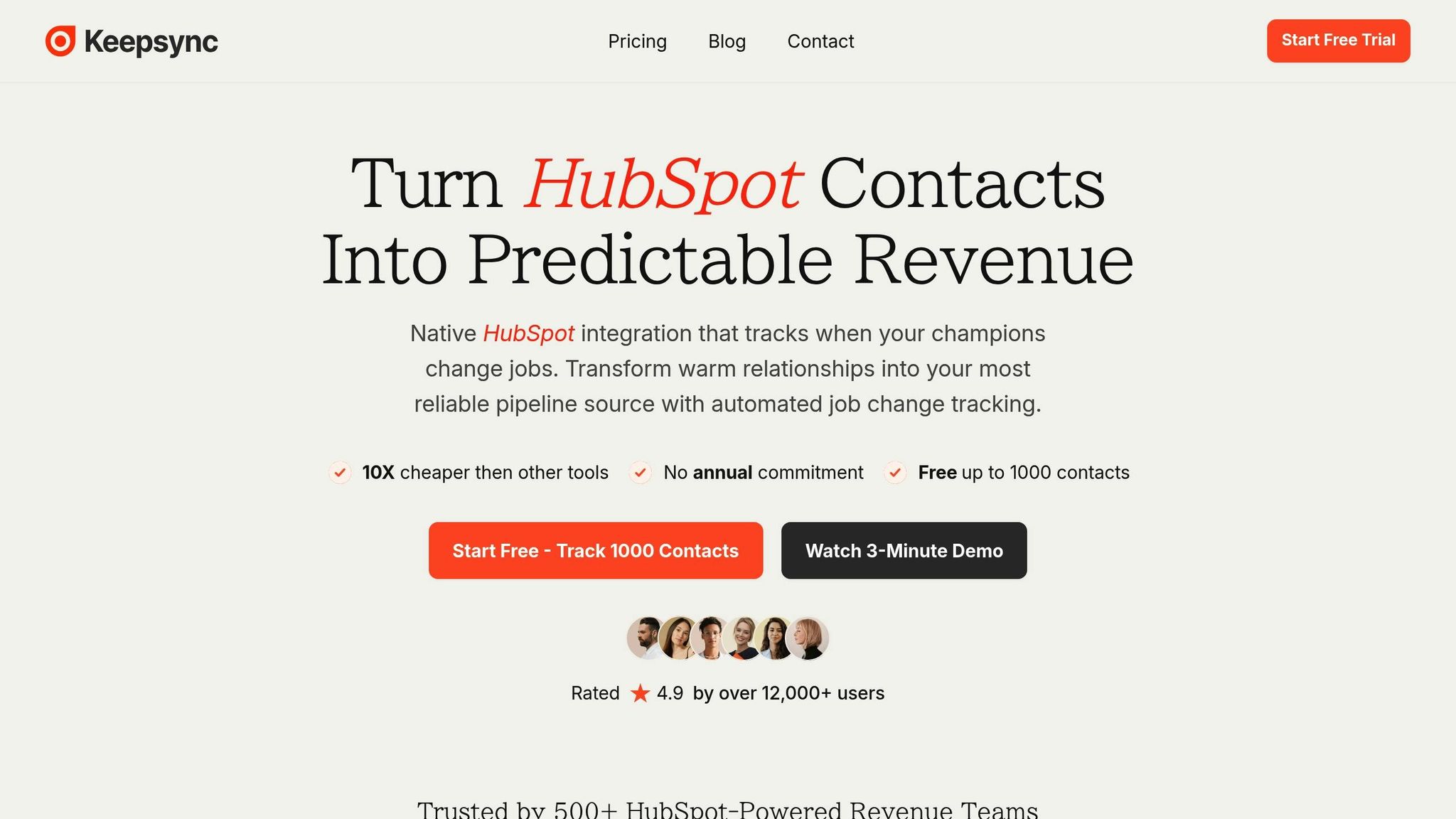
KeepSync combats outdated CRM contacts by blending automation, verified data, and seamless HubSpot integration, ensuring your database stays accurate without burdening your sales team.
KeepSync stays ahead of the curve by monitoring over 30 data sources - like company websites, LinkedIn, and press releases - to track job changes in real time. Unlike tools that update monthly or quarterly, KeepSync refreshes your contact data weekly, giving you a competitive edge [11].
To maintain accuracy, the platform employs a triple-verification process, reducing false positives. For top-level changes, human verification adds an extra layer of precision, achieving a 94% accuracy rate in detecting job changes [11]. This approach ensures you capture job changes that might otherwise go unnoticed - 89% of them, to be exact [11].
Whenever a contact changes jobs, the system sends automatic alerts. This allows you to act quickly, leveraging a 3–6X higher close rate for contacts who switch roles [11]. With such automation, you’ll never miss out on key opportunities, all while seamlessly updating contact profiles.
KeepSync doesn’t just track job changes - it enriches your CRM with verified contact details, like work emails (with over 97% deliverability), direct phone numbers, and company technographics [11]. This ensures your outreach efforts are based on accurate, up-to-date information, helping you avoid mistakes like emailing invalid addresses or referencing outdated employers.
By automating these updates, KeepSync saves your sales team from the tedious task of manual research and data entry, freeing up 5 to 15 hours per week for more productive activities [6,20].
KeepSync’s integration with HubSpot takes just five minutes to set up - no developers needed [11]. Once connected, the platform automatically creates leads and deals in HubSpot whenever a tracked contact changes jobs. It even provides detailed context about the change, so your reps know exactly what’s happening.
The integration also supports smart routing, automatically assigning new opportunities to the right sales reps. Plus, you can trigger HubSpot workflows and sequences based on job change alerts [11]. These features ensure your CRM stays organized and efficient, all without manual effort.
"Now it's fully automated and integrated into our HubSpot workflows. Set it and forget it."
- Julia Chen, VP Sales Operations, Nexus Software [11]
With a 4.9/5 rating from over 12,000 users, KeepSync delivers measurable results. Sarah Kim, Director of Sales at Velocity Commerce, shared her experience:
"Within 45 days we had closed two deals from former customers who moved to bigger companies. Our SDRs love it because these are actual warm leads, not cold calls." [11]
To tackle the issue of CRM contact decay, HubSpot workflows can be a game-changer. By connecting KeepSync to HubSpot, you can create workflows that automatically react to job change alerts, ensuring your database stays current. KeepSync's property updates act as triggers for these workflows whenever contact details are updated[13].
When KeepSync identifies a job change, it updates specific contact properties in HubSpot, like job title, company name, or employment status. These updates can then be used as triggers for your workflows[13]. To set this up, head to the HubSpot workflow editor and create an enrollment trigger based on the KeepSync alert property you want to track.
Make sure to enable re-enrollment for the KeepSync trigger property. This ensures the workflow activates every time a new update is detected.
To streamline this process, use HubSpot's Property Sync field type to transfer KeepSync data - such as "New Job Title" or "New Company" - directly to Deal records within seconds[12]. To set this up, navigate to Settings > Properties, choose your target object (e.g., Deals), select "Property sync" as the field type, and link it to the corresponding KeepSync contact property. This one-way, read-only sync ensures all related records are updated instantly[12]. These triggers also improve lead management, as outlined below.
KeepSync data can refine how you score and allocate leads. For example, you can adjust your lead scoring model to add points when a contact changes roles or moves to a larger company. For lead routing, set up workflows that automatically assign new opportunities to the appropriate sales reps based on factors like territory, industry, or account size. By routing warm leads to reps who already have relationships with those accounts, you increase the chances of converting them into customers.
KeepSync's pipeline analytics offer a clear view of how accurate CRM data impacts your revenue. By comparing response and close rates for contacts with recently updated information to those with outdated records, you can assess the value of keeping your data up to date. Create custom HubSpot reports to segment deals by source - specifically, those generated from KeepSync job change alerts versus other channels. This helps you quantify the revenue benefits of automating data updates and highlights the inefficiencies of manual processes.
Outdated CRM data isn't just a minor hassle - it’s a direct hit to your revenue. When your database quality declines, it leads to misdirected outreach, damaged reputations, and inefficient workflows. All of this adds up to lost opportunities and wasted resources.
That’s where KeepSync steps in. With its 94% accurate job change tracking, KeepSync monitors your contacts across 30+ data sources every week, ensuring updates are captured as they happen. And thanks to its native HubSpot integration, verified contact data flows seamlessly into your workflows. This enables updated lead scores, automated routing, and personalized outreach - without lifting a finger. By keeping your CRM continuously updated, you turn it from a static tool into a powerful sales engine.
Here’s the reality: poor data management costs businesses about 12% of their annual revenue[4], and sales reps lose 5.5 hours each week to manual data entry[5]. Automating these processes doesn’t just clean up your data - it saves time, protects your brand, and ensures you’re connecting with the right people at the right time.
Take these insights and start modernizing your CRM. Begin by auditing your current database: identify contacts with outdated job titles or email addresses and calculate how much time your team spends on manual updates. Then, try KeepSync’s Starter plan to monitor up to 1,000 contacts and receive real-time job change alerts.
Once you’re set up, create your first HubSpot workflow using KeepSync triggers to automatically route warm leads when contacts move to target accounts. Use pipeline analytics to measure the revenue impact of reaching out to contacts shortly after a job change versus waiting weeks or months. The results will clearly show the benefits of keeping your CRM data fresh and actionable.
Keeping your CRM contacts updated is crucial for maintaining an accurate and effective database. Experts recommend refreshing your contact list at least once a month. Why? Regular updates ensure your information stays current, minimize the chances of outdated data, and boost the effectiveness of your sales and marketing strategies.
When setting up job-change workflows in HubSpot, focus on key properties like Job Title, Company Name, and Email - these help identify when a contact's job details are updated. To improve tracking, consider adding custom fields such as Previous Company and Job Change Date. Incorporating these properties into your workflows allows for timely notifications and more precise outreach whenever a contact's job information changes.
To understand how fresher CRM data affects revenue, focus on tracking key metrics such as deal size, sales cycle length, lead quality, close rate, and churn rate. By comparing your revenue forecasts with actual sales results, you can assess how accurate your predictions are. A CRM data quality scorecard can also be a game-changer. It helps pinpoint discrepancies in your data, shedding light on hidden revenue losses caused by outdated or incorrect information. This approach leads to better pipeline management and more reliable forecasting.