
Digital Marketing
·
April 10, 2026
How SaaS Companies Handle Billing Disputes & Chargebacks
Learn how SaaS billing disputes happen, what triggers chargebacks, and how both sides can resolve them faster.

Track power users' job changes to convert warm leads, prevent churn, and update HubSpot automatically with real-time alerts and workflows.


When your product's power users switch jobs, they become high-potential leads for their new companies - 5x more likely to convert than cold prospects. Yet, 85% of these opportunities are missed, and outdated CRM data leads to lost revenue. Tracking job changes helps you:
Tools like KeepSync integrate with HubSpot to automate job tracking, send real-time alerts, and update contact details. With plans starting free for 1,000 contacts, KeepSync simplifies monitoring, ensuring you don’t miss these valuable opportunities.

Power User Job Change Tracking: Key Statistics and ROI Impact
FOR HUBSPOT TEAMS
Track Job Changes at 1/10th the Cost
KeepSync monitors your HubSpot contacts for job changes with 94% accuracy. Starting at $79/month. No annual contracts.
Start now →In a product-led growth (PLG) framework, where automation drives sales, power users act as crucial indicators of new opportunities. These are your most engaged customers - individuals who’ve moved beyond basic use to become product experts. They actively promote your tool within their organizations, making them invaluable. In PLG businesses, power users progress through adoption stages (Stranger, Explorer, Beginner, Regular) until they reach the Champion stage, where they become advocates for your product [9][6]. Recognizing these users is the first step in tracking their career moves effectively.
Power users typically fall into two groups. Decision-makers are executives or VPs who have the authority to allocate budgets and enforce tool adoption across their teams. End-users, on the other hand, may not have budget control but use the product frequently and can serve as internal referrals. They also offer valuable insights into their company’s needs [8]. Each type requires a tailored approach to engagement.
Power users exhibit specific behaviors that set them apart. They log in often, make use of advanced features, and hit key onboarding milestones that signal long-term retention [8][9]. They also demonstrate a deep understanding of the product by completing advanced onboarding steps and achieving those critical "aha moments" [8][9].
Beyond their usage patterns, power users often score high on Net Promoter Score (NPS) surveys and actively invite colleagues to use the product [9][6]. Their influence spreads across teams, whether through formal authority - like holding titles such as VP or Director - or through cross-functional relationships that help drive adoption [8][6].
| Characteristic | Description | Key Metric |
|---|---|---|
| High Engagement | Regularly uses the product and explores advanced features. | Frequency of logins; time-in-app; core feature usage [6][10]. |
| Product Knowledge | Demonstrates a deep understanding of use cases and value. | Completion of advanced onboarding or "aha" milestones [8][9]. |
| Advocacy | Promotes the product internally and shares positive feedback. | High NPS scores; number of internal invites sent [9][6]. |
| Influence | Persuades stakeholders or holds budget authority. | Job title (VP, Director, Manager); cross-functional reach [8][6]. |
Power users’ engagement makes their career moves a critical signal for your business. When these champions switch jobs, they often bring their product preferences with them, acting as "advance scouts" in their new organizations [8]. Their familiarity with your product eliminates the need for lengthy demos, allowing for quicker adoption [1].
The data backs this up. 2% to 4% of users change jobs every month [8][4]. Additionally, C-level decision-makers typically spend $1 million on new solutions within their first 90 days in a new role [8]. Engaging with these users before your competitors can increase your chances of closing a deal by 74% [8].
"Any successful salesperson will tell you that referrals from happy clients are the best prospects. They take your call, you start the relationship with high credibility, and they rarely shop for other vendors." - Brynne Tillman, CEO, Social Sales Link [8]
Tracking job changes also helps safeguard your existing revenue. When a champion leaves a current customer’s company, your team must act quickly. Without building a relationship with the new point of contact, the account could be at risk. This visibility is essential for your Customer Success team to prevent churn and maintain strong client relationships.
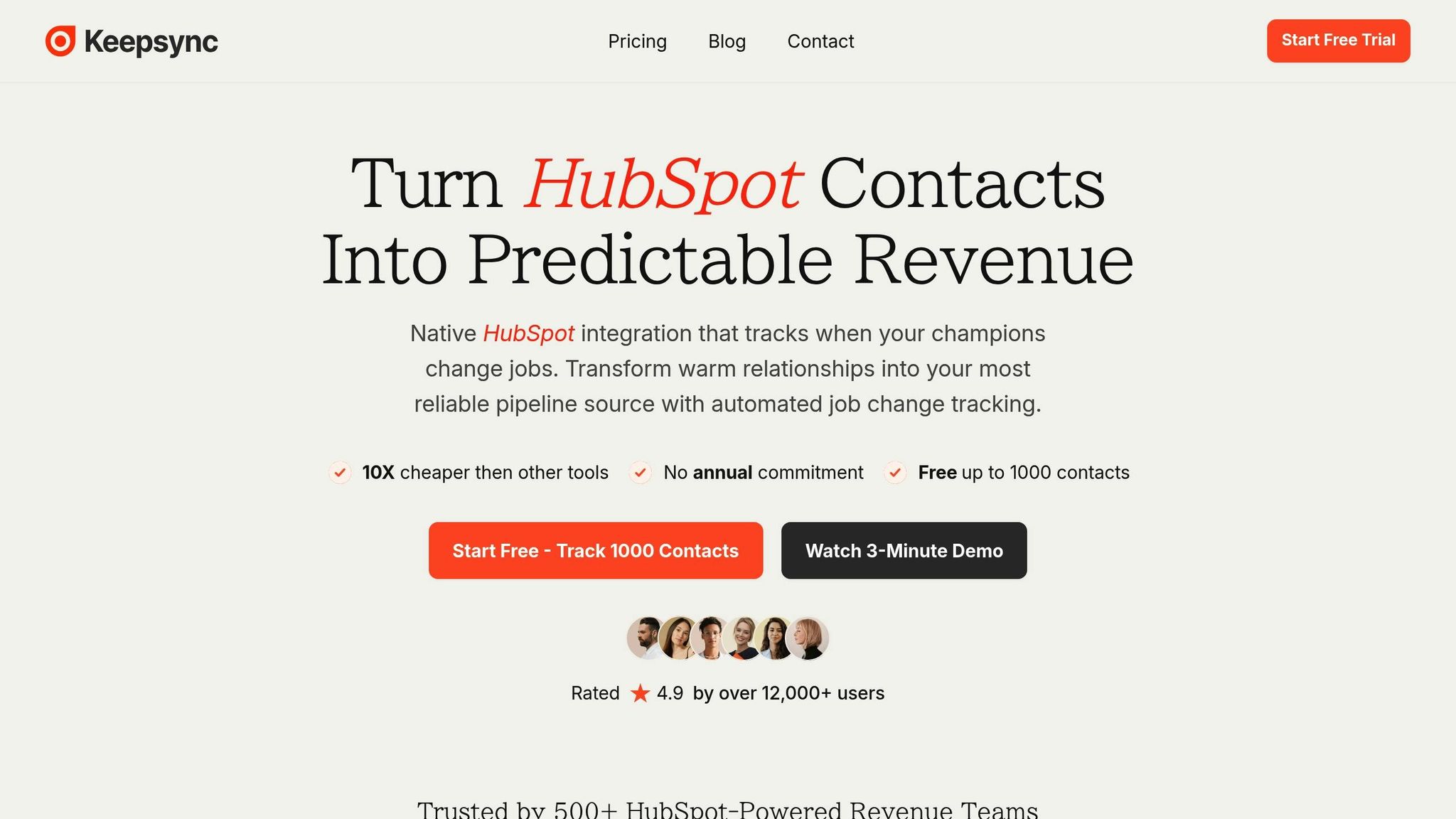
Setting up KeepSync to track job changes is straightforward and only takes about five minutes. No technical skills are needed. Once connected to HubSpot, KeepSync scans over 30 data sources weekly with an impressive 94% accuracy rate to identify job changes among your contacts.
The process has two main steps: integrating KeepSync with HubSpot and configuring your monitoring preferences. To get started, you’ll need Super Admin or App Marketplace permissions in HubSpot [11]. After the integration, you can customize alert settings to receive notifications via Slack or email whenever a tracked contact changes jobs [7]. This setup ensures your sales team can act promptly, aligning with the goal of using product-led growth (PLG) user tracking to drive timely sales engagement.
The first step is integrating KeepSync with your HubSpot account. Head over to the HubSpot App Marketplace and install KeepSync. You’ll need to grant permissions for KeepSync to read contact data and update your CRM [11]. Using email addresses as unique identifiers, KeepSync matches contacts between systems to ensure accurate updates [11].
For job change tracking, configure the integration to sync updated data directly to HubSpot. This includes new company details, job titles, and verified contact information [11]. KeepSync performs incremental syncs every five minutes and uses webhooks to deliver real-time alerts when changes are detected [11].
You can import target contacts using a CSV file, Google Sheets, or by syncing directly with your CRM [7][12]. Focus on your power users - those who’ve reached the Champion stage in your product adoption model. Apply an "Org change" filter to your contact list, narrowing the timeframe to the last 6–12 months to track recent job changes [7].
Once the integration is set up, move on to configuring your monitoring preferences to receive real-time notifications.
Enable "Job started" and "Job ended" alerts in your monitoring settings to track both new roles and departures [13]. For real-time updates, toggle on notifications for "Contact additions" in your segment settings. This ensures contacts are automatically added whenever a job change is detected [7].
To make these alerts actionable, route them to the right sales representatives. Use status features or HubSpot workflows to ensure that account owners receive updates for changes within their specific accounts [7]. This automation is crucial - 70% of new executives allocate budgets within their first 100 days, making it essential to reach out quickly [14].
When KeepSync identifies a job change, you can automate your follow-up using HubSpot workflows. These workflows streamline tasks like notifying your sales team and updating contact records, saving time and ensuring nothing falls through the cracks.
To get started, go to Automation > Workflows in HubSpot and select Create workflow > From scratch. Since you're tracking individual users, set up a contact-based workflow. Configure the enrollment triggers to activate whenever job change properties are updated - this could be a custom property like "Job Change Detected" or built-in signals such as "Job started" or "Job ended."
Make sure to enable re-enrollment so the workflow triggers with every job move. HubSpot retains enrollment history for 6 months and stores historical data for over 2 years [15], giving you a clear view of long-term trends. Once the triggers are set, you can move on to building out the workflow steps.
When a power user transitions to a new company, your sales team needs to know right away. HubSpot workflows make this easy by automating notifications and lead routing. Add a "Send notification" action to alert the contact owner via email or Slack. Use "If/then" branches to route leads based on account type or assign them to the appropriate company owner.
To help your sales reps prioritize these leads, consider setting up a "Job Changes" task queue. This is especially important since 70% of new executives allocate budgets within their first 100 days [2]. Acting quickly can make all the difference. You can also use the "Add to sequence" action to enroll the contact in a personalized email campaign, such as a "Welcome to Your New Role" series.
Your workflows should also take care of updating contact records whenever job changes occur. Use the "Set property value" action to refresh details like email address, phone number, job title, and company name with the latest data from KeepSync.
Don't forget to update the associated company record so the contact is linked to their new employer. You can also create custom date stamp properties - like "Job Change Lead Date" - to log these updates. This makes it easier to track ROI and measure the impact of your efforts.
Job change data can be a game-changer for securing deals. Why? Because new executives tend to allocate 70% of their budget within the first three months of stepping into their roles. That means there’s a limited window to make a strong impression and offer something valuable during this critical period [2]. By leveraging this data, you can craft personalized outreach strategies and track performance with precision.
Automated alerts are just the starting point - what you do next makes all the difference. When reaching out to someone in a new role, your message should feel personal, not like a cookie-cutter template. Mention their past achievements and how they might replicate that success in their current position. For instance, if they drove impressive results at their previous company, bring that up and ask if they’re looking for similar outcomes now [1]. This approach not only skips the need for lengthy product introductions but also shows you’ve done your homework.
Don’t limit yourself to one method of contact. Start by sending a LinkedIn connection request to congratulate them on their new role. A few days later, follow up with a well-crafted email that’s tailored to their situation [2]. If this person championed your product at their old company, consider asking them to introduce you to key decision-makers at their new organization [3].
To keep things organized, segment your leads based on their engagement level and the seniority of their new role [4]. You can also set up a dedicated "Job Change" task queue in HubSpot. This allows your sales team to focus on these warmer leads instead of wasting time on standard cold outreach [2].
Tracking how well your job change strategy works is just as important as the outreach itself. Use custom HubSpot reports to monitor key metrics like response rates, pipeline generated, and revenue closed from job change alerts [2].
The results can be impressive. For example, Steve Jones created over $28 million in pipeline, while Grace Feeney achieved a 44x ROI by acting quickly on job change opportunities [4].
Tools like KeepSync’s pipeline analytics can help you compare the performance of job change leads against traditional cold outreach. You can even identify which sales reps are responding to alerts promptly and which ones might need extra coaching. With 20% of the corporate workforce changing jobs annually and companies missing out on 85% of these opportunities [4], refining this strategy can help you capture more deals and grow revenue.
KeepSync makes job change tracking easy and adaptable to your business needs. Whether you're just starting out or managing thousands of contacts across multiple teams, their pricing plans are designed to grow with you. Every plan includes weekly monitoring across 30+ data sources and boasts 94% accuracy for job change detection, so you can count on reliable results.
Here’s how the plans break down:
KeepSync keeps things simple with transparent pricing, no forced contracts, a quick 5-minute setup, and seamless integration with HubSpot. This ensures your job change alerts flow effortlessly into your existing workflows.
For most businesses, the Team Plan strikes the right balance between features and cost, especially if you're tracking former champions or closed-lost deals. Larger organizations or agencies managing multiple HubSpot portals will appreciate the Agency Plan for its white-label options and personalized support. Pick the plan that aligns with your needs to get the most out of every job change alert.
Keeping tabs on job changes isn't just a nice-to-have - it’s a hidden goldmine for revenue. Companies that overlook this miss out on countless sales opportunities. Why? Because former champions and power users already understand the value of your product, making them 6 times more likely to convert than cold prospects [16]. That’s where KeepSync steps in, automating job change detection with an impressive 94% accuracy and seamlessly updating contact details in HubSpot. Your sales team gets real-time alerts when these power users land at new companies - just as they're seeking proven tools to make an impact.
Here’s another critical insight: when a product champion leaves an account, there’s a 51% chance that account will churn within a year [5]. By tracking these moves and acting strategically, you can convert alumni users into warm leads, engage with their successors, and keep your sales cycles moving faster. Some companies have even seen a 44x return on investment in just 11 months from job-change leads alone [4]. Whether you’re starting small with the Starter plan ($79/mo) for 1,000 contacts or scaling up with the Team or Agency plans, KeepSync’s straightforward pricing and quick 5-minute setup make it simple to capture these opportunities before they slip away.
Staying aware of when your most active users change jobs is a smart way to keep your connection alive during their career shifts. By reaching out quickly, you can nurture the relationship and even turn them into champions for your product at their new workplace. This approach not only helps reduce the risk of losing them as users but also creates opportunities to expand your business into new organizations.
Power users are those who dive deep into your product, using it more frequently and extensively than the average user. They're the ones who truly understand its capabilities, often becoming champions within their teams. These users not only encourage others to adopt the product but also provide valuable feedback and influence decisions within their organization.
In a product-led growth (PLG) strategy, power users are easy to spot. They’re consistently active, make use of advanced features, and often hold sway as decision-makers or influencers. What makes them even more valuable? When they move to a new company, they frequently bring their preference for your product along, creating warm leads for B2B sales. By keeping tabs on these users, you can act quickly to maintain strong connections and ensure your product stays top of mind during their transitions.
KeepSync works effortlessly with HubSpot by leveraging the Contacts API and webhooks to keep employment details up-to-date whenever a job change is detected. When KeepSync spots a new role, it updates the contact's company, job title, and even adds a Job-Change Detected flag directly within HubSpot.
This flag can activate HubSpot workflows, like notifying the contact owner, enrolling the user in a sales sequence, or creating a new deal. These automated actions help your sales team connect with key users at the perfect moment, turning job transitions into fresh opportunities. Plus, the updated information improves HubSpot’s intent signals, enabling your team to focus outreach efforts on the most current and relevant data.