
Digital Marketing
·
April 10, 2026
How SaaS Companies Handle Billing Disputes & Chargebacks
Learn how SaaS billing disputes happen, what triggers chargebacks, and how both sides can resolve them faster.

How Revenue Operations aligns sales, marketing, and customer success with processes, tools, and metrics to scale predictable revenue.


Revenue Operations (RevOps) is the process of aligning sales, marketing, and customer success teams to drive predictable revenue growth. By unifying these departments under shared goals and data, businesses can eliminate inefficiencies, improve collaboration, and achieve better results. Companies using RevOps see faster growth (19%), higher profitability (15%), and reduced go-to-market costs (30%).
Key takeaways:
RevOps isn't just a method - it's a necessity for B2B SaaS companies aiming to scale efficiently and improve revenue outcomes.

Revenue Operations Impact: Key Statistics and Benefits
RevOps focuses on key processes that smooth out the revenue funnel and improve team collaboration. These processes lay the groundwork for using automation tools and tracking metrics effectively to drive revenue growth.
Lead scoring assigns numerical values to prospects based on their engagement (e.g., email clicks, webinar participation) and fit (e.g., job title, company size). This helps sales teams focus on leads most likely to convert while providing marketing teams with feedback on lead quality [9].
For example, HubSpot allows you to create scoring models that track specific behaviors - like visiting a pricing page or attending a webinar - and assign points accordingly. To keep scores accurate, you can set category caps to prevent repetitive actions, such as opening multiple emails, from inflating a lead's score [9]. Negative scoring is equally important, deducting points for signals like bounced emails or prolonged inactivity (e.g., 60+ days), ensuring your pipeline stays clean [11].
If you're ready to go beyond manual scoring, predictive scoring leverages AI to analyze historical data and identify the factors that truly predict success [9]. Defining thresholds is crucial - for instance, a score of 50 might qualify a lead as an MQL, while a score of 100 could trigger SQL status [11]. Companies that operationalize a well-defined Ideal Customer Profile (ICP) in HubSpot can even cut customer acquisition costs by 30% [8].
Another useful tactic is time-based decay, where points expire after a set period (e.g., 90 days). This ensures scores reflect recent engagement rather than outdated interactions from months ago [9].
Once lead scoring is in place, the next step is automating repetitive tasks.
Manual CRM updates can be a major time drain. In fact, 46% of RevOps directors report that their go-to-market processes are overly manual and lack proper automation [3]. Workflow automation tackles this inefficiency by automating tasks like deal stage updates, activity logging, and follow-up reminders [3][1].
HubSpot workflows allow you to automatically move contacts through lifecycle stages based on specific triggers. However, it's better to avoid HubSpot's default "lifecycle toggles", as they can disrupt accurate funnel reporting. Instead, create manual workflows that advance contacts one stage at a time and include date properties (e.g., "Became an MQL Date") to track progress accurately [8].
You can also set up required fields to ensure reps input critical data - like deal value or decision-maker details - before advancing a deal. This maintains data quality without relying on reps to remember every detail [8].
HubSpot's Breeze AI takes automation a step further by summarizing records and triggering "Dynamic Sequences" when prospects show intent. This reduces wasted effort on unengaged contacts [8]. As Adam Statti from RevPartners explains:
"HubSpot CRM is the best place to build your RevOps engine because it ties everything together: lifecycle stages, sales stages, target accounts, automation, reporting, and now even AI with Breeze" [8].
Quick response times are critical. Reaching out to a lead within five minutes makes you 21 times more likely to convert them into an opportunity [12]. Manual lead assignment often causes delays and uneven workloads. Automated lead routing eliminates these issues by instantly assigning leads based on criteria like geography, industry, or account tier [12].
In HubSpot, workflows can use round-robin logic to distribute leads evenly across your sales team. Alternatively, you can set up rules to route enterprise accounts to senior reps and SMB leads to inside sales [8][13]. This ensures smooth transitions between marketing and sales while balancing workloads [7][10].
For example, you can configure workflows to route West Coast leads to reps in Pacific Time or assign enterprise accounts to experienced closers [8].
The payoff? 78% of leads buy from the first company that contacts them [12]. Automated routing ensures your team is always first in line, accelerating response times and reinforcing RevOps' mission of efficient revenue management.
The right tools transform RevOps strategies into actionable workflows. They take the processes we've discussed and ensure they are executed efficiently, with minimal friction. While processes outline what needs to happen, the tools determine how smoothly and effectively those tasks are carried out. For many B2B SaaS companies, HubSpot serves as the core platform, while specialized tools like KeepSync fill in the gaps that traditional CRMs might overlook.
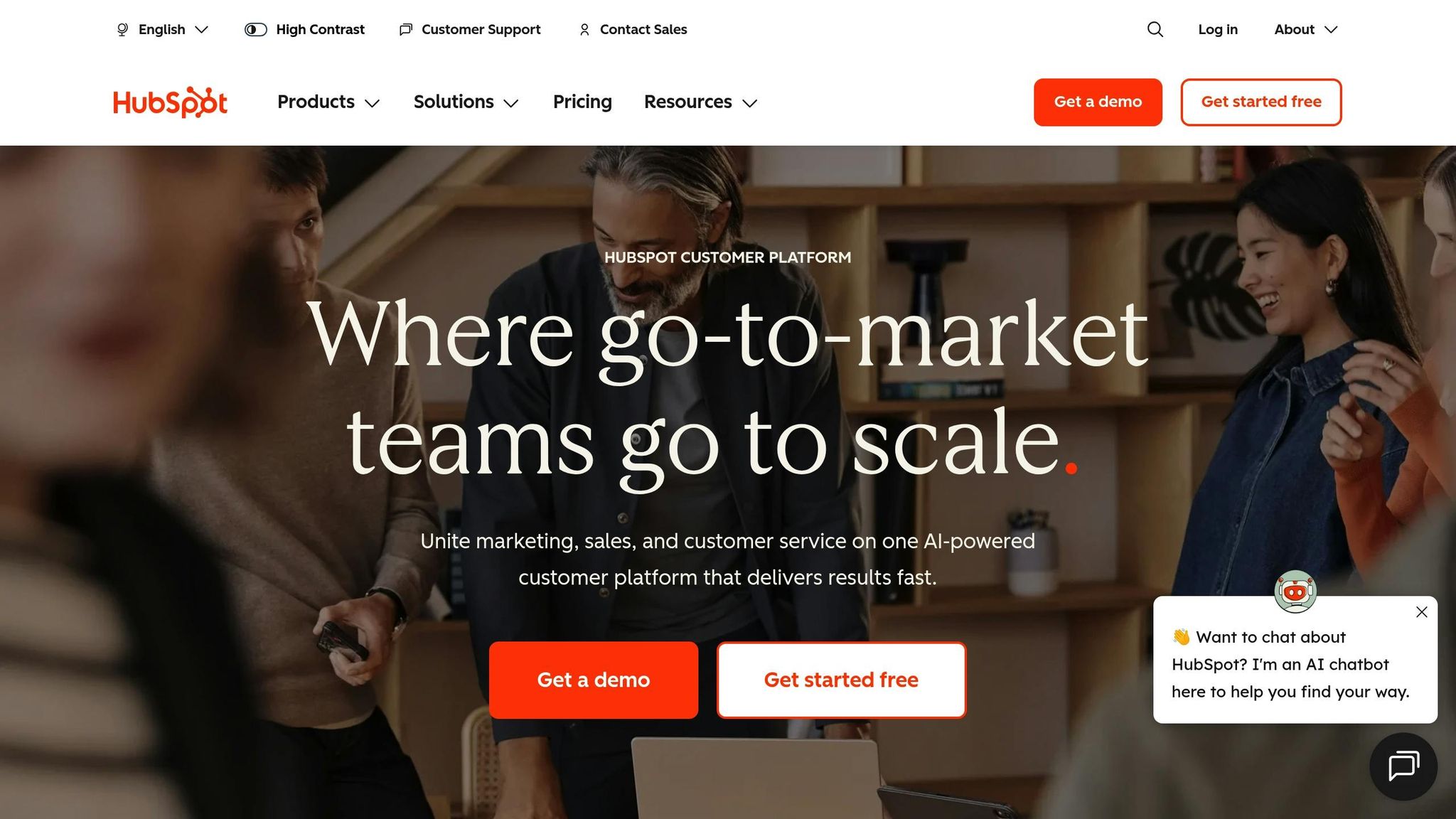
HubSpot is a powerhouse when it comes to automating workflows and generating insightful reports. Its automation features are designed to simplify repetitive tasks. For example, the built-in workflows use "if/then" logic to handle tasks like routing leads by geography or deal size, sending upsell notifications, and automatically updating deal stages. As Justin Schulze, Owner of Schulze Creative, aptly puts it:
"If you're not using workflows on HubSpot, you're missing out on a huge productivity hack."
HubSpot also boosts sales outreach with its Sales Sequences, which automate follow-up emails and task creation whenever prospects interact with your content. On top of that, its Data Quality Automation feature ensures your CRM stays clean and reliable by fixing formatting issues and removing duplicates.
When it comes to reporting, HubSpot takes things to the next level with custom attribution models. These models combine data from various sources - like deals, tickets, and custom properties - to offer a full view of the customer journey. This helps teams identify which marketing efforts are driving revenue. Alex Vasylenko, Founder of The Frontend Company, highlights this advantage:
"Most teams are used to simple pipeline or sales reports, but the real magic happens in combining data from multiple HubSpot objects, like deals, tickets, and custom properties, to build out bespoke reports that answer a specific operational question."
For Enterprise users, the Datasets feature allows teams to create clean, reusable tables with pre-calculated formulas. This makes it easier to handle tasks like calculating sales commissions or tracking time spent in each deal stage. Companies using such real-time analytics often see a significant performance edge, reportedly outperforming their peers 80% of the time [15].
While HubSpot excels at internal automation and reporting, specialized tools like KeepSync help take engagement and tracking to the next level.
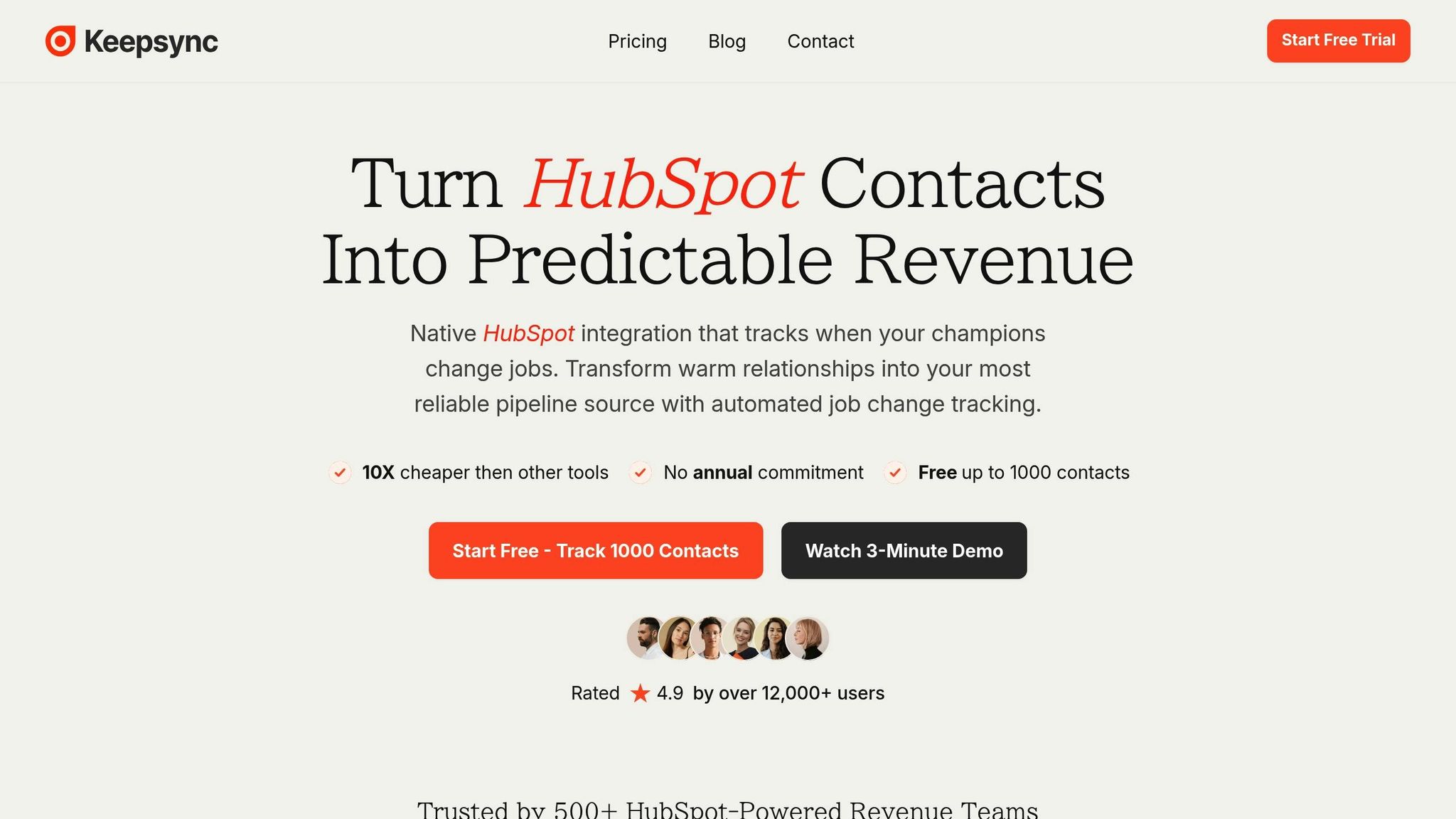
One limitation of CRM automation is its inability to track key contact movements, such as job changes. KeepSync fills this gap. This HubSpot-native tool keeps tabs on your contacts, sending real-time alerts when they change jobs. Notifications can be delivered via Slack, email, or directly within HubSpot.
When a former customer or a lost deal contact moves to a new company, KeepSync enriches their record with verified email, phone, and company details. This transforms what might have been a cold outreach into a warm reconnection. By monitoring contacts weekly across 30+ data sources and using multi-source verification, KeepSync ensures accuracy.
The tool integrates seamlessly with HubSpot workflows and takes just five minutes to set up. Once active, it can route job change alerts to the right team member, trigger personalized outreach, or flag contacts as they move. This automation helps avoid the delays often caused by manual tracking, which can add over 20% to the length of sales cycles [16].
KeepSync also includes pipeline analytics to measure ROI and response rates, giving teams clear insights into how job change tracking impacts deal closures. Pricing starts at $79/month for up to 1,000 contacts and scales to $149/month for 5,000 contacts, making it an affordable and scalable option for growing teams.
Tracking the right metrics takes Revenue Operations (RevOps) from guesswork to measurable success. These metrics provide insight into the effectiveness of automated workflows and CRM integrations. Research shows that 72% of RevOps teams consider revenue growth their primary success metric [19]. Below are some of the most important metrics to monitor for evaluating pipeline performance and conversion efficiency.
Pipeline velocity measures how quickly deals move through the sales funnel, translating into revenue over a specific period. The formula is straightforward: (Number of Opportunities × Average Deal Size × Win Rate) / Sales Cycle Length [18][19].
For example, if you have 50 opportunities, each worth $10,000 on average, with a 30% win rate over a 60-day cycle, your pipeline velocity would be $2,500 per day. If this number drops, it could signal issues such as stalled deals, declining win rates, or a lengthening sales cycle [5][20].
Jordan Shaheen, Head of Revenue Operations at Candid, underscores the importance of recurring revenue metrics:
"Overall, the number that the board and the CEO are looking for is annual recurring revenue (ARR). How is your ARR improving throughout the year? Are you going to hit your goal? Can you demonstrate sustainable growth over time?" [17]
Win rate reflects the percentage of sales opportunities that turn into closed deals. It’s calculated by dividing the number of deals won by the total number of deals and multiplying by 100 [18]. Companies that refine their sales strategies often achieve up to 11% higher win rates [19].
Lead-to-close time, also known as the sales cycle length, measures the average time from initial contact to a closed deal. This is calculated by dividing the total time taken to close deals by the number of closed deals [6]. Shorter sales cycles not only improve cash flow but also enhance forecast accuracy. When analyzed alongside win rate, these metrics help identify whether your team is efficiently closing high-quality deals or spending too much time on less promising opportunities [5][20].
Together, these metrics provide a clear view of your team's efficiency and the quality of your sales process.
Assessing the ROI of automation tools helps determine if your tech stack is delivering real value. Automation can reduce work time by up to 40% [1] and directly contribute to revenue growth. Companies using Revenue Operations & Intelligence solutions report significant outcomes: 41% experience major revenue increases, and 59% see improved win rates [6]. Additionally, lower customer acquisition costs (CAC) and shorter sales cycles further demonstrate the positive impact of automation on profitability [3][5][18].
RevOps works best when it turns key signals into actionable steps, helping teams grow revenue up to three times faster by cutting down on manual tasks [22].
Job change alerts are a great way to trigger the next steps in your workflows [21]. When someone in your contact list changes jobs, they often bring their vendor relationships along. By using a tool that monitors job changes in real time, you can feed accurate alerts directly into your system.
The real magic happens when your job tracking tool syncs seamlessly with HubSpot [21]. For instance, if a key contact moves to a new company, workflows can automatically adjust their lead score, assign them to the right sales rep, and kick off personalized outreach. Using AI-driven prospecting with these signals can improve response rates by 10% while saving sales reps about five hours per week [21].
To get started, map out key points in the customer journey where job alerts should prompt action [14]. For example, if a contact who previously evaluated your product lands a director-level role at a larger organization, your workflow can immediately assign them to your enterprise sales team and send a congratulatory message. Companies using this approach, with tightly connected go-to-market teams, see a 100-200% boost in ROI on digital marketing campaigns [22].
This kind of integration sets the stage for automating even more processes, like post-meeting actions.
Post-meeting follow-ups often slip through the cracks, but HubSpot’s Smart Deal Progression feature solves this by automating updates and task creation based on deal stage changes [14][23]. After a meeting is logged, workflows can automatically record the "Became Opportunity Date", update the deal stage, and assign follow-up tasks to both sales and customer success teams.
To ensure data accuracy, use required fields [8]. For example, before moving a deal from "Discovery Call Completed" to "Proposal Sent", require your reps to fill in fields like "Meeting Outcome" or "Next Steps." This keeps your data clean and ensures your revenue operations run smoothly.
The Sales Workspace simplifies daily tasks by centralizing "Tasks for Today" and "Guided Actions" [8]. When combined with real-time job alerts, this creates a dynamic feedback loop: after a meeting, workflows update the deal stage and assign tasks, and if that contact later switches jobs, the system automatically re-engages them at their new company. This setup helps teams stay proactive and aligned.
RevOps brings your sales, marketing, and customer success teams together under one unified strategy and shared dataset[4]. This approach minimizes friction and helps create predictable revenue streams. In fact, companies with aligned revenue operations see growth rates nearly 19% faster and profitability 15% higher compared to those operating in silos[2].
The concept is simple: streamlined processes reduce the handoff issues that can derail deals, while integrated tools like HubSpot provide a single, reliable source of truth. Tools like KeepSync ensure you don’t miss opportunities by tracking changes in contact roles. Plus, data-driven metrics replace guesswork with accurate forecasts, giving you the clarity to make faster, smarter decisions.
By breaking down departmental silos, RevOps enables teams to move in sync toward shared objectives, removing barriers that can stifle growth.
Aligned go-to-market teams see impressive results, including up to a 200% return on investment, a 30% reduction in costs[2], and a 40% decrease in time spent on repetitive tasks[1]. Public companies with dedicated RevOps functions have even seen their stock performance rise by 71%[6].
Start by centralizing your data to power automated workflows and shared KPIs, ensuring all teams contribute to a unified revenue strategy[1][4]. The businesses thriving today aren’t just working harder - they’re working smarter, with RevOps as their backbone. Make RevOps the foundation of your strategy to build a resilient, data-driven engine for sustained growth.
Revenue Operations, or RevOps, is all about uniting sales, marketing, and customer success teams under a shared vision. By setting common goals, simplifying workflows, and centralizing data, RevOps eliminates silos that often hinder collaboration. When everyone is on the same page, teams can work together seamlessly toward shared revenue objectives.
One of the key strengths of RevOps lies in integrating tools and processes. With access to consistent, real-time data, teams can communicate better, make decisions faster, and operate more efficiently. It also fosters a sense of accountability, as each team clearly sees how their work impacts the overall revenue strategy.
The result? Deals close faster, customer relationships grow stronger, and revenue becomes more predictable. Plus, customers benefit from a smoother, more cohesive experience.
Tracking the right metrics is key to making Revenue Operations work effectively. Start with customer lifetime value (CLV) - it’s a great way to gauge long-term profitability. Next, keep an eye on conversion rates to see how efficiently your sales funnel is performing. Another critical metric is pipeline velocity, which shows how quickly deals progress through your pipeline.
You’ll also want to track metrics like adoption rate and overall sales performance. These can pinpoint areas where processes might need tweaking, helping you refine operations and boost revenue growth. By focusing on these numbers, you’ll gain insights that lead to smarter decisions and better alignment across your sales, marketing, and customer success teams.
Tools like HubSpot and KeepSync are game-changers for improving Revenue Operations (RevOps). These platforms work together to align sales, marketing, and customer success teams by integrating their data into a single, unified system.
HubSpot stands out as a robust CRM platform that simplifies workflows, automates repetitive tasks, and provides detailed reporting. This centralization ensures teams stay on the same page, reduces inefficiencies, and empowers better decision-making with real-time, accurate data.
On the other hand, KeepSync focuses on seamless data synchronization and automation across multiple platforms. It eliminates the need for manual data entry and breaks down silos, paving the way for smoother collaboration and actionable insights.
By combining these tools, businesses can streamline their processes, speed up the sales cycle, and establish a predictable revenue growth model. Together, they form the backbone of a scalable revenue strategy that drives efficiency and enhances overall performance.