
Digital Marketing
·
April 10, 2026
How SaaS Companies Handle Billing Disputes & Chargebacks
Learn how SaaS billing disputes happen, what triggers chargebacks, and how both sides can resolve them faster.

Use HubSpot job-change tracking with KeepSync to detect role moves, trigger workflows, protect accounts, and convert former advocates into pipeline.


30% of your CRM contacts will change jobs this year, and most won't notify you. HubSpot's job change tracking helps you turn these transitions into revenue opportunities. By automatically detecting when contacts switch roles or companies, you can reconnect with former advocates (who are 5x more likely to convert) and protect existing accounts.
Here’s how it works:
The guide covers setup, workflows, and ROI measurement to help you turn job changes into a reliable revenue source.

4 Key Job Change Signals for Revenue Operations
Job change tracking is a feature that keeps an eye on CRM contacts when they switch roles or companies, automatically triggering workflows for sales and retention. It turns former advocates into a steady stream of warm leads.
Here’s how it works: when someone who has previously purchased from you starts a new job, they become a warm lead already familiar with your product or service. The system identifies these changes and updates the relevant HubSpot records automatically.
There are two main ways to track job changes: using HubSpot’s native tools or through external integrations.
Once a change is detected, HubSpot can take several actions automatically, such as creating a task for a sales rep, enrolling the contact in a sequence, or setting up a custom object to log the signal for future reporting. Including LinkedIn URLs in your contact records is a good practice since they act as unique identifiers, minimizing the chances of errors.
Tracking job changes can result in a 10–50% boost in pipeline generation [1]. When a former supporter moves to a new company, they often aim to replicate their previous successes, making this a golden opportunity to reconnect.
Here are four key scenarios where job change tracking can help protect and grow revenue:
| Signal Type | RevOps Purpose | Sales Opportunity |
|---|---|---|
| Champion Move | Expansion | Use existing trust to establish a foothold in a new account |
| New Hire at Target | Entry Point | Approach new decision-makers with fresh budgets |
| Promotion | Upsell | Engage with contacts who now have more authority and budget |
| Champion Exit | Retention | Spot renewal risks and quickly connect with their replacement |
Beyond generating new opportunities, job change tracking is essential for reducing churn. If a key stakeholder leaves, you can immediately activate account protection strategies to engage their successor. This automated, real-time intelligence eliminates the need for manual monitoring, keeping your CRM updated and your team focused on what matters most - seizing high-value opportunities.
Up next, learn how to set up job change tracking in your HubSpot workflows.
Getting job change tracking up and running in HubSpot is a straightforward process, especially with KeepSync's native integration, which takes just about five minutes to set up.
First, make sure your HubSpot account has administrative permissions. You’ll need these to map fields, create tasks, and possibly configure custom objects, depending on your subscription level [3].
The key to accurate tracking is having LinkedIn Profile URLs for your contacts. These act as unique identifiers and significantly improve match accuracy [3].
Next, segment your contacts. Create active or static lists in HubSpot focusing on high-value groups. For example, you might prioritize:
By targeting the right segments, your team can zero in on the most valuable opportunities.
Finally, decide how you’ll map fields in HubSpot. Identify which contact properties will store updated job titles, company names, and other enriched data. If you’re on HubSpot Enterprise, think about using Custom Objects instead of Tasks. This option offers better long-term reporting and insights into pipeline influence [1].
Once your contacts are organized and your field mapping strategy is set, you’re ready to configure KeepSync and activate alerts.
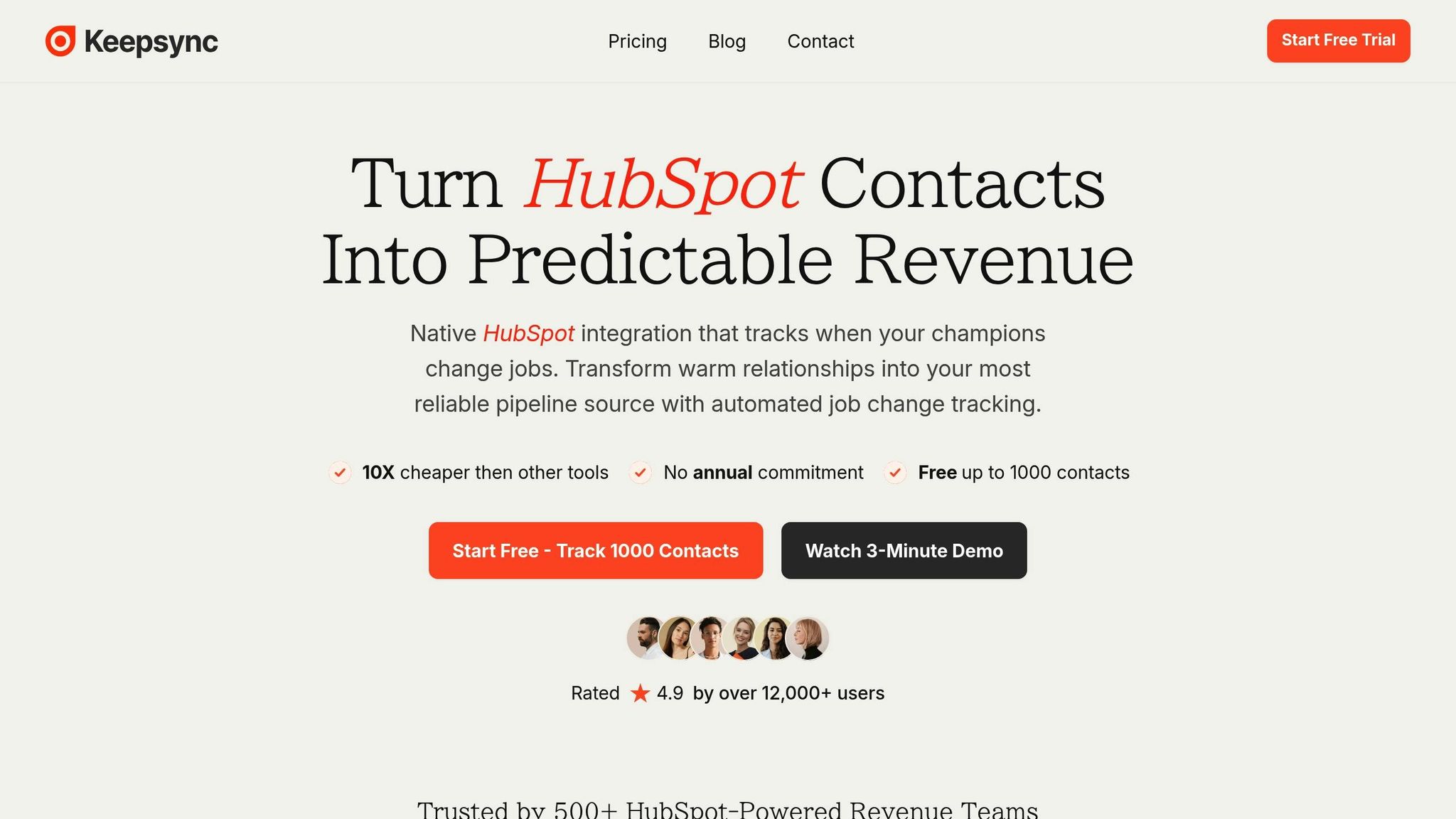
With the groundwork laid, it’s time to integrate KeepSync with HubSpot. Start by connecting KeepSync to your HubSpot account through the integration settings. Be sure to select the LinkedIn URL property as your primary identifier - this ensures the highest possible match rates [3].
Choose which contact lists you want KeepSync to monitor. The tool will scan these contacts weekly across 30+ data sources with a 94% accuracy rate. You can enable automation to update records, create tasks, or generate custom object records automatically [3].
Set up your notification preferences. For high-priority signals, such as when a key champion moves to a target account, consider sending Slack notifications directly to your #sales channel for immediate action [1].
Finally, apply ICP (Ideal Customer Profile) filters to weed out irrelevant changes. For instance, if a former executive transitions to a non-corporate role outside your target market, you can exclude that from triggering any sales outreach [3]. These filters help your team stay focused on meaningful opportunities without unnecessary distractions [1].
When KeepSync detects a job change, you can leverage HubSpot workflows to take immediate action. This could mean routing leads, tailoring your outreach, or keeping your CRM organized and up-to-date.
Use the enriched fields from KeepSync as workflow triggers. For example, when KeepSync updates fields like Job Title, Company Name, or Previous Company, you can set workflows to automatically re-enroll those contacts. To make this happen, enable re-enrollment by using the "Property is known" filter. As Megan Legge, Product Manager for Workflows at HubSpot, explains:
"Enroll an object in a workflow, every time a certain property's value changes... Use 'Is known' as an enrollment and re-enrollment criteria" [5].
You can also create a property called Job Change Date and use the "Date of step" action to populate it [6]. This gives you a clear record of when the change was detected and allows you to track how quickly your team acts on new opportunities.
For lead routing, add If/Then branches to evaluate updates like a new job title or company. For instance, route contacts to a Senior Account Executive if they step into VP or Director roles. You could also set up a Slack alert when they join a target account [5][7]. Additionally, the Previous Company field can help you identify former advocates who’ve moved to new organizations - these are often some of your warmest leads.
Active lists in HubSpot can help you stay on top of job changes. For example, build a list filtered by properties like No Longer at Company or contacts Created by KeepSync in the last 30 days. These lists update automatically, giving your sales team real-time access to new opportunities [8].
On your Contacts page, set up custom views with columns for Job Title, Previous Company, and Job Change Date. You can also filter these views by job change properties to track leads in real time. To monitor progress, create a Job Change lead status with stages such as First outreach sent and Successful intro completed - this helps you keep tabs on relationship-building efforts [9].
For Enterprise users, HubSpot's Property Change Events can be a powerful tool. These events let you track updates to specific job-related fields across lists, workflows, and reporting. However, keep in mind that HubSpot allows up to 25 property change events, and they count toward a monthly limit of 30 million events. Once you hit that limit, the events cannot be recovered [4].
Next up, we'll dive into how to measure the ROI of these automated workflows.
Once you've set up automated alerts, the next step is proving their value. Revenue Operations Managers are always looking for measurable returns, and job change tracking can significantly impact your pipeline. It has the potential to increase pipeline generation by 10–50% and help close deals five times more often [1].
To evaluate the effectiveness of job change tracking, focus on three key HubSpot reports:
Timing is critical here. Studies show that new executives allocate 70% of their budgets within their first three months [1]. This means your team should aim to engage within the first 100 days, as buying intent is at its highest during this window.
For deeper insights, make use of advanced HubSpot configurations. For example, you can create a custom "Intent" object to log details like Old Company, Old Job Title, and New Hire Status. This approach not only tracks immediate results but also preserves historical data for ongoing ROI analysis [1][3]. Dashboards can then be built to visualize conversion rates at every stage - from the initial job change alert to a booked meeting, a qualified opportunity, and, ultimately, a closed deal.
Retention is another area to keep an eye on. Job changes can signal churn risks, especially when key champions leave. By monitoring accounts where these transitions occur, you can trigger immediate customer success actions. While harder to quantify, tracking the number of accounts "saved" after such alerts can provide valuable insights into retention efforts [2].
KeepSync offers flexible pricing plans to match your team's needs, making it easier to scale as you see results:
By implementing the setup and workflow strategies outlined above, the advantages of tracking job changes become undeniable. Automating the monitoring of contact movements in HubSpot does more than just keep your CRM updated - it establishes a dependable system that identifies warm leads at the exact moment they’re most likely to convert. This is critical because, without proactive tracking, 89% of previous customers won’t return on their own [1].
The data backs this up. Businesses leveraging job change signals often experience a 10–50% boost in their generated pipeline [1]. Additionally, engaging decision-makers early helps close deals 63% faster [10]. Beyond driving new revenue, this approach also protects existing accounts by alerting your Customer Success team when key champions leave. This gives them the chance to secure renewals before risks escalate.
Take advantage of KeepSync's Starter plan ($79/mo), which supports up to 1,000 contacts. Use it to set alerts for your most valuable segments and develop playbooks that focus on both protecting current accounts and driving growth. Then, monitor response rates and pipeline performance directly in HubSpot.
With 30% of the workforce changing jobs each year [2], your database is constantly evolving. Without automated tracking, you risk missing critical signals and leaving revenue on the table. Revenue Operations isn’t just about streamlining processes - it’s about seizing opportunities when they matter most.
Job change tracking in HubSpot keeps you updated when your important contacts switch roles or companies. With automated alerts, you can take action quickly - whether it’s maintaining renewals, reconnecting with warm leads, or spotting new business opportunities.
This tool can help grow your sales pipeline by strengthening existing relationships and opening doors to new prospects. For Revenue Operations Managers, it’s an effective way to refine sales strategies and drive revenue growth.
To set up job change tracking in HubSpot using KeepSync, the first step is to tidy up your CRM data. Make sure everything is clean and standardized - this means removing duplicates and ensuring fields like Job Title, Company Name, and Email are formatted consistently. This preparation is essential for accurate updates.
Next, create custom properties in HubSpot to track job changes effectively. For example, you could add fields like Previous Company and Job Started Since to store relevant details about a contact's employment history.
Once your CRM is ready, integrate KeepSync to enable real-time job change monitoring. KeepSync automatically updates these custom properties with job change signals. From there, you can use HubSpot workflows to trigger alerts whenever these fields are updated. Set up notifications for your team or assign follow-up tasks so you can act quickly on new opportunities.
To stay organized, create dynamic lists or saved views in HubSpot to focus on contacts with recent job changes. This makes it easier to prioritize outreach and monitor the results. You can even track metrics like pipeline growth and revenue generated from these opportunities to measure the impact of your efforts.
By setting up this system, you can automate job change tracking and tap into new sales opportunities with KeepSync’s real-time insights.
To figure out the ROI of tracking job changes in HubSpot, start by setting a baseline for your pipeline and win rates before activating job-change alerts. HubSpot’s custom properties, like Previous Company or Job Started Since, along with automated workflows, can help you identify contacts who have switched jobs. From there, create a specific list for these contacts and monitor key metrics such as:
Next, compare the extra revenue generated against the cost of your tracking tool (e.g., a KeepSync subscription) and the time saved through automation. You can calculate ROI using this formula:
ROI = ((Incremental Revenue - Tool & Labor Cost) / Tool & Labor Cost) × 100%
Leverage HubSpot’s reporting tools to make the data visual. Add job-change properties to your revenue analytics reports to track trends, such as month-over-month performance and cost-per-opportunity. Consistently reviewing these metrics ensures your investment translates into measurable gains.