
Digital Marketing
·
April 10, 2026
How SaaS Companies Handle Billing Disputes & Chargebacks
Learn how SaaS billing disputes happen, what triggers chargebacks, and how both sides can resolve them faster.

Leverage real-time buyer signals—pricing views, job moves, funding—to automate timely, personalized B2B outreach that raises win rates and shortens sales cycles.


Signal-based selling transforms how B2B sales teams connect with prospects. Instead of mass outreach, this approach uses real-time data to identify when potential buyers show interest - like visiting your pricing page, securing funding, or changing jobs. By focusing on these signals, sales teams can engage prospects at the right time, leading to 26.3% higher win rates and saving 12 hours per week on manual tasks.
Key takeaways:
The shift from generic pitches to intent-driven conversations isn’t just effective - it’s becoming essential for staying competitive in B2B sales.
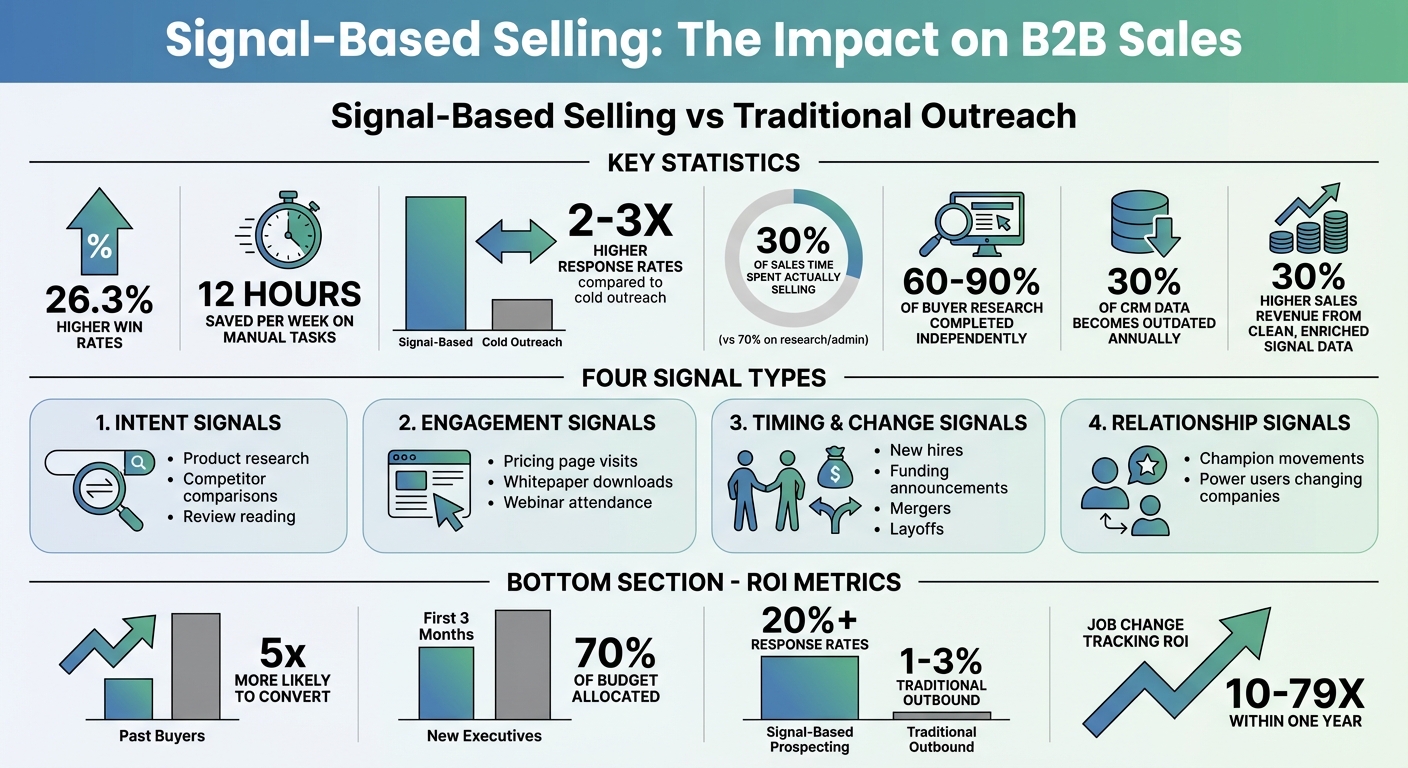
Signal-Based Selling ROI: Key Statistics and Benefits for B2B Sales Teams
Signal-based selling is a method that uses real-time data - like website visits, job changes, or funding updates - to guide sales outreach. Instead of focusing solely on ideal customer profiles, it hones in on buyers who are actively showing interest or intent to purchase.
Unlike traditional cold outreach, which relies on static lists and general company details (like size, industry, or location), signal-based selling adds a layer of timing by analyzing what prospects are doing. For instance, repeated visits to a pricing page or a former customer joining a new company can reveal interest that a simple demographic profile might miss.
This approach shifts sales from generic pitches to conversations that begin when a buyer’s interest is already evident. Many sales teams use a technique called "signal stacking", where multiple indicators - like a new executive hire combined with a pricing page visit - are layered to identify high-value opportunities. AI plays a key role here, analyzing vast amounts of data to uncover insights that might otherwise go unnoticed. This strategic use of signals is reshaping how B2B sales teams operate.
On average, sales reps spend only about 30% of their time actually selling, with the rest consumed by tasks like research and admin work [2]. Warm outreach, guided by signals, often sees response rates 2–3 times higher than traditional cold calls [6]. By the time a prospect fills out a form or responds to an email, they’ve typically completed the bulk of their research.
"It's the difference between knocking on a hundred random doors and knocking on the one where someone is already looking out the window for help."
- Semir Jahic, Founder, Salesmotion
Sales signals are at the heart of this approach, shifting efforts from broad outreach to precise targeting. These signals fall into four main categories:
To prioritize effectively, signals can be ranked in tiers. For example, demo requests and multiple pricing page visits might be Tier 1 (urgent), while casual social media engagement or keyword research could be Tier 3 (better suited for nurturing over time).
Adopting signal-based selling can lead to tangible improvements across the sales process. Companies using these strategies have reported a 26.3% increase in win rates [3], and sales teams save an average of 12 hours per week by automating manual tasks [3].
Timely, relevant outreach - like referencing a recent webinar attendance - can significantly boost engagement, with response rates 2–3 times higher than cold outreach [6].
Sales cycles also become shorter. Since modern B2B buyers complete 60–90% of their research independently [1][4], contacting them at the right moment is critical.
Another advantage is better ROI. Clean, enriched signal data can drive 30% higher sales revenue compared to outdated CRM records [9]. For a team of 10 sales development reps (SDRs), automating signal-based research could reclaim about 164 hours each month [9]. This approach also addresses the challenge of stale data, as roughly 30% of CRM information becomes outdated annually [3].
"When signals and AI come together, they give revenue teams the power to influence outcomes long before a buyer ever raises their hand. It's about creating engagement that feels helpful, not pushy - meeting buyers where they are with the right message at the right time."
- Latane Conant, Forbes Contributor
Next, we’ll explore how HubSpot can help you identify and act on these critical signals.
HubSpot's built-in tools turn your CRM into a dynamic signal tracker. It monitors visitor intent (like website visits), research intent (topics companies are actively searching), news events (such as funding rounds or executive changes), and job changes (when contacts start or leave roles) [8]. Plus, when you start tracking a new company, HubSpot automatically fills in signals from the past 30 days [8].
To access these features, go to Marketing > Buyer Intent > Signals. If you have HubSpot Credits and Data Enrichment permissions, the system will automatically begin monitoring companies when they become Target Accounts or reach a specific lifecycle stage [8].
Take GRAPHISOFT Italia as an example. They implemented a signal-based lead scoring system that tracked website visits, blog engagement, and email interactions. When a lead crossed a specific score threshold, sales reps were notified automatically. Marketing Coordinator Giulia Sicurella shared:
"Lead scoring helps resellers a lot in organizing their work. Today, we finally have a system that works, a lead database that is constantly updated and shared with the sales network."
This strategy quadrupled their MQLs and doubled new leads year-over-year [12].
Here’s how to set up signal triggers in HubSpot: Navigate to Automation > Workflows, create a new Company- or Contact-based workflow, and set the trigger under Data Values > Company Signal Events. Choose specific events, like Funding or Job Started, and use the + icon to add actions - such as creating tasks, enrolling leads in email sequences, or activating the Breeze Prospecting Agent. Don’t forget to toggle Re-enroll to catch recurring signals [8][11].
For instance, Reposit Power, an energy management software company, revamped its distribution process using HubSpot's automated pipelines. Co-Founder and CEO Dean Spaccavento remarked:
"There is no way we would have been able to sustain this volume without the pipeline set up the way that it is. As soon as there's complexity, scaling stops."
This overhaul led to a jump in sales calls from 20 to 1,000 per week and boosted monthly sales from 2 to 35 in just five weeks [12].
Once your workflows are set, you’re ready to automate outreach whenever signals pop up.
With signal triggers in place, you can automate outreach for a faster, more personalized response. The Breeze Prospecting Agent researches target accounts, tracks signals, and handles email outreach for you [10]. Add the "Enroll in prospecting agent" action to your workflow, configure Outreach guidance to set limits (like maximum emails per enrollment and minimum days between emails), and ensure users enable "agent access" in their email settings [10].
For example, Market Financial Solutions moved from Excel spreadsheets to HubSpot's centralized pipeline, streamlining how they handled new inquiries and tracked sales activities. The result? A 30% increase in new inquiries, a 45% jump in loan value, and improved email open rates - from 30% to over 40% [12].
Similarly, COPA-DATA deployed HubSpot's prospecting workspace globally to standardize their lead processing. This shift led to a 5x increase in captured sales activities and a 3x faster qualification rate from MQL to SQL [12]. The key is to align the right action with each signal type - funding announcements may call for immediate sales outreach, while research intent signals are better suited for nurture campaigns.
HubSpot's built-in tools already cover a wide range of sales triggers, but job changes stand out as one of the most effective opportunities in B2B sales. Job changes often signal a readiness to buy, and KeepSync is designed to help you seize these moments. This HubSpot-native tool tracks when your key contacts - like champions, former customers, or even closed-lost leads - switch companies, giving your sales team a head start on potential deals.
KeepSync scans your HubSpot contacts weekly, leveraging over 30 data sources such as LinkedIn, company websites, and press releases. With a 94% accuracy rate, it identifies job changes and updates your records with verified contact details, new company information, and technographics. Setup is quick and takes just five minutes - no technical expertise required.
Once a job change is detected, KeepSync springs into action:
For executive-level changes, triple-verification and human oversight ensure top-notch data quality. Verified emails maintain a deliverability rate of over 97%. This matters because past buyers are five times more likely to convert into revenue compared to cold leads. Additionally, new executives often allocate 70% of their budget in their first three months on the job [13][14]. With KeepSync, sales teams can take immediate action on these high-value opportunities.
Julia Chen, VP of Sales Operations at Nexus Software, shared her experience:
"With 1,500+ customers, manually tracking job changes was impossible... Now it's fully automated and integrated into our HubSpot workflows. Set it and forget it." [13]
Businesses using automated job change tracking report an average ROI of 10-79X within a year, capturing 89% of job changes that manual methods usually miss [13].
KeepSync offers flexible pricing across three tiers, with no annual contracts required:
| Plan | Monthly Price | Annual Price | Contacts Included | Key Features |
|---|---|---|---|---|
| Starter | $0 | $0 | 1,000/month | Weekly monitoring, email alerts, webhooks, email support |
| Team | $149 | $1,490 | 5,000/month | Everything in Starter, plus Slack alerts, API access, email & phone enrichment ($0.02/additional contact) |
| Agency | $399 | $3,990 | 20,000/month | Everything in Team, plus white label and a dedicated CSM ($0.015/additional contact) |
Rated 4.9/5 by over 12,000 users, KeepSync is trusted by more than 500 HubSpot-powered revenue teams [13].
Sarah Kim, Director of Sales at Velocity Commerce, emphasized the tool's impact:
"The ROI was immediate. Within 45 days we had closed two deals from former customers who moved to bigger companies." [13]
Using job change data to turn passive information into active opportunities is a game-changer. With KeepSync's job change tracking, you can seamlessly integrate these signals into workflows that drive action.
Connecting KeepSync to your HubSpot account is quick - it takes less than five minutes [13]. Once connected, KeepSync automatically pulls in your existing contacts, including former champions, power users, and decision-makers from closed-lost deals. It then monitors these contacts weekly across over 30 sources, with an impressive 94% accuracy in detecting job changes [13].
To make the most of this, organize your tracking into three main categories:
When KeepSync detects a job change, you can configure workflows to prioritize opportunities. Focus on how well the new company aligns with your ideal customer profile (ICP) and the seniority of the contact's new role [14]. For high-priority changes, set up Slack alerts so your team can act quickly. Here's an example: In 2024, General Labels, a manufacturing company, used this strategy to track engineers starting new roles. They launched a campaign offering free sample kits tied to these job changes, which kept their sales pipeline full for weeks [15].
After setting up your workflows, it's essential to track their performance for ongoing improvement.
With HubSpot and KeepSync analytics, you can measure the success of your workflows. Pay attention to metrics like response rates for signal-based outreach, the pipeline value generated from job change triggers, and lead velocity [16]. Signal-based prospecting often achieves response rates above 20%, compared to the 1–3% typical of traditional outbound methods [17].
For example, in late 2025, Workforce Software saw a 121% increase in engagement with in-market accounts over six months after adopting a signal-based strategy [6]. Another critical metric is pipeline influence - how much of your overall pipeline results from signal-triggered outreach. By focusing on timing-based relevance and conversion quality instead of activity metrics like email volume, signal-based selling proves to be a far more effective approach [5][17].
Signal-based selling moves the focus from sheer volume to meaningful value. Instead of bombarding unresponsive prospects with generic messages, you're targeting the right individuals at the perfect time - when they're most likely to engage. Companies leveraging this approach have reported a 26.3% increase in win rates, while sales teams save an average of 12 hours per week by replacing manual research with automated signal alerts [3].
HubSpot serves as the backbone for collecting and acting on these signals, while KeepSync excels at leveraging one of the most impactful triggers: job changes. Together, they streamline the "detect-and-act" process, making signal-based selling scalable. For instance, when a former advocate switches companies, you're instantly notified and can reach out with relevant context - leading to 3x higher win rates and 54% larger deal sizes compared to traditional cold outreach [3]. This integration showcases how this method delivers measurable results.
To get started, identify the signals that matter most for your business - whether it's job changes, funding news, website activity, or hiring trends. Use HubSpot to set up automated workflows that trigger personalized outreach when these signals are detected. Success should be measured by response rates, pipeline impact, and conversion quality - not by the volume of activity.
"Signal-based selling isn't optional anymore - it's survival." - LeadGenius [7]
Incorporating real-time data into your strategy ensures your approach stays relevant and effective. With 30% of CRM data becoming outdated annually [3], tracking signals in real time is no longer a luxury - it’s a necessity for staying connected to your market. Start small by focusing on key signals, test your workflows, and scale up successful strategies. The future of B2B outreach is already here, and it’s all about smarter, more informed conversations.
Signal-based selling takes the guesswork out of sales by focusing on prospects who show clear signs of buying intent. Instead of relying on cold calls or generic messages, this strategy uses real-time data - such as job changes, company growth, or repeated visits to specific web pages - to pinpoint when a prospect is ready to engage. For example, if a decision-maker repeatedly visits a pricing page, it’s a clear indication they’re interested, giving sales teams the perfect opportunity to reach out.
This approach makes outreach more personalized, timely, and relevant, which naturally leads to higher engagement and better conversion rates. Rather than casting a wide net with untargeted efforts, signal-based selling focuses on smarter, data-driven strategies that align with where the prospect is in their buying journey. The result? Sales teams can work more efficiently and close more deals.
The best signals for B2B sales outreach are those that show a prospect’s interest, intent, or readiness to engage. These might include website activity (like frequent visits to pricing pages or specific resources), company milestones (such as funding rounds, leadership changes, or job transitions), and marketing engagement (downloading materials or attending webinars). Each of these signals gives insight into what the prospect needs and when they might be ready to act.
Using tools to identify and analyze these signals allows sales teams to focus their outreach where it matters most. This ensures their messages hit the right note at the right time, helping to create stronger relationships, boost engagement, and achieve better outcomes.
HubSpot and KeepSync team up to make signal-based selling easier by leveraging real-time data to pinpoint key buying opportunities. HubSpot identifies signals like job changes, funding news, or repeated visits to important pages, giving sales teams insight into when prospects are ready to engage.
KeepSync takes this a step further by weaving these signals into automated workflows, eliminating the need for manual research. This ensures timely, personalized outreach that aligns perfectly with the prospect's behavior.
By pairing HubSpot's powerful CRM tools with KeepSync's automation, sales teams can respond faster to critical triggers. The result? Stronger connections, better conversion rates, and a noticeable boost in ROI.