
Digital Marketing
·
April 10, 2026
How SaaS Companies Handle Billing Disputes & Chargebacks
Learn how SaaS billing disputes happen, what triggers chargebacks, and how both sides can resolve them faster.

Automate buyer job-change detection in HubSpot to protect revenue, re-engage former champions, and capture warm leads with real-time alerts.


When a buyer changes jobs, it creates both risks and opportunities for your sales team. Without tracking these changes, you could lose key advocates, miss churn risks, or overlook warm leads at new companies. Here’s the problem: 89% of job changes go unnoticed by sales teams, and relying on manual LinkedIn checks isn’t effective.
The solution? Automating job change detection. Tools like KeepSync, integrated with HubSpot, track over 30 data sources, alerting you in real time when a key contact moves to a new role. This allows you to:
Why it matters: The first 2–3 weeks in a new role are critical for decision-makers evaluating tools. With automation, you can act quickly, keeping your outreach relevant and timely.
Set up HubSpot with custom properties like LinkedIn URLs and job change dates, then use KeepSync to automate alerts and enrich contact data. This approach saves time, reduces churn, and opens new revenue opportunities, with teams reporting 10–79X ROI within a year.

Job Change Tracking ROI: Key Statistics for Sales Teams
Job changes can open up revenue opportunities. When a buyer familiar with your product moves to a new company, they take their trust and experience with them. This transforms your sales strategy from cold outreach to warm, meaningful conversations with someone who already understands your product's value.
Taimoor Tariq, Lead at Clay Club Berlin, explains it well:
Simply put, a customer's move carries forward their positive experience, turning them into a valuable advocate at their new organization [2].
The impact is clear. Instead of starting from zero, you can re-engage these warm leads with confidence. These former users often become internal advocates, helping to speed up the sales process. By taking this proactive approach, you can not only protect existing revenue but also identify new opportunities more effectively.
When a key contact leaves their role, your deals can hit a wall - or worse, fall apart entirely. Without your champion at the account, maintaining momentum becomes difficult. If you're unaware of their departure, the relationship could fade, and the risk of churn increases. On top of that, sending emails to an inactive address wastes time and effort.
This is where automated tracking comes in. Real-time alerts notify you when a contact changes jobs, allowing you to follow them to their new role or identify fresh decision-makers at the original account. Both actions are essential: one ensures the relationship continues, while the other closes potential gaps in your account coverage. With these tools, you can respond quickly, keeping deals alive and uncovering new opportunities.
Job changes don’t just protect revenue - they can also unlock new prospects. Every time a satisfied user joins a new company, it could be your next big opportunity. If their new organization aligns with your Ideal Customer Profile, you’ve got a built-in advantage. They already know your product, understand its benefits, and can champion it internally in a way that cold leads simply can’t.
HubSpot highlights this shift in strategy:
Rather than starting with cold prospecting, this approach begins with your existing customers [2].
The key to success lies in qualifying these opportunities. Not every job change is worth pursuing. If the new company doesn’t meet your criteria - like size or industry - it’s more effective to focus your efforts elsewhere.
Before you can automate job change tracking in HubSpot, it's crucial to prepare your CRM with the right properties. This ensures that your system can identify key contacts and track the data needed for effective monitoring.
The LinkedIn Profile URL is the cornerstone of this setup. When someone changes jobs, their professional email address often changes too. The LinkedIn URL acts as a stable identifier, allowing tracking tools to recognize the same individual across different companies. If your key contacts are missing this field, use a LinkedIn URL finder to fill in the gaps before starting the tracking process [6]. Once your CRM is structured, you can segment your contacts for focused monitoring.
To begin, create static lists in HubSpot for the groups you want to monitor. Unlike active lists, which update automatically as properties change, static lists capture a snapshot of contacts meeting specific criteria at a given time. For example, you might include trade show attendees or contacts from closed-lost deals [4].
Prioritize high-value groups such as current customers who champion your product, closed-lost deals where budget was the issue, or decision-makers at target accounts. Filter these lists to include only contacts in "Key Accounts" AND those with a LinkedIn Profile URL. This ensures your lists are ready for data enrichment [4].
If you're using the Professional or Enterprise plans, take advantage of association labels (e.g., "Decision Maker" or "Former Employee") to add context to each contact. These labels make it easier to identify segments like "Former Champions" who have moved on to new roles [5].
Once you've segmented your contacts, enhance their profiles with custom properties to streamline job change tracking.
In addition to the LinkedIn URL, you'll need to create custom properties to manage job change data effectively. Start with a boolean property named "No longer at Company" to flag contacts who have left their roles. This prevents outdated contacts from being included in active sales workflows [6].
Next, add a date property labeled "Job started since" to track when someone begins a new role. This helps you time your outreach appropriately. Include text properties for "Previous Company", "Previous Title", and "Previous Lifecycle Stage" to preserve relationship history when creating a new record for their updated position [6].
Finally, set up a "Last scraped at" date property to log when each profile was last reviewed. To catch job changes promptly, aim to recheck profiles every 25 days [6]. With this structure in place, KeepSync can automatically detect job changes, and your CRM will capture all the critical details for immediate action. This setup ensures your HubSpot CRM is fully equipped to support seamless job change tracking.
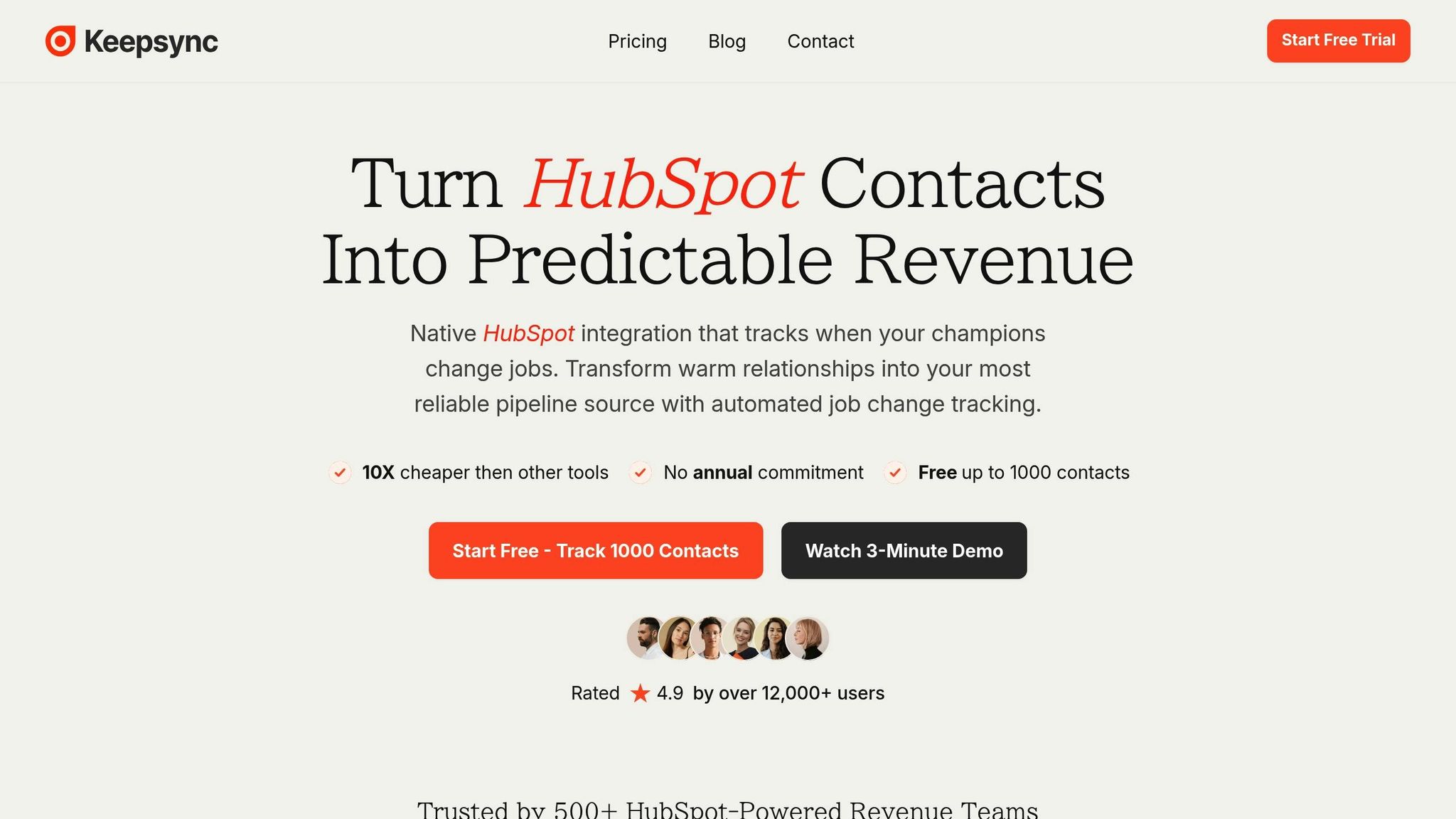
Once your CRM is ready, automating job change detection becomes a game-changer for keeping up with critical movements in real time. With HubSpot CRM in place, KeepSync steps in to monitor over 30 data sources - like LinkedIn, company websites, and press releases - to track when your key contacts switch roles. The platform performs weekly checks to ensure updates are timely [1]. Why does speed matter? Missing the first couple of weeks after a champion's job change often means losing a deal [1]. This automated detection ensures your outreach stays sharp and perfectly aligned with HubSpot.
Getting KeepSync connected to HubSpot is quick and hassle-free. No developers or technical expertise needed. The native integration takes less than five minutes to set up, and it automatically imports your contact lists [1]. By building on the CRM setup, this integration ensures a smooth monitoring and follow-up process. Once synced, KeepSync tracks your segmented lists using a three-step verification process to maintain accuracy. For executive-level updates, it even adds a layer of human verification to avoid false positives [1].
Marcus Rodriguez, RevOps Manager at Streamline Analytics, shared his experience:
We were blind to job changes with monthly LinkedIn checks. Now, we're first to reach out [1].
The platform boasts a 94% accuracy rate in job change detection, catching up to 89% of job moves that manual tracking would typically miss [1].
You can configure real-time alerts through Slack, email, or HubSpot to stay on top of high-value job changes [1]. Slack is ideal for urgent updates, ensuring your team gets notified instantly, while email works well for broader monitoring needs. The Starter plan includes email alerts and webhooks at no additional cost, while the Team plan ($149/month) adds Slack integration [1].
Sarah Kim, Director of Sales at Velocity Commerce, saw the benefits almost immediately:
The ROI was immediate. Within 45 days we had closed two deals from former customers who moved to bigger companies. Our SDRs love it because these are actual warm leads, not cold calls [1].
Real-time alerts give your team the edge, allowing them to reach out while the lead is still "warm" and adjusting to their new role. These alerts rely on accurate, up-to-date data, which KeepSync enriches automatically.
When KeepSync identifies a job change, it doesn’t just notify you - it updates HubSpot with verified information like new email addresses, direct phone numbers, and updated technographics [1]. This automatic enrichment keeps your CRM fresh and ready for action, eliminating the need for manual updates.
Julia Chen, VP Sales Operations at Nexus Software, highlighted the impact:
With 1,500+ customers, manually tracking job changes was impossible. We were leaving money on the table every month. Now it's fully automated and integrated into our HubSpot workflows [1].
Beyond basic updates, KeepSync also provides buying committee mapping, helping you spot other decision-makers within the contact's new company [1]. This added layer of insight ensures your outreach strategy stays effective and targeted.
HubSpot workflows make it easy to automate responses to job change alerts. When KeepSync identifies a job change and updates your HubSpot CRM, workflows spring into action - whether it’s enrolling contacts in sequences, assigning leads to the right team member, or sending notifications through Slack. These automations leverage your CRM data and real-time updates to help you capitalize on job change opportunities without missing a beat.
Workflows can be set up to instantly enroll flagged contacts into tailored sequences. For example, when a former advocate transitions to a new company, you can trigger a "Welcome to the New Role" sequence that highlights how your solution aligns with their new position. Additionally, workflows can automatically generate new deal records, complete with critical job-change details like the contact's verified new email (boasting over 97% deliverability) and updated company information. This eliminates the hassle of manual data entry. It’s worth noting that former champions and power users often convert at rates 3–6 times higher than cold leads [1].
Workflows can also streamline lead assignment based on factors like ICP (Ideal Customer Profile), territory, or technographics. For instance, "Former Champions" can be routed directly to Account Executives for potential expansion deals, while "Closed-Lost Decision Makers" might be directed to SDRs for fresh logo opportunities. You can even score leads based on how well their new company fits your target profile. A contact joining a Fortune 500 company in your preferred market might get fast-tracked, while someone moving to a smaller business might follow a different nurturing path [1].
Use workflows to notify your Customer Success team to reconnect with former champions and proactively address churn risks. When these champions move to new companies, your sales team gets notified to explore expansion opportunities. The impact can be game-changing: Cobalt added $1.7M to its pipeline by tracking former champions, representing 8% of all new logo acquisitions. Similarly, UserTesting closed over $1M in fresh business by re-engaging former users, and Lattice generated $6.7M in pipeline while achieving a 40X ROI on their tracking initiatives [1].
Using timely job change alerts, KeepSync and HubSpot make it easier to measure how automation enhances sales performance. By tracking pipeline metrics tied to job change alerts, you can clearly see the impact. HubSpot's analytics, paired with KeepSync's built-in reporting, help quantify the pipeline growth directly linked to these alerts.
In HubSpot, you can create custom views to focus on contacts flagged for job changes. For example, set up a view that filters for contacts marked as "No longer at Company." You can segment these contacts into groups like former champions, closed-lost decision-makers, or power users. These segments make it easier to identify trends - such as which industries or company sizes generate the most opportunities when contacts change jobs. Dive deeper by pulling metrics like email open rates, click-through rates, and reply rates for these job change lists. Then, compare these metrics against your standard cold outreach results to spot what’s working best for your team [7].
To see the real value of job change leads, compare their performance against traditional outreach. Key metrics to monitor include time to close, win rates by lead source, and pipeline velocity - this measures how many opportunities are created per job changer contacted. Job change leads often outperform cold outreach, delivering 2.3 times higher opportunity conversion rates [7]. Additionally, track the time from the initial job change alert to the first closed deal. Most teams notice results within 60 days, with warm relationships from job changes converting 3 times faster than cold outbound leads [1]. Use HubSpot dashboards to visualize these sales cycle improvements. Tag deals with "Source: Job Change Alert" to calculate accurate customer acquisition costs, giving you a clear picture of how automation is driving results [7].
The ROI benefits highlight why investing in KeepSync makes sense. The platform offers three pricing plans tailored to different team sizes:
Teams using KeepSync typically experience 10–79X ROI within 12 months, making even the higher-tier plans a smart investment. The pipeline generated from tracking job changes often uncovers opportunities that would’ve otherwise slipped through the cracks [1].
This article highlights how automated tracking can reshape sales outreach. By tracking buyers' job changes, you unlock a powerful revenue opportunity. Without this system, a staggering 89% of these moves go unnoticed, meaning you risk losing connections with key champions who could open doors to new accounts [1].
Here’s the kicker: past buyers are 5x more likely to convert into closed-won revenue compared to cold leads [8]. Even better, they close deals 3x faster [1].
Setting up KeepSync with HubSpot is quick - just about five minutes - and the results speak for themselves. Sarah Kim, Director of Sales at Velocity Commerce, shared her experience:
The ROI was immediate. Within 45 days we had closed two deals from former customers who moved to bigger companies. Our SDRs love it because these are actual warm leads, not cold calls [1].
Automation takes the hassle out of manual tracking. With HubSpot workflows, you can trigger personalized outreach, route leads to the right reps, and flag contacts who’ve moved to companies that fit your ideal customer profile. This streamlined process not only prevents churn but also drives new revenue. In fact, it can help convert 36% of closed-lost deals when timing aligns, all while ensuring you stay ahead of stakeholder departures [1].
Tracking former customers who have moved to new jobs can be a game-changer for your sales strategy. Why? They're far more likely to engage with you compared to cold leads. Start by identifying updates in your CRM, such as changes to Job Title or Company Name - especially for key decision-makers or influencers.
Pay close attention to executives and managers during their first 90 days in a new role. This is often when they set priorities and allocate budgets, giving you a prime window to reconnect and offer solutions tailored to their new challenges.
To keep tabs on job changes in HubSpot, pay close attention to fields like Job Title and Company Name, making sure they stay up-to-date. You can also create custom properties like Previous Company and Job Change Date to make tracking more effective. These additions not only improve the accuracy of your CRM but also allow you to automate workflows, ensuring timely and personalized follow-ups.
During the first 90 days of a new job, people are much more open to connecting. This period offers a prime opportunity to reach out, as they're often eager to establish relationships and explore fresh opportunities. Take advantage of this window to make meaningful connections while they're most receptive.