
Digital Marketing
·
April 10, 2026
How SaaS Companies Handle Billing Disputes & Chargebacks
Learn how SaaS billing disputes happen, what triggers chargebacks, and how both sides can resolve them faster.

Why outbound reply rates are falling and how clean data, signal-based timing, deep personalization, and multi-channel outreach can fix them.


Your outbound response rates are dropping, and here’s why:
The main culprits? Message overload, bad contact data, generic outreach, and poor timing. Buyers are overwhelmed, and outdated tactics no longer work.
However, top-performing teams achieve 12%+ reply rates by addressing these issues. They focus on:
Fixing these pain points - while tracking metrics like positive reply rates and cost per meeting - can help revive your pipeline and boost results.

Outbound Sales Response Rate Decline Statistics 2019-2026
If your outreach efforts aren’t hitting the mark, you’re not alone. The modern sales environment has created new hurdles that make connecting with prospects trickier than ever. Let’s break down the key reasons response rates are dropping and set the stage for actionable solutions.
Prospects are overwhelmed. The average decision-maker is bombarded with over 15 cold emails per week - adding up to more than 780 emails annually. And that’s just emails. Add LinkedIn messages, phone calls, and other outreach, and you’ve got a recipe for overload [2].
Automation tools and AI have made it easy to send messages at scale, but this "spray-and-pray" approach often backfires. Buyers can spot generic templates from a mile away and have learned to tune them out.
"I don't even read messages that look like templates anymore. If the first sentence applies to 1,000 other people, I archive it immediately. I only reply if it feels like it was written only for me." - SaaS founder in EMEA [3]
The stats are telling: 64% of B2B buyers feel inundated with promotional emails, and they respond to less than 10% of the messages they receive [6]. Your outreach isn’t just competing with other sales efforts - it’s fighting for attention in a sea of internal emails, meetings, and endless notifications.
Bad data is a silent killer for outreach campaigns. Sending messages to outdated or incorrect email addresses wastes time and energy while damaging your email deliverability. High bounce rates hurt your sender reputation, leading to spam filters blocking even valid emails [4][8].
And the financial cost? It’s massive. Businesses lose an average of $9.7 million annually due to bad data, including missed opportunities and wasted productivity [9].
"Automation is powerful, but it's only as good as your data. Sending to unverified or outdated addresses crushes deliverability - which means your emails never reach inboxes." - James Milsom, Head of Marketing @ Hunter.io [8]
To avoid this, keep bounce rates below 2% [4]. Teams that prioritize clean, up-to-date data and maintain domain health can see reply rates improve by 15–20% [4].
Relevance is everything. A whopping 71% of ignored emails fail because they lack relevance, and 43% of decision-makers cite poor personalization as the main reason they dismiss outreach [2].
Basic personalization - like using someone’s name or company - just doesn’t cut it anymore. Buyers now expect messages tailored to their specific circumstances, such as recent company news or challenges tied to their role.
The difference in performance is striking. Generic emails average a 2.1% reply rate, while messages with tailored insights jump to 6.5% or more - a 210% boost [2]. Taking personalization even further, with deep context and relevance, can push reply rates to 8–12% [2].
But be careful with AI-generated personalization. Overly polished messages can feel robotic and raise red flags.
"The more perfect your cold email is... the more likely people assume ai wrote it." - Ry Walker, Founder [5]
Even the best-crafted messages can flop if they land at the wrong time. Many sales teams rely on static contact lists and pre-set schedules, ignoring real-time signals that indicate when a prospect might actually be ready to engage. The reality? Only about 5% of your target market is actively looking to buy at any given moment [6].
Timing matters. Intent-driven messaging - based on real signals like job changes, company news, or hiring trends - can deliver three times higher response rates [10]. Teams that combine signal-based timing with a multi-channel strategy see response rates soar by 287% compared to those sticking to a single channel [7].
These challenges highlight why traditional outreach methods are falling short. By addressing these pain points, you can set the foundation for more effective strategies moving forward.
Boost your response rates by leveraging real-time signals and HubSpot's automation tools.
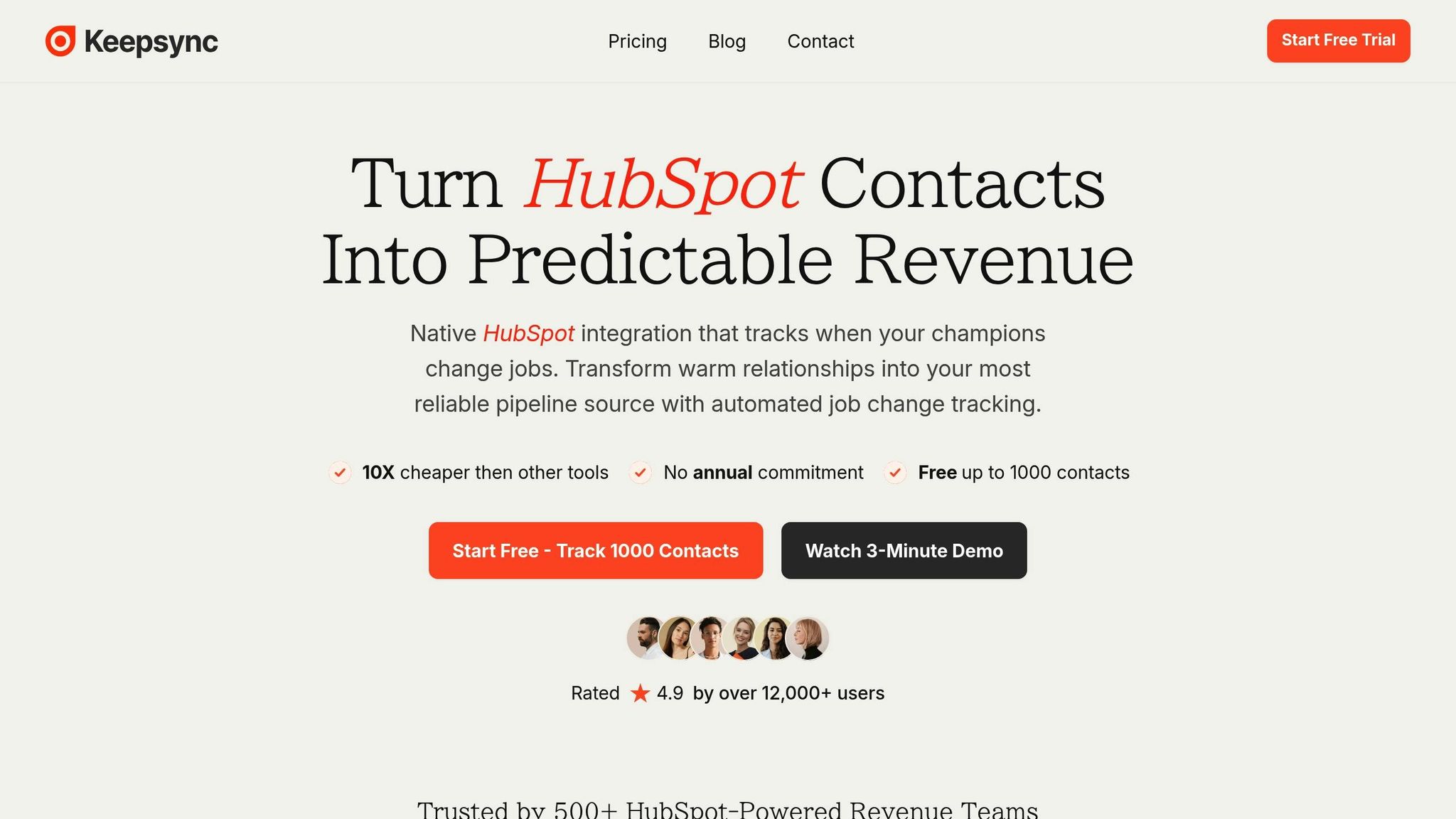
Job changes are a powerful trigger in B2B sales. When someone steps into a new role - especially within their first 90 days - they’re often rethinking processes, selecting tools, and actively looking for solutions to make an impact fast [12]. KeepSync integrates with HubSpot to monitor your contacts across 30+ data sources with 94% accuracy, sending you real-time alerts when a job change occurs. This allows you to engage during a critical decision-making window, increasing reply rates from 2.1% to 8–12% with personalized outreach [2].
Instead of a generic "Congrats on the new role" message, tie your outreach to a relevant business outcome. For example, you could say:
"As you scale your new sales team at [Company], I wanted to share how we helped [Similar Company] maintain pipeline visibility during a similar transition" [12].
This approach transforms your message into a value-driven conversation, addressing a key business need during a pivotal moment for the prospect.
Once you’ve identified these opportunities, automate the process to ensure consistent and timely follow-up.
Automation takes care of timing and personalization, ensuring your outreach hits the mark. Use HubSpot Workflows for tasks like lead routing and enrollment triggers, and Sequences for outreach steps such as emails, calls, and LinkedIn messages [11].
Set up a workflow to automatically enroll contacts when KeepSync detects a job change. Then, create a sequence with 6–10 touches over a 2–3 week period, using a mix of channels like email, LinkedIn, and phone [11].
"The outcome is a high-quality conversation. This means we first define the ideal customer profile and the trigger that makes outreach timely. Without clarity on who and why now, no sequence performs."
– Joey Gilkey, CEO, TitanX
To keep your messages personal, require a brief manual note before launching each sequence. This hybrid method balances efficiency with a human touch. Also, set workflows to automatically unenroll contacts once they reply or book a meeting - nothing ruins credibility faster than unnecessary follow-ups.
Timing is everything when it comes to outreach. Moving beyond rigid schedules, top-performing teams now rely on behavior and relationship triggers - like pricing page visits, content downloads, or job change alerts from KeepSync - to pinpoint the best moments to connect [13].
For email timing, aim for mid-morning (9–10 AM) or evening (7–10 PM) on Tuesdays or Thursdays, avoiding Mondays and late Fridays. AI-driven tools can further refine this timing, boosting open rates by 35–50% [13].
If you’re running a multi-channel sequence, try a schedule like this:
Limit email-only outreach to three attempts before switching channels to avoid diminishing returns. By using signal-based "Earned Outbound" strategies like this, you can achieve response rates of 15–25%, far outpacing the 1–5% typical of traditional cold emails [1]. This approach ensures your outreach is both timely and relevant, addressing the common pitfalls of generic, poorly timed messaging.
Once you’ve fine-tuned your outreach strategies, the next step is measuring how well they’re working and making adjustments. By analyzing performance, you can identify what’s working, drop ineffective tactics, and double down on strategies that lead to meetings.
Pipeline analytics tools, like those offered by KeepSync, can help you zero in on the stages where your outreach succeeds - or falls short. Instead of guessing which leads are worth pursuing, you can analyze conversion rates to identify bottlenecks. For instance, if you notice a low conversion rate between Lead Nurturing and Marketing Qualified Leads (MQLs), it might indicate issues with your qualification process or engagement strategy [16].
A great example of this in action comes from COPA‐DATA, which used HubSpot's prospecting tools in 2026 to boost captured sales activities by 5× and speed up MQL-to-SQL qualification by 3× [18]. This kind of visibility allows for smarter, data-driven decisions.
Another key metric to monitor is "time-in-stage." If a prospect stays stuck in the same pipeline stage longer than your average deal cycle, it could be a sign to either re-engage with a fresh approach or disqualify the lead entirely [16][17]. Features like job change alerts from KeepSync can also help you act quickly when stalled contacts move to new companies.
Beyond identifying patterns, it’s important to evaluate the financial impact of your outreach efforts to ensure you're getting the most out of your investment.
Start by calculating your outreach ROI. Add up all related costs - like software subscriptions, CRM tools, lead data credits, and SDR hourly rates - and divide by the number of meetings booked to find your cost per meeting [14][20]. For startups, aiming for a cost per meeting under $150 in the first month is a solid benchmark before refining further [14].
One critical metric to track is your Positive Reply Rate, which measures the percentage of responses that show genuine interest. This metric is 33% more predictive of booked meetings than the overall response rate [15].
"Optimizing for positive replies has 33% higher correlation with booked meetings than response rate on its own." - Meghan Donovan, Sales Sequence Specialist at Outreach [15]
Another helpful KPI is your Meetings Rate, calculated by dividing the number of meetings booked by the total emails delivered. While the average reply rate for cold email campaigns in 2026 was 3.43%, top performers achieved rates of 10.7% or more [4]. Using a multi-channel strategy - combining email, phone, and LinkedIn - can further boost your conversion rate by about 30% compared to sticking with a single channel [19].
Lower response rates are often the result of outdated data, bland messaging, and poorly timed outreach. The key difference between average and standout performers lies in relevance. The old "spray and pray" approach just doesn’t cut it anymore. Teams that focus on deep personalization and signal-based timing see far better reply rates.
Rather than overhauling your entire process, focus on practical improvements. For instance, use tools like KeepSync to track job changes, allowing you to connect with prospects during key buying windows. Leverage platforms like HubSpot to automate workflows and ensure outreach happens at the right moment. Pay attention to metrics that matter - like positive reply rates, cost per meeting, and time-in-stage - to identify what’s driving success and where adjustments are needed.
Here's a powerful stat: AI-driven personalization can increase response rates by 58% and boost qualified conversations by 47% [21]. Add multi-channel strategies to the mix, and you'll outperform email-only approaches by a mile. These aren’t minor tweaks - they’re game-changers that could turn a struggling pipeline into one that consistently hits its targets.
The quickest way to connect with prospects who are ready to make a purchase is by spotting intent signals. These can include things like recent job changes, adopting new technologies, hiring activity, or even posts that align with your offering. By understanding these signals, you can tailor your outreach to match their current needs, making it far more likely they'll engage with you.
To tackle deliverability problems linked to poor contact data, it's essential to keep your contact list clean, accurate, and up-to-date. Start by using email verification tools to identify and remove invalid or inactive addresses. Incorporate data enrichment processes to refine your contact details and ensure they’re precise. Automating validation during data entry can also prevent errors right from the start. These practices help maintain high-quality data, lower bounce rates, and boost the chances of your emails landing in the inbox.
Meeting Rate (or qualified meeting rate) goes beyond just tracking reply rates. This metric shows how many outbound interactions result in booked, meaningful meetings - an important indicator of their contribution to the sales pipeline. By focusing on this, you can gauge whether your outreach efforts are successfully creating valuable opportunities for your team.