
Digital Marketing
·
April 10, 2026
How SaaS Companies Handle Billing Disputes & Chargebacks
Learn how SaaS billing disputes happen, what triggers chargebacks, and how both sides can resolve them faster.

Choose between phone-verified contact data for cold outbound or relationship intelligence tracking job changes to power warmer, higher-converting pipelines.

Cognism and UserGems are two leading data enrichment platforms, but they cater to different sales strategies. Here's a quick breakdown:
Key Stats:
Quick Comparison:
| Feature | Cognism | UserGems |
|---|---|---|
| Focus | Cold prospecting | Warm lead generation |
| Key Feature | Phone-verified Diamond Data® | Job change tracking |
| Data Accuracy | 98% for Diamond Data® | 40% better than ZoomInfo/LinkedIn |
| Best For | EMEA markets, outbound sales | Relationship-based selling |
| Pricing | Custom quotes, starts ~$16,500/year | Transparent tiers: $33,000–$120,000/year |
Bottom Line:
Choose Cognism for precise contact data and outbound efforts. Opt for UserGems if you prioritize reconnecting with past customers and champions for faster conversions.
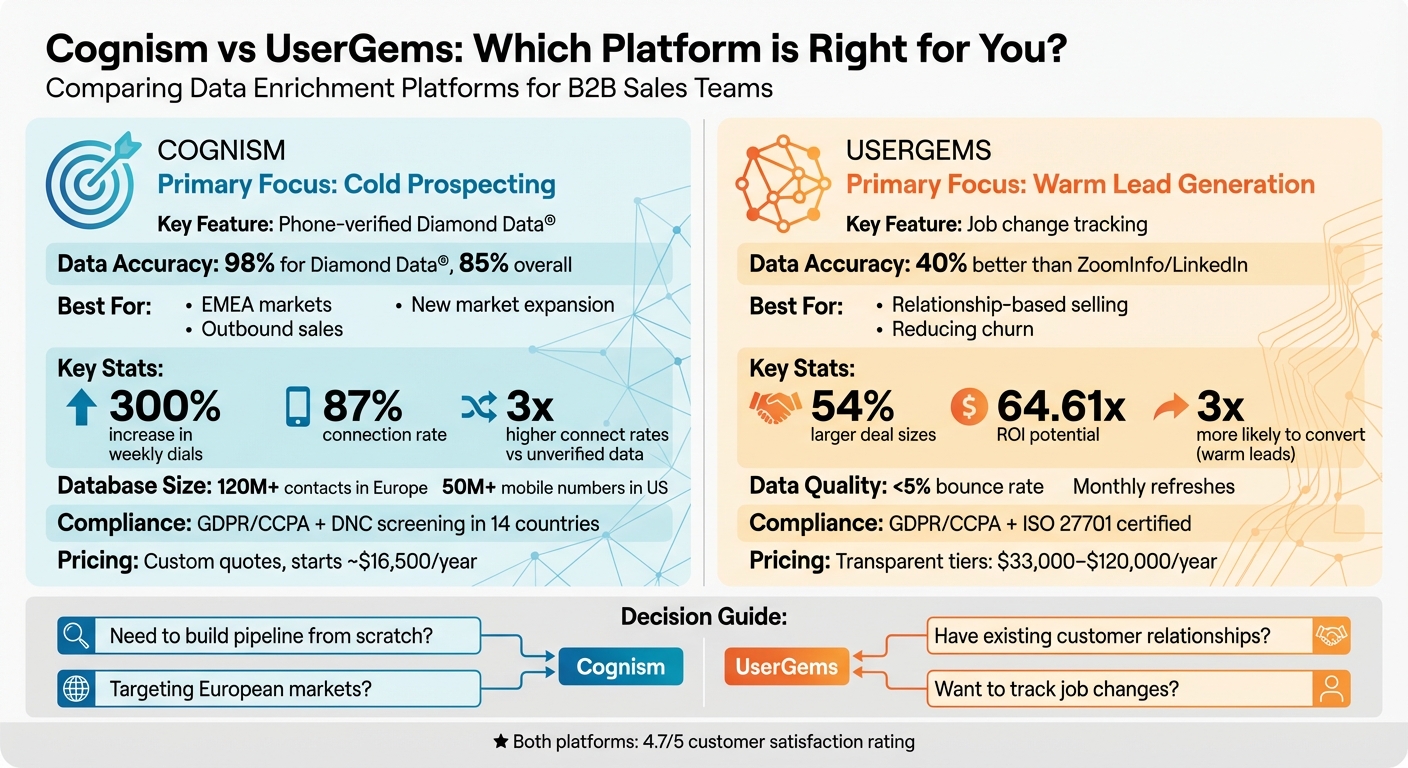
Cognism vs UserGems: Feature Comparison and Key Statistics

Cognism is a platform built to streamline B2B lead generation, account management, and data enrichment. Trusted by over 4,000 revenue teams worldwide, it’s tailored for large enterprises and fast-growing companies that rely on precise contact data to power their outbound sales efforts [6][11].
One standout feature is its Diamond Data®, which offers phone-verified mobile numbers validated by experts. This boosts direct connections with decision-makers. For instance, SingleStore reported a 300% increase in weekly dials after adopting Cognism in 2022 [6][11].
The platform also tracks hiring trends, funding rounds, and leadership changes to identify buying intent, enabling sales teams to reach out at the right time. Meanwhile, its AI-powered Sales Companion simplifies research by delivering one-click business summaries and contact recommendations, saving sales reps hours of effort [6].
Cognism is particularly strong in European markets, boasting a vast database of decision-makers in the UK and EMEA regions, alongside global coverage. Unlike some competitors, it doesn’t charge additional fees for accessing international data [6][7]. Every package includes GDPR and CCPA compliance, as well as Do-Not-Call (DNC) screening across 14 countries [6][7].
Let’s take a closer look at the features that make Cognism a go-to platform for sales teams.
Cognism offers more than just accurate data - it’s equipped with tools designed to supercharge prospecting efforts.
"It's like a companion that does a lot of thinking for me, highlighting the contacts that are important for the team to reach out to... saving them time and making them more effective." [11]
Cognism stands out for its data accuracy and results-driven approach. For example, Justin Humphreys, Head of Revenue Operations at Bright Network, ran a procurement test in 2026 and found Cognism’s data accuracy to be 85%, significantly outperforming their previous provider, ZoomInfo, which had 50% accuracy. This led to a 10-15% improvement in contact data deliverability [7].
Even in the U.S., Cognism’s mobile data coverage shines. Paul Thomas, CEO of Lead Forensics, compared it to five competitors and found Cognism delivered superior results, boosting his team’s overall performance by 50% [6][10].
Another major strength is its compliance capabilities. Cognism adheres to GDPR and CCPA regulations and checks more DNC lists than any other provider. Ruth Holmes, Chief Marketing Officer at Newable, highlighted this advantage:
"We were able to build up a GDPR-compliant database of contacts which we could then start targeting." [6]
Customer support is another high point, with users benefiting from a 20-second average response time on live chat and a 99% satisfaction score [2].
UserGems takes a fresh approach to pipeline generation by leveraging relationship intelligence rather than relying on traditional cold outreach. The platform tracks when your past customers, champions, or power users switch jobs and notifies your sales team, giving them a chance to reconnect at these new companies [12].
The concept is simple but powerful: instead of cold-calling people who have no idea who you are, you reach out to those who already know and trust your product. These "warm leads" are three times more likely to convert than cold prospects [12]. Without automation, most companies miss out on 85% of job-change opportunities [12].
Beyond tracking job moves, UserGems keeps tabs on other buying signals like internal promotions, funding rounds, and hiring trends [12]. And the results? They're impressive. Outreach, for example, tracked over 5,000 job changes in a year using UserGems. This effort led to 101 new opportunities, a $1.2 million pipeline, and an 8x return on investment (ROI) [4]. Another example: Cobalt closed a $95,000 deal in just three weeks after a former champion moved to a new company [12]. On top of that, the platform helps customer success teams by flagging key contacts who leave a customer account, allowing teams to act quickly and maintain those relationships [12].
These features form the backbone of UserGems' approach, as outlined below.
UserGems offers a suite of tools to automate relationship-driven selling:
These features work together to drive revenue growth and expand pipelines.
UserGems excels at turning existing relationships into new revenue opportunities. Deals involving former champions tend to have 54% larger deal sizes, 114% higher win rates, and 12% shorter sales cycles [12].
The platform's strength lies in automating pipeline generation. Take Mimecast, for example. Revenue Operations Manager Gar Smyth used UserGems to ensure no leads slipped through the cracks, resulting in $18 million in new business pipeline [12]. As Smyth explains:
"UserGems is a prospecting machine. It automates the end-to-end. It's not just providing these are the people you should contact, you're saying these are the people in these accounts that look like they're going to buy soon."
- Gar Smyth, Revenue Operations Manager, Mimecast [16]
UserGems also stands out with its ability to track relationships, preserving the full context of past interactions. This allows for personalized, meaningful outreach instead of generic messaging. Derek Kelliher, Sr. Director of Strategic Sales at SmartBear, put it this way:
"UserGems is just a technology that makes sense for any business that creates loyal customers/users. The automation capabilities to not only track job changes but then enroll in personalized outreach is truly differentiated."
- Derek Kelliher, SmartBear [14]
For account-based selling teams, UserGems identifies multiple stakeholders within a buying committee, contributing to win rates increasing by up to 5x and deal sizes growing by 57% [15]. At SAP LeanIX, this approach led to a 15x ROI in closed-won revenue [15].
Cognism and UserGems take very different approaches to enriching sales pipelines. Cognism boasts a database of over 120 million contacts in Europe and 50 million mobile numbers in the U.S. [4]. Its strength lies in cold outbound prospecting, equipping teams with the data needed to reach decision-makers who may not yet know about them. On the other hand, UserGems zeroes in on relationship intelligence, tracking when past customers and champions change jobs, allowing businesses to reconnect with them at their new companies [1][4]. Let’s take a closer look at how these platforms handle data verification, AI tools, and signal detection.
When it comes to data enrichment and verification, the two platforms stand apart. Cognism uses a rigorous 16-step process, including manual phone verification, to ensure its Diamond Data® reaches 98% accuracy [19]. This hands-on approach has been shown to triple connect rates for teams [2]. UserGems, in contrast, refreshes its data monthly and maintains bounce rates under 5%. It claims to be 40% more accurate than platforms like LinkedIn Sales Navigator or ZoomInfo for tracking job changes [4]. For example, when Bright Network switched from ZoomInfo to Cognism, they saw their data accuracy improve from 50% to 85% [7].
Both platforms also leverage AI to enhance outreach, but they do so in unique ways. Cognism’s Sales Companion uses AI for natural-language searches and tailored outreach messaging, helping sales teams pinpoint decision-makers who are ready to buy [2][7]. Meanwhile, UserGems’ Gem-E functions as an AI SDR agent, monitoring accounts for buying signals, scoring prospects, and drafting personalized messages [3][4]. At Smartling, Gem-E reduced manual tasks for SDRs by 97%, resulting in $1.8 million in direct pipeline generation [15].
Signal detection is another area where these tools differ significantly. Cognism focuses on account-level triggers, such as hiring trends, funding announcements, and Bombora-powered intent data, which highlight companies actively researching solutions [18][4]. UserGems, however, prioritizes relationship signals like job changes, promotions, and new roles at target accounts [4][17]. For instance, when OneUp Sales adopted Cognism, SDR Manager Marc Parsons noted that 60% of their deals were influenced by mobile numbers sourced from the platform, including the company’s largest deal ever [18]. These differences underscore how each tool can uniquely contribute to driving sales pipeline growth.
| Feature | Cognism | UserGems |
|---|---|---|
| Primary Focus | Global B2B lead generation and compliance | Job change tracking and relationship intelligence |
| Data Enrichment | API/CSV; firmographics and technographics | CRM-native; job history and contact updates |
| AI Capabilities | Sales Companion (AI for search and outreach) | Gem-E (AI for buying signals and messaging) |
| Data Verification | 16-step process with manual phone checks | Monthly refreshes; automated tracking |
| Signal Detection | Intent data (Bombora), hiring, funding alerts | Job changes, promotions, new roles |
| Data Accuracy | 98% for Diamond Data®; 85% overall [19][7] | 40% more accurate than LinkedIn Sales Navigator or ZoomInfo [4] |
| Compliance | GDPR/CCPA; DNC scrubbing in 14 countries [4][7] | GDPR/CCPA compliant; ISO 27701 certified [1] |
| Best For | High-volume cold outbound, especially in EMEA | Warm lead generation from existing relationships |
Integrating HubSpot effectively is a key step in enhancing CRM data, and both Cognism and UserGems bring their own methods to the table. Cognism offers a simple two-click connection for real-time data enrichment, helping keep your CRM organized and up-to-date. With this setup, you can push quality leads into HubSpot, enrich contacts effortlessly, and access prospect details through a Chrome Extension. Filipa Enes, Sales Administrator at Simpleshow, highlighted its impact:
"Cognism's automatic integration with Salesforce [and HubSpot] means I no longer spend time manually inserting leads to our CRM. It merits 5 stars!"[9]
UserGems, on the other hand, connects via a dedicated HubSpot integration user, which takes about a minute to set up[13]. This platform monitors HubSpot lists to track job changes and automatically creates new contact records when past champions transition to new companies[13]. During onboarding, a Customer Success Manager introduces custom properties like "UG - No Longer at Company" and "UG - Past Relationship Type" to ensure the relationship history between roles is preserved[13].
These integration methods pave the way for distinct automation workflows. Cognism focuses on automating lead routing and data cleaning, assigning leads based on precise territory data[2]. One Business Development Executive shared that this saved them roughly 10 hours of admin work each week[8]. Meanwhile, UserGems uses signal-based workflows to trigger custom sequences when a contact changes jobs[13]. For example, Smartling utilized this approach to generate $1.87 million in new pipeline revenue and achieved a 64.61× ROI[3].
Cognism emphasizes speed with its instant setup, while UserGems provides a more personalized onboarding experience led by a Customer Success Manager[13][4]. During implementation, UserGems requires defining buyer personas and uploading data, aiming for at least 50% alignment between AI-generated personas and titles in open opportunities[13].
Here’s a side-by-side comparison of their HubSpot integration features:
| Feature | Cognism | UserGems |
|---|---|---|
| Setup Process | Two-click connection[9] | Connect integration user; ~1 minute[13] |
| Primary Focus | Real-time enrichment and accuracy[9] | Signal-based lead generation from job changes[13] |
| Automation | Lead routing and data cleansing[2] | Sequences triggered by job changes[13] |
| Data Synchronization | Real-time updates for firmographics and technographics[8] | Bi-directional list reading; relationship mapping[13] |
| CRM Benefits | Prevents CRM clutter; Chrome Extension overlay[9][2] | Maintains history; avoids duplicates[13] |
| Custom Properties | Standard B2B data fields[20] | "UG" signal properties[13] |
| Onboarding Support | Training and 24/7 live chat[20] | CSM-led sessions[13][4] |
One major difference between these platforms is how they handle pricing transparency. UserGems openly lists its monthly and annual rates, making it easier for businesses to budget without surprises[21]. On the other hand, Cognism requires a demo before providing a customized quote, meaning you won’t know the exact cost until after that step[22][23]. This side-by-side comparison helps clarify what each platform offers for the price.
Let’s break it down further. UserGems has three annual subscription tiers - Core, Advanced, and Elite. These tiers allow for record limits ranging from 30,000 to 180,000, with a one-time setup fee of $3,000 to $10,000[21]. Each plan also caps the number of admin users, end users, and records you can manage[21]. A standout feature? UserGems provides a money-back ROI guarantee, promising returns of 1x to 3x your investment in closed-won revenue, depending on your plan[21].
Cognism, on the other hand, uses a pricing model that combines a platform fee with per-user licenses[22][24]. Estimated annual costs range from $16,500 for mid-sized teams to over $90,000 for enterprise plans[22]. This structure may appeal to larger teams needing extensive data access. The platform fee covers essentials like maintenance and onboarding, while the per-user licenses add to the total cost[24]. Cognism also boasts unrestricted data access, meaning there are no limits on credits or records[24]. For those willing to pay for premium features, Cognism offers add-ons like phone-verified Diamond Data® (with 98%+ accuracy) and advanced intent data for higher-tier plans[22][23].
Katherine Aybar, Head of Growth at IGLeads, highlighted that Cognism’s pricing “ranges from $125 to over $2,000 per month depending on your plan and number of users”[22]. Both platforms operate on annual contracts, so you’re committing for the long haul[21][22].
| Feature | Cognism | UserGems |
|---|---|---|
| Pricing Transparency | Low[22][23] | High[21] |
| Base Annual Cost | $16,500–$90,000+ (estimated)[22] | $33,000–$120,000[21] |
| Pricing Model | Platform fee + per-user license[22][24] | Tiered by users and records[21] |
| Data Access | Unrestricted[24] | 30k–180k records per tier[21] |
| Implementation Fee | Included in platform fee[23] | $3,000–$10,000 (one-time)[21] |
| Contract Terms | Annual only[22] | Annual (monthly rates shown)[21] |
| ROI Guarantee | Not specified | 1x–3x money-back guarantee[21] |
| Premium Features | Diamond Data®, Intent topics (add-ons)[22][23] | Contact-level Intent, Ad Sync (add-ons)[21] |
Here's a breakdown of the strengths and weaknesses of each platform to help you make an informed choice.
Cognism stands out for its phone-verified contact data and strong compliance measures. Its Diamond Data feature provides manually verified mobile numbers, enabling sales teams to connect with about 87% of their target audience[3]. The platform also ensures compliance with GDPR, CCPA, and global Do-Not-Call lists, which helps protect domain reputation during outbound campaigns[4]. However, users have noted some shortcomings, particularly outdated contact information in regions like Germany and Asia[4]. For instance, Sam A., an Account Executive, shared:
"Many contacts I found had left the company or had no numbers, especially in Germany"[4].
Additionally, the platform's Chrome extension has been criticized for requiring frequent re-sign-ins[4], and its 60-day cancellation policy can be a sticking point for some customers[4].
On the other hand, UserGems shines in leveraging relationship intelligence to identify and convert warm leads, especially when integrated with Salesforce. The platform accurately tracks job changes, reportedly performing over 40% better than LinkedIn Sales Navigator or ZoomInfo[4]. Hannah Hawkesely, Senior Sales Manager at MOO Prints, remarked:
"UserGems has given us a new customer base that we previously couldn't tap into. It's made a very manual process more automated, which has increased our capacity"[4].
That said, UserGems has its limitations. Users relying on CRMs like HubSpot may find its custom workflows for tracking job changes less flexible[5]. It also lacks context about the size of a contact's new company or the seniority of their new role[1], and costs can rise significantly as your sales team grows[5].
Both platforms boast a 4.7/5 customer satisfaction rating[1]. While Cognism excels at providing high-quality, verified global data, UserGems is ideal for automating relationship-based lead tracking. The right choice depends on whether you value verified contact data or a relationship-driven pipeline more.
| Platform | Pros | Cons |
|---|---|---|
| Cognism | Phone-verified Diamond Data with 87% connection rates[3]; GDPR/CCPA/DNC compliance[4]; Strong EMEA coverage[3]; Real-time intent data and sales triggers[4] | Regional data gaps in Germany and Asia[4]; Unreliable Chrome extension[4]; Strict 60-day cancellation policy[4] |
| UserGems | Tracks warm leads 3x more likely to convert[4]; 40%+ more accurate than LinkedIn/ZoomInfo[4]; Under 5% bounce rate[4]; Automated job change workflows[3] | Heavily optimized for Salesforce over other CRMs[5]; No context on new company size or role seniority[1]; Costs escalate with team growth[5]; Less effective without an existing customer base[4] |
If you're starting from scratch and need to build pipelines, Cognism is your go-to. It's especially effective for cold prospecting and expanding internationally, thanks to its phone-verified Diamond Data and strong GDPR compliance. For example, Amanda Newman, SDR Manager at UserEvidence, shared that Cognism delivered a 98% match rate and a 22% call connect rate, which led to a 33% pipeline increase in just three months[2].
On the other hand, UserGems shines when it comes to leveraging existing relationships. By tracking job changes, it helps trigger warm lead outreach. At Smartling, this approach generated $1.87 million in new pipeline and $1.29 million in closed revenue, delivering a massive 64.61x ROI. Similarly, Tipalti used UserGems to re-engage past customers, creating a $4 million pipeline and achieving a 23x ROI in closed-won revenue[3].
Your CRM setup also plays a crucial role in getting the most out of these tools. UserGems works best with Salesforce, while Cognism integrates with a broader range of platforms, including Salesforce, HubSpot, Pipedrive, and Microsoft Dynamics[1][4].
If you're targeting European markets or need GDPR-compliant mobile numbers for cold calling, Cognism's solid EMEA presence makes it a strong choice. For mid-market tech companies focused on reducing churn and converting warm leads, UserGems offers a more targeted approach. Its leads are 3x more likely to convert than cold prospects. Teams with tight budgets and established customer bases will find value in UserGems' automated job-change playbooks. Meanwhile, teams looking to break into new markets or needing verified contact data for international growth will see greater ROI with Cognism's Diamond Data. Weigh these factors carefully to align your choice with your sales objectives.
Cognism and UserGems offer two distinct solutions for data enrichment, each catering to specific business priorities.
Cognism is all about building detailed and verified profiles. It pulls information from reliable sources like company websites, public records, and press releases. Using AI-powered validation, it ensures the data is accurate and compliant, making it a great choice for large enterprises focused on generating high-quality leads.
UserGems, on the other hand, emphasizes real-time updates. Its system automatically tracks job changes and refreshes contact information in your CRM. This approach helps mid-market teams seize new opportunities quickly while ensuring their buyer details remain accurate.
To sum it up, Cognism delivers rich, verified data for large-scale lead generation, while UserGems focuses on keeping your existing contacts fresh and actionable with automated updates.
UserGems keeps an eye on when a customer, user, or prospect changes jobs and gathers their new contact details, like updated email addresses and phone numbers. This information is then seamlessly updated in your CRM, with notifications sent directly to your sales team. From there, outreach is triggered automatically, enabling you to act fast on this job-change signal and turn it into a warm lead.
Cognism places a strong emphasis on compliance, offering a privacy-first database that aligns with the European Union’s General Data Protection Regulation (GDPR). This ensures adherence to one of the most stringent international data privacy standards. The platform also includes built-in tools to manage consent and support data-subject rights, such as access, correction, and deletion requests.
With a focus on meeting global data protection requirements, Cognism equips businesses with the tools they need to enter new markets while remaining compliant with local laws. These features make it an excellent option for companies dealing with complex international legal frameworks.