
Digital Marketing
·
April 10, 2026
How SaaS Companies Handle Billing Disputes & Chargebacks
Learn how SaaS billing disputes happen, what triggers chargebacks, and how both sides can resolve them faster.

Compare job change tracking vs sales intelligence for HubSpot — re-engage past contacts quickly or use broader data to find new accounts.


When deciding between Job Change Tracking and Sales Intelligence, the choice depends on your sales strategy and goals. Here's the gist:
Both tools integrate with CRMs like HubSpot, but their focus areas differ. If timing and existing relationships are key, Job Change Tracking is your best bet. You can even track customer job changes in HubSpot automatically using workflows. If you’re looking to expand into new markets or identify in-market buyers, go for Sales Intelligence.
Quick Comparison:
| Feature | Job Change Tracking | Sales Intelligence |
|---|---|---|
| Scope | Career transitions (e.g., promotions) | Broad data (firmographics, intent) |
| Best Use Case | Re-engaging past leads | Finding new prospects |
| Data Updates | Real-time or monthly | Quarterly or semi-annual |
| Accuracy | ~94% | 80–90% |
| Budget | Starts at ~$9,500/year | $15,000–$50,000+/year |
If you’re a HubSpot user, KeepSync is a top choice for Job Change Tracking, offering 94% accuracy and automated workflows for as low as $79/mo for 1,000 contacts for 5,000 contacts. For Sales Intelligence, tools like Crunchbase provide broader insights but require a larger budget and setup effort.

Job Change Tracking vs Sales Intelligence: Feature Comparison Chart
FOR HUBSPOT TEAMS
Track Job Changes at 1/10th the Cost
KeepSync monitors your HubSpot contacts for job changes with 94% accuracy. Starting at $79/month. No annual contracts.
Start now →Job change tracking is an automated system that keeps tabs on when your CRM contacts switch companies, get promoted, or take on new roles. Instead of manually scouring LinkedIn profiles, this tool scans a variety of data sources every week and notifies your sales team as soon as a contact makes a career move [10].
Here’s why it matters: studies show that 23%–30% of the corporate workforce changes jobs each year [10][7]. Without automation, your team could miss up to 85%–90% of the opportunities these transitions create [10][13]. The system focuses on contacts already in your HubSpot database, helping you maximize the value of your existing relationships.
Reconnecting with past customers or leads is incredibly effective. Deals with former customers close five times more often, close twice as fast, and boast three times higher win rates [10][12]. When a previous advocate moves to a new company, their trust in your product or service can open doors to new opportunities.
Let’s dive into how this tracking system works within your HubSpot workflow.
The process starts by selecting specific HubSpot lists to monitor, such as closed-won contacts, high-intent leads, or active users. The tool then scans over 30 data sources weekly - LinkedIn and other professional platforms included - to identify profile updates [10][12].
When a change is detected, the system verifies the update by cross-checking LinkedIn URLs and company domains, achieving an impressive 94% accuracy rate [12]. Once verified, the tool updates the contact record in HubSpot, creates a new company profile if necessary, and triggers workflows like reassigning contact ownership, creating tasks, or enrolling the contact in an outreach sequence. These updates integrate seamlessly with HubSpot workflows, ensuring smooth CRM functionality.
Real-time alerts are sent through Slack, email, or directly within HubSpot as soon as a contact changes roles. Timing is everything here: new executives usually allocate 70% of their budget within their first 100 days [10]. Engaging during this window can boost deal closure rates by 63% [1].
This streamlined system enhances lead engagement and helps prevent churn, making it a valuable addition to any sales strategy.
One of the biggest advantages is identifying warm leads at new companies. Take the example of Ben Cauchois, Head of Sales at Seiza, who generated nearly $300,000 in new pipeline within just one month of using job change tracking in 2024. The system highlighted former advocates in new roles, allowing his team to reconnect at the perfect time - when budgets were being allocated [10].
"Implementing tracking of job changes is the easiest and smartest growth hack of the year. It's x10 ROI!" - Hugues Peuchot, Co-founder, Skillup [10]
Another key benefit is preventing missed opportunities with former champions. Research shows that 89% of previous customers don’t return to a vendor on their own when they start a new role [12]. By monitoring these contacts, your team can deliver tailored outreach that builds on shared history, eliminating the need for cold introductions.
The system also automates lead routing through HubSpot workflows. Instead of relying on manual updates, it creates task queues, updates custom objects for reporting, and triggers sequences based on how well a contact’s new company fits your Ideal Customer Profile [12]. This keeps your sales pipeline moving efficiently without adding extra work.
Finally, job change tracking helps reduce churn. When a key contact leaves an existing customer account, your team is immediately notified, giving Customer Success a chance to engage with the new decision-maker before the relationship falters. Companies using this proactive approach have cut churn by up to 28% [10].
Sales intelligence involves gathering, organizing, and analyzing data from public, proprietary, and behavioral sources to provide actionable insights about prospects and customers [3][14]. By constantly collecting information on companies and decision-makers, it helps your team pinpoint who’s ready to buy and why they might need your solution. When integrated with tools like HubSpot, it further enriches your CRM data, offering even deeper insights.
This system monitors digital activities, engagement metrics, and interactions across multiple touchpoints to identify "in-market" buyers - those actively researching solutions [3][16]. Unlike job change tracking, which focuses specifically on career transitions, sales intelligence takes a broader approach, uncovering new prospects and analyzing their buying patterns.
The global sales intelligence market is anticipated to grow from $4.85 billion in 2026 to $10.25 billion by 2032, with an estimated annual growth rate of 11.3% [3].
"The main goal of sales intelligence is to help you better understand your prospects and customers." – Kristen Baker, HubSpot [6]
Sales intelligence relies on four main types of data: firmographic (e.g., company size, revenue, and industry), technographic (details about a prospect’s current technology stack), intent signals (online behaviors suggesting readiness to buy), and trigger events (real-time updates like leadership changes, funding rounds, or mergers) [3][14][16]. These data points arm sales teams with the knowledge to make informed, timely decisions.
To make the most of sales intelligence, you’ll want to understand its key features. One standout tool is the lead scoring system, which ranks prospects based on their likelihood to convert. This scoring uses behavioral and firmographic data to prioritize outreach. For example, companies that recently secured funding are 2.5x more likely to invest in new solutions [16].
Another powerful feature is multi-signal alerts. These notifications trigger when several buying signals align - like when a company in your target industry visits your pricing page, downloads a whitepaper, and announces new funding all within the same week. By leveraging AI automation for prospecting and research, sales reps save an average of 2 hours and 15 minutes daily [5], freeing them to focus on meaningful conversations rather than manual data collection.
Technographic data is another game-changer, enabling account-based targeting by revealing the software and hardware companies already use. For instance, if your product integrates with Salesforce, you can identify companies already using that platform. This information allows sales teams to craft messaging that directly addresses specific technology gaps or needs [2][5].
The adoption of AI in sales intelligence is on the rise, with four out of five sales teams either experimenting with or fully implementing AI tools to analyze massive datasets and extract relevant insights [15]. This shift enables real-time responses, allowing sales reps to act on buyer signals - like social media activity or website visits - right away [6][3]. These capabilities translate into actionable strategies for driving sales success.
Sales intelligence identifies potential leads by analyzing firmographic and technographic data to find accounts that match your Ideal Customer Profile (ICP) [3][14]. It can surface companies that fit your criteria, even if they’ve never interacted with your brand before.
It also predicts which accounts are most likely to buy by combining historical deal data with real-time intent signals. For example, if a company starts researching competitors or engaging with content related to your solution, the system flags them as in-market. Engaging multiple stakeholders within a target organization can boost deal closure rates by 37% [3], and sales intelligence tools help identify key decision-makers within those companies.
Timing is everything, and buyer intent signals help teams reach out at the perfect moment. As Samuel Hall, Sales Enablement & Training Specialist at LinkSquares, explains:
"Sales intelligence surfaces information so quickly we don't even have to think about going to look for it. My sales reps get immediate updates on funding rounds, acquisitions and hot companies" [2]
This real-time visibility transforms cold outreach into warm, personalized conversations centered on recent company developments.
Sales intelligence isn’t just about finding new customers - it also helps prevent churn. By tracking when existing customers begin researching competitors [16], it gives Customer Success teams an early warning to take action before accounts are lost. This expanded scope makes sales intelligence far more comprehensive than tools focused solely on job changes.
While both tools aim to enhance sales strategies, they serve different purposes. Job change tracking hones in on a specific event - when someone transitions to a new role, company, or receives a promotion [1]. On the other hand, sales intelligence takes a broader approach, collecting details like firmographics, technographics, intent signals, and other data to create a complete profile of potential prospects [2].
The way they gather data also sets them apart. Job change tracking tools rely on professional platforms like LinkedIn and job boards to capture real-time career updates [1]. Meanwhile, sales intelligence platforms pull data from a variety of sources, including web crawling, browser cookies, news releases, government filings, and content interaction patterns [2].
When it comes to integration and updates, job change tracking is more straightforward. It typically offers easy API or managed service integration with updates provided monthly or in real time [1]. In contrast, sales intelligence tools often require more extensive setup, including detailed field mapping and manual updates, which are typically refreshed only every six months [5][8]. These differences impact how quickly and effectively each tool can be used in your sales process.
"Job changes are more than just profile updates... this movement creates a rare window where budgets change, teams are open to new vendors, and new conversations can begin." – Chris P., Crustdata [1]
Accuracy plays a crucial role in timely outreach. Job change tracking boasts an impressive 94% verified accuracy [1], whereas sales intelligence tools generally fall between 80% and 90%, depending on the provider and update cycles [9]. This discrepancy can significantly affect your ability to connect with decision-makers during critical moments, such as the early stages of their new role.
| Feature | Job Change Tracking | Sales Intelligence |
|---|---|---|
| Scope | Focused on career transitions (e.g., promotions, exits, moves) | Broad view including firmographics, technographics, and intent data |
| Data Sources | Professional networks (LinkedIn, job boards) | Web crawling, browser cookies, news, government filings, content engagement |
| Setup Time | Fast - typically delivered as a managed service or API | Longer - requires extensive field mapping and CRM integration |
| Primary Use Case | Re-engaging previous champions and timing outreach | Prospecting new accounts, lead scoring, and competitive monitoring |
| Data Accuracy | High (~94% verified) | Variable (80–90% based on provider and refresh cycles) |
| Update Frequency | Monthly or in real time | Often quarterly or every six months for large databases |
Engaging with decision-makers during their transition period can reduce deal cycles by 63% [1], making job change tracking a powerful tool for account-based strategies. On the flip side, sales intelligence shines when identifying new markets or scoring leads. By understanding these distinctions, you can better align your sales tools with your HubSpot workflow, ensuring your strategy delivers the best possible results.
Job change tracking is a game-changer when your sales strategy hinges on existing relationships and timing-based outreach. If you’ve built a network of past customers, stalled deals, or contacts at competitor accounts, keeping tabs on their career moves gives you a direct line back to people who are already familiar with your product.
Here’s why it works: past buyers are 5x more likely to convert into paying customers compared to cold leads. And when new executives step into a role, they often make big decisions quickly - usually within their first three months [12]. This creates a short but highly valuable window for your outreach. In fact, sales teams that connect with decision-makers during this transition period close deals 63% faster [1]. By focusing on these moments of change, you’re not just reactivating old leads - you’re tapping into opportunities at the perfect time.
The problem? Without a proactive system, these warm opportunities can slip through the cracks [12]. With about 30% of the corporate workforce changing jobs annually [7], manually tracking these shifts on platforms like LinkedIn becomes unmanageable, especially if you’re juggling multiple accounts.
Job change tracking also addresses a CRM upkeep headache. On average, B2B databases lose over 70% of their accuracy each year [17], meaning your contact details become outdated fast. Automated tracking solves this by keeping your HubSpot records fresh - no more manual updates for titles, companies, or email addresses. Tools like KeepSync make this seamless, turning these updates into actionable workflows.
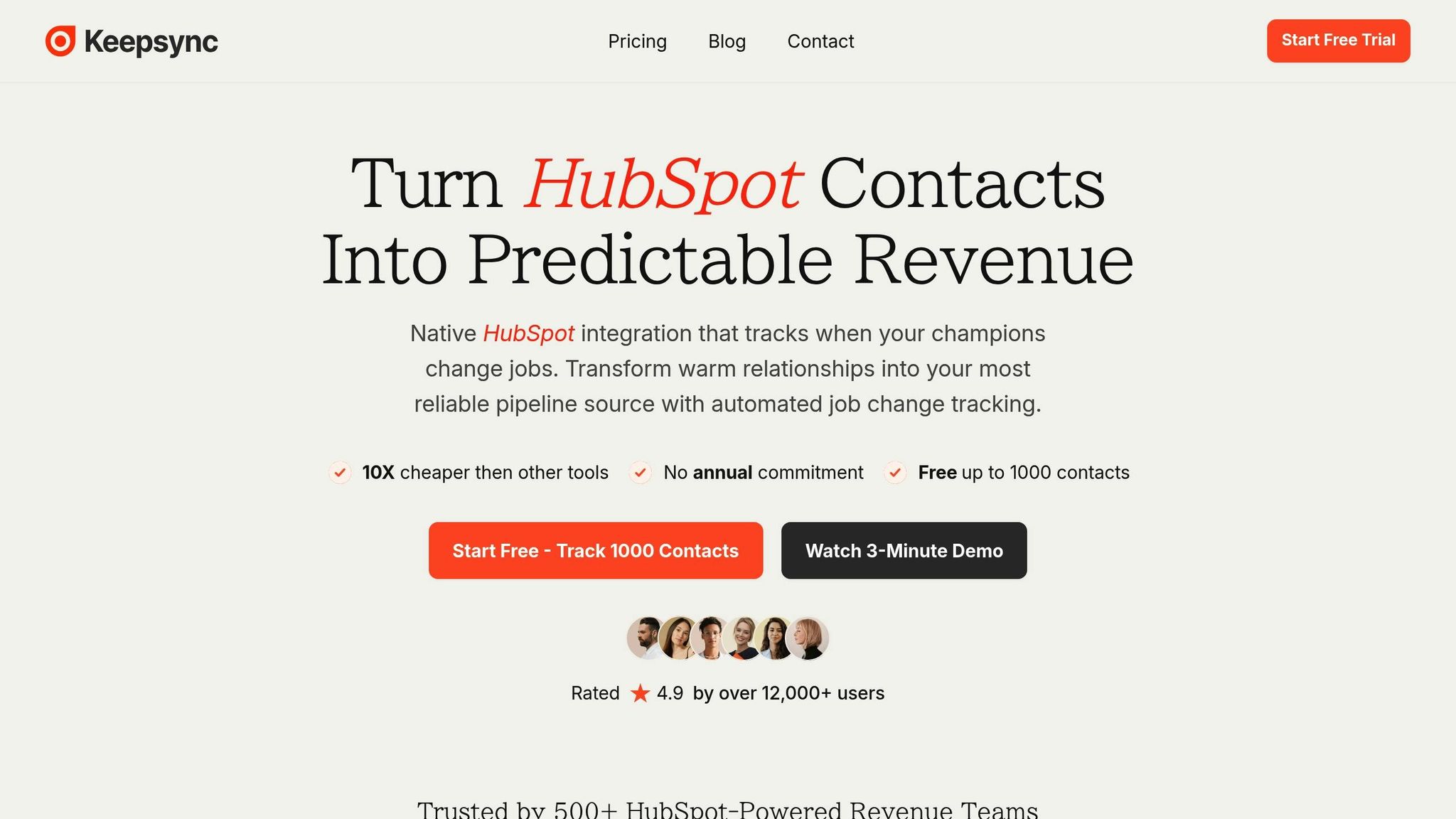
KeepSync integrates directly with HubSpot, automating the most effective job change tracking scenarios to maximize your ROI.
The best part? KeepSync’s HubSpot-native design makes setup quick and easy - it takes just five minutes. The platform tracks contacts weekly across 30+ data sources with 94% accuracy, automatically updating HubSpot properties and triggering workflows tailored to your needs. Whether you’re managing 1,000 contacts on the Starter plan ($79/mo) or 20,000 on the $399/month Agency plan, the automation runs effortlessly in the background.
| Job Change Scenario | Sales Strategy | HubSpot Automation Trigger |
|---|---|---|
| Former Champion at New Co | Warm Outreach / Referral | Task Assignment |
| New Exec at Target Account | 90-Day Impact Pitch | Enroll in "New Hire" Sequence |
| Champion Leaves Account | Churn Mitigation | Alert Customer Success Manager |
| Promotion within Account | Upsell / Expansion | Update Lifecycle Stage to SQL |
| New Hire at Closed-Lost | Fresh Start / Re-discovery | Create "New Opportunity" Deal |
Job change tracking is great for strengthening existing connections, but sales intelligence takes things a step further by helping you break into new markets or connect with entirely unfamiliar prospects. Unlike job change tracking, which focuses on leveraging current relationships, sales intelligence tools help you uncover fresh opportunities by identifying new companies and contacts. This approach complements job change tracking by broadening your reach to new prospects.
Sales intelligence tools excel at precision. They can generate targeted prospect lists using firmographic data, funding stages, and employee counts - features that job change tracking alone can't provide.
Another standout feature is how sales intelligence uses buying signals to prioritize leads. These tools track intent data (like online research behaviors), technographic details (such as the software a company uses), and trigger events (like funding rounds or executive hires). For example, Crunchbase, a leading sales intelligence tool, provides real-time updates on these signals. As one sales enablement specialist explains:
"Crunchbase surfaces information so quickly we don't even have to think about going to look for it. My sales reps get immediate updates on funding rounds, acquisitions, and hot companies." [2]
The impact of sales intelligence is hard to ignore. HubSpot users who integrated these tools reported 129% more leads and a 36% increase in closed deals. Plus, 73% of sales professionals noted improved win rates after adopting these platforms.[5] On top of that, sales reps save over two hours daily through AI-driven automation.[5] These benefits highlight specific scenarios where sales intelligence proves invaluable.
Sales intelligence is particularly effective for large-scale prospecting campaigns across different industries or regions. If your team needs to evaluate thousands of leads based on ideal customer profile (ICP) criteria and engagement signals, these platforms can automatically rank prospects. This allows sales reps to focus on the most promising deals instead of spending time manually researching each account.[4][5]
Another powerful use case is technographic targeting. If your sales strategy hinges on understanding a prospect's current tech stack - whether to assess compatibility or identify integration opportunities - sales intelligence can deliver this information on a large scale.[2][14]
For account-based marketing (ABM) initiatives, sales intelligence provides a detailed and comprehensive view of target accounts. This includes insights into funding rounds, revenue patterns, organizational structures, and M&A activity. Such a broad perspective is far more insightful than simply tracking individual job changes.[2] When targeting enterprise clients, having a full understanding of an organization's readiness to buy can make all the difference.
Another key advantage is intent-based prioritization. Sales intelligence tools can identify prospects actively researching solutions by monitoring behavioral signals like content consumption and website visits. This means you can engage with buyers who are already in the market for your offerings.[6][14]
However, these tools are best suited for teams with larger budgets and dedicated sales operations support. Entry-level solutions typically cost $49–$79 per user per month, while advanced enterprise platforms can exceed $499 per month.[18] They also require ongoing management to configure filters, maintain clean data, and integrate with your CRM. As a result, these tools are a better fit for organizations with the resources to support them effectively.
Deciding on the right tool for your HubSpot workflow largely depends on your goals. Are you aiming to re-engage warm leads like past champions, former customers, or closed-lost deals? If so, job change tracking is your best bet. On the other hand, if your focus is on finding entirely new accounts using intent data, technographics, and firmographic filters, sales intelligence platforms are the way to go. Each approach serves a distinct purpose, so aligning your choice with your objectives is key.[2]
Another important consideration is your budget and team size. Sales intelligence platforms typically come with a hefty price tag, ranging from $15,000 to $50,000+ per year. These tools often have unclear pricing structures and require a significant administrative effort to manage.[8] In contrast, job change tracking tools are more budget-friendly and transparent, with specialized solutions priced around $9,500 annually. This makes them a better fit for smaller teams or those with a focused scope.[8]
Data accuracy and update frequency are critical as well. Many sales intelligence databases refresh only 1–3 times per year, leaving you with outdated information.[11] In contrast, job change tracking tools offer monthly or even real-time updates, ensuring you capture executives during their first 100 days in a new role - a period when 70% of their budget is typically spent.[12] Engaging decision-makers during this early window can speed up deal closures by 63%.[1]
Finally, consider how well the tool integrates with HubSpot. Basic integrations might only create tasks for notifications, but advanced setups can use Custom Objects for detailed reporting and long-term tracking of key signals.[12] This deeper integration is vital for measuring ROI and identifying which signals are driving pipeline growth. Automating these processes ensures your CRM stays up-to-date and your team doesn’t waste time chasing stale leads. These factors highlight why KeepSync is specifically designed for job change tracking.
KeepSync is tailored for HubSpot users who want to harness job change signals without the complexity of a full-blown sales intelligence platform. The platform boasts an impressive 94% accuracy rate, achieved by monitoring contacts weekly across 30+ data sources and combining automated verification with human review for reliability.
Integration with HubSpot is seamless and takes just five minutes. Once set up, KeepSync automatically creates tasks, enriches contact records, and triggers workflows whenever someone in your database changes roles. Real-time alerts are sent via Slack, email, or directly in HubSpot, eliminating the need to manually track LinkedIn or juggle multiple tools. This automation is especially important since 89% of previous customers don’t return to a vendor on their own after starting a new role.[12]
KeepSync’s pricing model is straightforward and accessible. It offers a Starter plan for up to 1,000 contacts per month, while the Team plan costs $79/mo for 1,000 contacts for 5,000 contacts, and the Agency plan is $399/month for 20,000 contacts. This transparent pricing makes it a practical choice for growing revenue teams that need focused job change tracking without the financial commitment of enterprise-level sales intelligence tools. By considering your objectives, budget, and integration needs, it’s clear why it’s clear why KeepSync stands out among job change tracking tools.
Deciding between job change tracking and sales intelligence ultimately comes down to your specific goals. Sales intelligence platforms are designed to uncover brand-new accounts by using data like firmographics, technographics, and intent signals [2]. On the other hand, job change tracking shines when it comes to reconnecting with warm leads. It works by keeping tabs on individuals as they transition between companies, allowing you to tap into pre-existing relationships [1][7].
The numbers speak for themselves. Engaging with new decision-makers during job transitions can speed up deal closures by 63% [1] and convert past buyers five times more often than reaching out to cold leads [12]. Considering that nearly 30% of the corporate workforce changes jobs every year [7], the chance to re-engage with former advocates is massive. Add to that the fact that new executives allocate 70% of their budgets within the first three months [12], yet 89% of previous customers won’t return without a nudge [12], and it becomes clear why timely follow-ups are so crucial.
If your focus is on making the most of your existing CRM data - whether it’s re-engaging closed-lost deals, reconnecting with former champions, or reducing churn - KeepSync is a powerful solution. With 94% accuracy, instant alerts, and smooth HubSpot integration, all starting at just $79/mo for 1,000 contacts for 5,000 contacts, it delivers the job change insights you need to turn warm leads into conversions.
Choosing between job change tracking and sales intelligence tools comes down to what your business needs most. If your priority is keeping your CRM data up-to-date, staying informed when contacts switch roles or companies, and acting quickly - like reconnecting with a former client at their new job - then job change tracking is the right choice. It allows you to stay ahead with real-time updates, automated processes, and better lead conversion opportunities.
However, if you’re looking for a broader market perspective, want to identify buying signals, or need to prioritize leads across numerous accounts, sales intelligence tools are better suited for the job. These platforms dig deeper into prospect behavior, offering insights like intent data, firmographic information, and predictive scoring, making them perfect for large-scale prospecting and building a robust sales pipeline.
In short, if your focus is on responding to individual contact changes, job change tracking is your best bet. But if you’re aiming to expand prospecting efforts and enhance leads with detailed market data, sales intelligence tools are the way forward.
Job Change Tracking takes a sharp, real-time lens to your contact list, pinpointing exactly when someone changes roles or companies. This keeps your data fresh, cutting down on bounced emails and safeguarding renewal revenue. Plus, it opens the door to reconnect with former customers in their new positions - a strategy that can grow your pipeline by an impressive 10–50% and turn casual conversations into real opportunities.
Unlike the broader scope of sales intelligence, which offers general prospect insights, Job Change Tracking zeroes in on specific, actionable updates about individual contacts. This accuracy not only boosts response rates and shortens sales cycles but also eliminates the hassle of manual data updates. With less time spent on admin tasks, your team can focus on what really matters: building genuine connections and driving meaningful results.
Job Change Tracking works effortlessly with your CRM, automatically updating contact records as employment changes happen. Using KeepSync, it monitors reliable data sources for updates like job titles, company changes, or new email addresses, syncing this information straight into HubSpot through its native API.
You can map these updates to custom fields you set up, such as Current Title, Previous Company, or Job Start Date, keeping your data accurate without lifting a finger. These updates can also trigger workflows instantly - whether it’s notifying account owners, creating follow-up tasks, or adding contacts to re-engagement lists - so you can respond to new opportunities without delay.
What’s more, KeepSync enables bidirectional syncing, enriching your CRM with verified details like email addresses or phone numbers, all while keeping your records clean and free of duplicates. This integration ensures your sales pipeline is always current and actionable, giving you the upper hand when key contacts transition to new roles or companies.