
Digital Marketing
·
April 10, 2026
How SaaS Companies Handle Billing Disputes & Chargebacks
Learn how SaaS billing disputes happen, what triggers chargebacks, and how both sides can resolve them faster.

Compare LoneScale and KeepSync—pricing, update frequency, HubSpot integration, data accuracy, and which fits enterprise vs small sales teams.


LoneScale and KeepSync are job change automation tools designed to help sales teams save time and boost efficiency. Here’s a quick breakdown:
Both integrate with HubSpot, but LoneScale provides more advanced features like hiring intent tracking, while KeepSync keeps things simple with straightforward pricing and weekly updates.
Quick Comparison:
| Feature | LoneScale | KeepSync |
|---|---|---|
| Pricing | $1,000/month (Core Plan) | $79/month (Starter) |
| Updates | Daily | Weekly |
| Users | Unlimited | Limited by plan |
| HubSpot Integration | Advanced automation | Basic workflows |
| Best For | Large teams needing detailed tracking | Small teams on a budget |
For teams needing advanced automation and daily updates, LoneScale is a strong option. If you're looking for a budget-friendly solution with essential features, KeepSync is a solid choice.
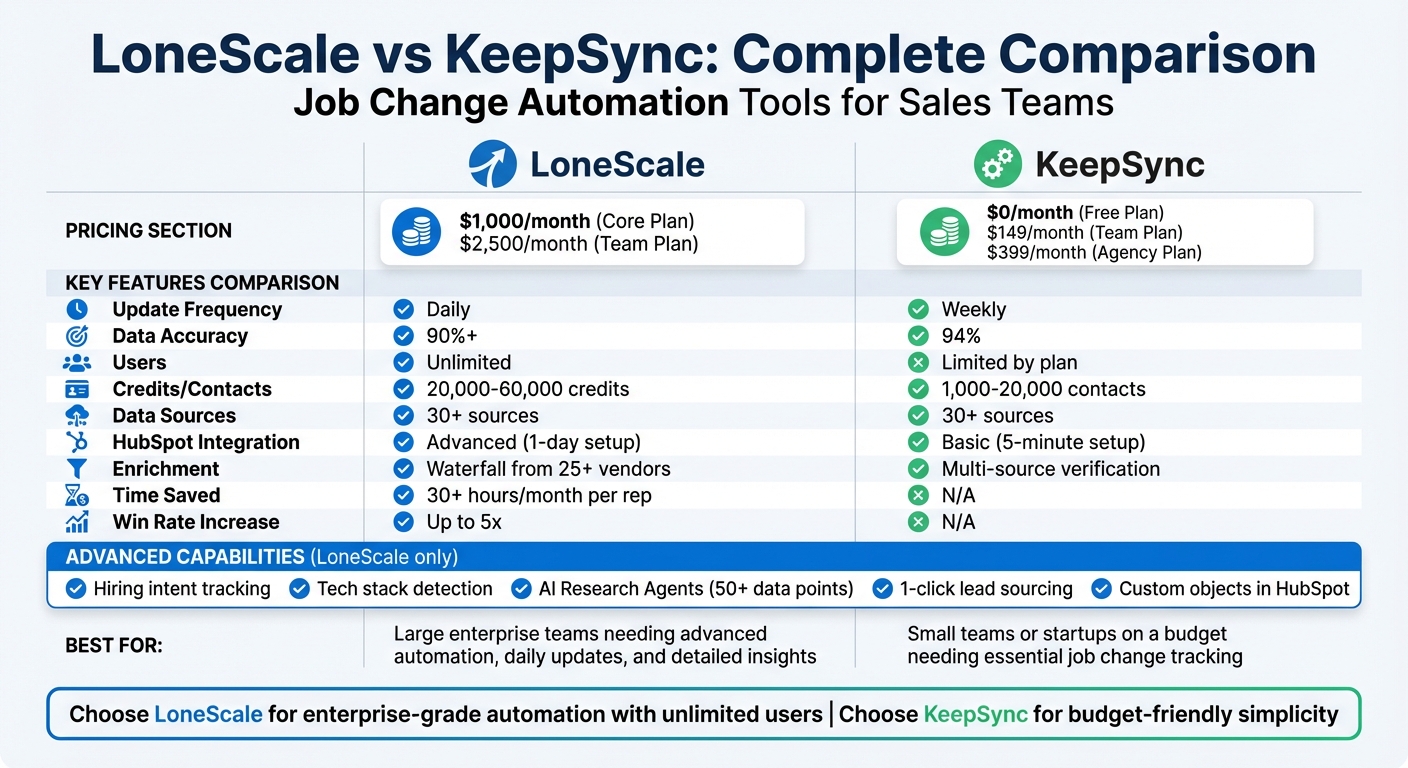
LoneScale vs KeepSync: Features, Pricing, and Best Use Cases Comparison
LoneScale's pricing starts at $1,000 per month for the Core Plan, which includes up to 20,000 credits. That’s enough for 20,000 verified emails or 10,000 full contact records. The plan allows unlimited users and uses results-based pricing, meaning you only pay for enriched records. For teams with larger needs, the Team Plan costs $2,500 per month and offers up to 60,000 credits, along with perks like a dedicated Customer Success Manager and RevOps support. LoneScale also provides a demo for its contact tracking features. Its Waterfall Enrichment feature aggregates data from over 30 sources, prioritizing your existing vendor credits [1][5][6].
These flexible pricing options make LoneScale an attractive choice for teams looking to combine affordability with powerful features.
LoneScale’s standout feature is its job change intelligence, which tracks champions, former customers, and users as they move between companies. This is a game-changer, especially since about 25% of people change jobs each year, creating a consistent flow of warm leads. The platform also monitors new executive hires - Directors, VPs, and CxOs - at target accounts. Why is this important? These decision-makers often allocate 70% of their budget within their first 100 days.
The platform’s AI Research Agents take things further by analyzing over 50 data points to create tailored selling strategies and map out the full buying committee, which can increase win rates by up to 5x. LoneScale also boasts impressive data accuracy, claiming over 90% accuracy for verified emails, direct dials, and LinkedIn profiles, with mobile phone data coverage reaching 98% [3][7][4].
"LoneScale is one of our best outbound pipeline generation providers. You guys are able to generate a lot of volume. And this volume is qualitative and high intent."
– Théo R., Head of Sales Operations [3]
By automating prospecting and focusing on high-intent opportunities, LoneScale helps sales teams work smarter, not harder.
LoneScale integrates seamlessly with HubSpot through a native "Plug & Play" feature that eliminates the need for manual exports or scripts. Whenever the platform detects a job change or new hire signal, it automatically updates HubSpot with the latest data. This includes creating tasks for sales reps, updating contact records, or even generating custom objects. Users can map LoneScale data fields - like job titles, LinkedIn URLs, and company tech stacks - to standard or custom HubSpot properties, ensuring the CRM stays up-to-date in real time.
The integration also supports workflow automation and lets users apply persona and Ideal Customer Profile filters to keep their database clean. It’s no surprise that this integration has earned a perfect 5/5 rating on the HubSpot App Marketplace, making CRM management smoother for sales teams [4][2].
LoneScale is built to grow alongside your organization. Unlike platforms that charge per user - like Outreach (~$100/user/month) or Lemlist ($69/user/month) - LoneScale includes unlimited users in all its plans. This makes it a cost-effective option for scaling teams. The platform also supports bulk and API enrichment, allowing you to process large datasets efficiently. Plus, it performs daily refreshes across 30+ live data sources to ensure your CRM data remains accurate.
The benefits are clear: sales reps save about 30 hours of manual work each month, while contact data quality improves by 70%. Using sales triggers can triple meeting bookings, and tracking past buyers through job changes makes them 5x more likely to convert into closed-won deals [1][3][7].
KeepSync offers a straightforward pricing structure designed to scale with your needs. It starts with a Starter plan ($79/mo), which includes 1,000 contacts per month and weekly monitoring - perfect for testing the platform with actual data before committing. For growing teams, the Team plan costs $149 per month, covering up to 5,000 contacts, with additional contacts priced at $0.02 each. Agencies managing multiple clients can opt for the Agency plan, priced at $399 per month, which supports 20,000 contacts and includes white-label capabilities. Additional contacts under this plan cost $0.015 each.
If you prefer annual billing, you can save significantly. The Team plan is available for $1,490 per year, saving about $298, while the Agency plan costs $3,990 per year, offering savings of roughly $798. Now, let’s dive into the features that make KeepSync a standout tool for job change tracking.
KeepSync is built for automated job change tracking, delivering 94% accuracy across more than 30 sources. The platform sends real-time notifications via Slack, email, or directly within HubSpot whenever a tracked contact switches jobs. Once a change is identified, KeepSync enriches the contact record with verified email addresses, phone numbers, and updated company information.
It’s not just about tracking job changes. KeepSync lets you monitor former champions, closed-lost deals, and even competitors' customers as they move to new roles. With multi-source and human verification, the data accuracy is solid, allowing sales teams to focus on warm leads instead of wasting time on cold outreach. The platform also automates workflows, routing leads to the right team members and triggering personalized outreach sequences. On top of that, pipeline analytics provide insights into metrics like ROI and response rates.
KeepSync’s native integration with HubSpot makes tracking customer job changes and workflow automation effortless. Setting it up takes just five minutes, and once connected, KeepSync syncs directly with HubSpot workflows. The platform updates contact records, creates tasks, and triggers outreach sequences automatically whenever job changes are detected. All alerts and enriched data are seamlessly incorporated into your existing HubSpot setup, eliminating the need for manual data entry.
By leveraging HubSpot’s automation tools, KeepSync ensures job change tracking and follow-up actions are managed efficiently within one platform. For teams needing more flexibility, the platform also supports webhook and API access for custom integrations with other tools.
KeepSync is designed to grow with you. Its tiered pricing model ensures you can scale your contact volume without unexpected costs. If you exceed your plan’s limits, overage charges are predictable and transparent - no hidden fees or complicated credit systems. With weekly monitoring, KeepSync keeps your contact database up-to-date as your list expands, ensuring you’re always working with current information.
Each platform offers distinct strengths, but they vary in pricing, feature set, and how they integrate with HubSpot. LoneScale operates on a pay-for-results model with unlimited users, while KeepSync provides an affordable entry-level option, making it ideal for smaller teams that want to avoid hefty upfront costs.
In terms of features, LoneScale stands out with its advanced capabilities. It doesn’t just track job changes - it analyzes job postings to detect hiring intent, tool mentions, and team structures. Plus, it uses a waterfall enrichment system that pulls data from over 25 vendors, ensuring robust email and phone coverage [4][5]. LoneScale also refreshes job titles and firmographics every 24 hours, which keeps HubSpot records up to date. This enables users to save over 30 hours per rep each month and can potentially increase win rates by about 10% [8]. On the other hand, KeepSync focuses on job change tracking with 94% accuracy, pulling data from 30+ sources and offering weekly updates. It’s a simpler solution for teams that primarily need job change notifications.
For HubSpot integration, both platforms offer native connections, but their approaches differ. LoneScale’s "Plug & Play" setup is ready to go in just one day. It automatically creates HubSpot tasks or custom object records when contacts change jobs or companies. It even includes 1‑click lead sourcing to help populate target account lists with verified decision-makers [2][6][8]. KeepSync, by comparison, offers a quick five-minute setup that integrates directly with HubSpot workflows, ensuring contact records are updated and outreach sequences are triggered without hassle.
Here’s a side-by-side comparison of the platforms:
| Platform | Strengths | Weaknesses |
|---|---|---|
| LoneScale | Unlimited users, daily data refresh, advanced signal tracking (hiring intent, tech stack detection), waterfall enrichment from 25+ vendors, 1‑click lead sourcing, saves 30+ hours/month per rep | Higher starting price ($1,000/month); may exceed the needs of teams looking for basic job change tracking |
| KeepSync | Low entry cost (Starter plan ($79/mo) available), transparent overage pricing, five‑minute HubSpot setup, 94% accuracy, weekly monitoring, job-change-focused features | Weekly updates instead of daily; fewer advanced signals; limited enrichment options |
Both platforms offer transparent pricing. LoneScale clearly lays out its Core and Team plan costs with no hidden fees or seat charges [1]. KeepSync, meanwhile, specifies overage fees of $0.02 per additional contact on its Team plan and $0.015 on its Agency plan. If you need advanced tracking with daily updates, LoneScale is the way to go. For a budget-friendly, straightforward solution focused on job change monitoring, KeepSync is a solid pick.
Deciding between LoneScale and KeepSync boils down to your budget, the level of automation you require, and how you plan to incorporate job change data into your sales strategy. Here's a closer look at how each platform matches different team needs.
For larger teams that prioritize advanced automation, LoneScale is a strong choice. It provides real-time insights tailored for enterprise sales teams, enabling informed, data-driven decisions. Starting at $1,000 per month, it’s designed for those managing champions across multiple accounts, offering unlimited user seats and seamless HubSpot integration for a quick setup.
On the other hand, KeepSync caters to smaller teams or those new to job change tracking with a cost-effective approach. It starts at $79/mo for up to 1,000 contacts, scaling to $149 per month for 5,000 contacts. With 94% accuracy, weekly updates from over 30 sources, and a simple five-minute HubSpot integration, it covers the essentials. While it lacks LoneScale's daily refresh and advanced signal detection, it delivers reliable job change tracking with straightforward overage pricing at $0.02 per additional contact on the Team plan.
For teams seeking basic job change alerts and quick HubSpot integration, KeepSync offers great value. Meanwhile, enterprise sales teams that demand daily updates and multi-signal tracking will find LoneScale worth the investment. These distinct features make it easier for teams to select the platform that best supports their sales goals.
LoneScale is built to empower larger sales teams by introducing a per-record pricing model with unlimited users. This approach removes the burden of expensive seat licenses, allowing teams to grow without stressing over individual user costs.
The platform also delivers real-time updates on job changes and buying signals, keeping your team in the loop with critical decision-makers and potential opportunities. With tools like automated stakeholder mapping and seamless integrations with Salesforce and HubSpot, LoneScale simplifies complex sales processes and ensures outreach efforts are coordinated across the entire team.
LoneScale’s integration with HubSpot ensures your CRM remains up-to-date by automatically syncing real-time buying signals, such as job changes, new hires, or re-engagements at target accounts, directly into your HubSpot records. This eliminates the need for manual updates, keeping your database accurate and reliable.
Additionally, the integration enriches contact and company records with vital details like LinkedIn-sourced emails, phone numbers, and tech stack information. Sales teams can stay ahead with actionable alerts delivered through tasks or custom objects in HubSpot, allowing them to respond quickly to critical updates. By automating tasks like job-change tracking and data enrichment, LoneScale simplifies workflows, sharpens segmentation, and boosts both sales and marketing performance.
LoneScale’s Core plan comes in at $1,000 per month, offering a solid set of features. These include up to 20,000 credits, waterfall enrichment, list building, job-change tracking, reverse email lookup, integrations with Salesforce and HubSpot, a Chrome extension, bulk/API enrichment, and support for unlimited users.
Details about the Team plan, however, remain unclear, so any distinctions between the two plans can't be confirmed just yet.