
Digital Marketing
·
April 10, 2026
How SaaS Companies Handle Billing Disputes & Chargebacks
Learn how SaaS billing disputes happen, what triggers chargebacks, and how both sides can resolve them faster.

Why CRM records go stale, how data decay erodes revenue and productivity, and practical fixes—automation, validation rules, and HubSpot integration.


CRM data decay is a growing problem in 2026, with 70.3% of B2B contact data becoming outdated annually. This leads to significant revenue losses - 44% of companies lose over 10% of their revenue due to poor data quality. Key drivers include job changes, email updates, and inconsistent data entry, making manual cleanups unfeasible.
Switching from manual fixes to automated tools can recover lost revenue, improve team efficiency, and boost campaign performance. Businesses that prioritize clean CRM data see measurable gains, including higher conversion rates and a 5x to 10x return on investment within the first year.

CRM Data Decay Statistics 2026: Impact on Revenue and Business Performance
Data decay isn’t just an eyesore in your CRM - it’s a direct hit to your revenue. Knowing where this problem originates and understanding its financial impact can help you make a strong case for tackling it head-on.
Did you know that only 9% of your database stays accurate after a year without regular upkeep [1]? This rapid decline doesn’t just cause operational headaches - it can cost you big. On average, 2.1% of contact records become invalid every month [3], and in some cases, this rate spikes to 3.6% monthly [4].
Different industries face unique challenges when it comes to data decay:
| Industry | Annual Decay Rate | Primary Driver |
|---|---|---|
| Technology | 35%–45% | High job mobility (short tenures of 2–3 years) |
| Startups/VC-backed | 30%–70% | Frequent company changes and staff turnover |
| Healthcare | 30%–40% | Physician turnover and organizational changes |
| Financial Services | 25%–35% | Mergers, acquisitions, and regulatory shifts |
| Professional Services | 20%–40% | High employee mobility in consulting and agencies |
| Manufacturing | 10%–30% | Plant closures in an otherwise stable sector |
| Government | 8%–12% | Long employee tenures and stable organizations |
The decay doesn’t stop there. Work email addresses alone can degrade at a rate of 20% to 30% annually, while job titles, direct phone numbers, and company names follow close behind at 15% to 25% [3].
What’s behind this decline? It’s a mix of factors:
Together, these factors highlight the urgent need for automated tools to maintain CRM data accuracy.
The financial fallout from outdated data isn’t just theoretical - it’s measurable. Companies lose an average of 12% of annual revenue due to poor data quality [5]. For a business generating $10 million a year, that’s a staggering $1.2 million in preventable losses. And it gets worse - 44% of businesses report losing more than 10% of their revenue specifically due to data decay [2].
"Poor data quality costs organizations an average of $12.9 million annually." - Gartner [8]
Sales teams feel the pain too. Representatives waste about 27.3% of their time - roughly 546 to 550 hours annually - chasing bad leads or verifying outdated information [5]. That’s nearly 14 weeks of lost productivity, making it harder to hit quotas and discouraging CRM adoption.
Marketing teams aren’t spared either. High email bounce rates caused by outdated addresses can tank your sender reputation, cutting inbox placement by as much as 40% [5]. Once flagged, even valid emails may fail to reach your audience. Alarmingly, only 62% of submitted email addresses are valid at the point of entry [4], meaning nearly four out of ten leads may already be useless.
Bad data also disrupts key business processes like lead scoring, territory management, and revenue forecasting. When 76% of organizations admit that less than half of their CRM data is accurate and complete [1], and 10% to 30% of CRM records are duplicates [5][7], automated systems can’t deliver reliable results.
But here’s the silver lining: fixing this issue pays off. Businesses that prioritize clean data often see:
Even better, data quality initiatives typically deliver a 5x to 10x ROI within the first year, recovering lost revenue and improving team efficiency [5].

Before tackling data decay, it’s essential to understand its impact. HubSpot offers built-in tools that provide a clear picture of your CRM data's condition.
HubSpot's Data Quality Command Center is the go-to tool for assessing CRM data. You’ll find it under Data Management > Data Quality. This dashboard highlights issues like duplicate records, formatting errors, and property usage insights. Plus, you can opt for a weekly digest email to stay updated on any changes in your data quality [9][10][11].
Here are four critical metrics to monitor:
| Metric | How to Identify It | Target Benchmark |
|---|---|---|
| Duplicate Rate | Look for duplicate email domains, phone numbers, or names | < 5% [7] |
| Field Completion | Check Property Insights for missing job titles, phone numbers, or industries | > 85% [7] |
| Email Validity | Track hard bounce rates in campaign reports | > 95% [7] |
| Data Freshness | Filter contacts with no activity or updates in 12+ months | < 20% stale [7] |
Duplicates are often the easiest to spot. On average, 10% to 30% of CRM records are duplicates [5][7]. HubSpot’s fuzzy matching feature can help by comparing emails, phone numbers, and company details to flag duplicates.
Incomplete records are another challenge. These are less obvious but can be just as harmful. Studies show that 30% to 40% of B2B records lack essential information like job titles or company sizes [5]. HubSpot’s Property Insights tool can pinpoint which fields need attention, helping you prioritize cleanup efforts.
Stale data is a silent but serious issue. You can filter contacts by their "Last Modified Date" to identify records that haven’t been updated in over a year [5][3]. This is crucial because work email addresses degrade at a rate of 20% to 30% annually [3]. If a contact hasn’t engaged in over a year, chances are their information is no longer reliable.
By using these metrics, you can assess whether manual cleanup or automated tools are better suited to maintaining your CRM’s data integrity.
Tracking these metrics is just the first step - addressing the issues requires a shift from manual fixes to automation.
Manual data maintenance is time-consuming and prone to errors. Sales reps often prioritize selling over administrative tasks, which leads to incomplete or fabricated data entries. In fact, 37% of sales reps admit to entering false data just to meet requirements [1].
"You're asking reps to do admin instead of selling. They won't do it well. They shouldn't have to." - RecordContext [1]
Automation offers a way out. Tools like HubSpot Operations Hub can automatically format phone numbers or job titles using "Format Data" actions [10]. Similarly, Breeze Intelligence, HubSpot’s enrichment tool, scans for missing information and fills gaps without requiring manual input [10]. Validation rules can also block invalid data formats from entering your CRM in the first place [10].
Automated solutions not only improve accuracy but also free up time for your team to focus on selling. The payoff is significant: automated data quality initiatives often deliver 5x to 10x returns within the first year by recovering lost revenue and boosting email deliverability by up to 70% [5][10].
To tackle CRM data decay effectively, you need to shift from manual fixes to automated solutions. Addressing the root causes of decay is essential to keep your CRM running smoothly and efficiently. The strategies below will help you maintain your HubSpot CRM without adding extra work for your sales team.
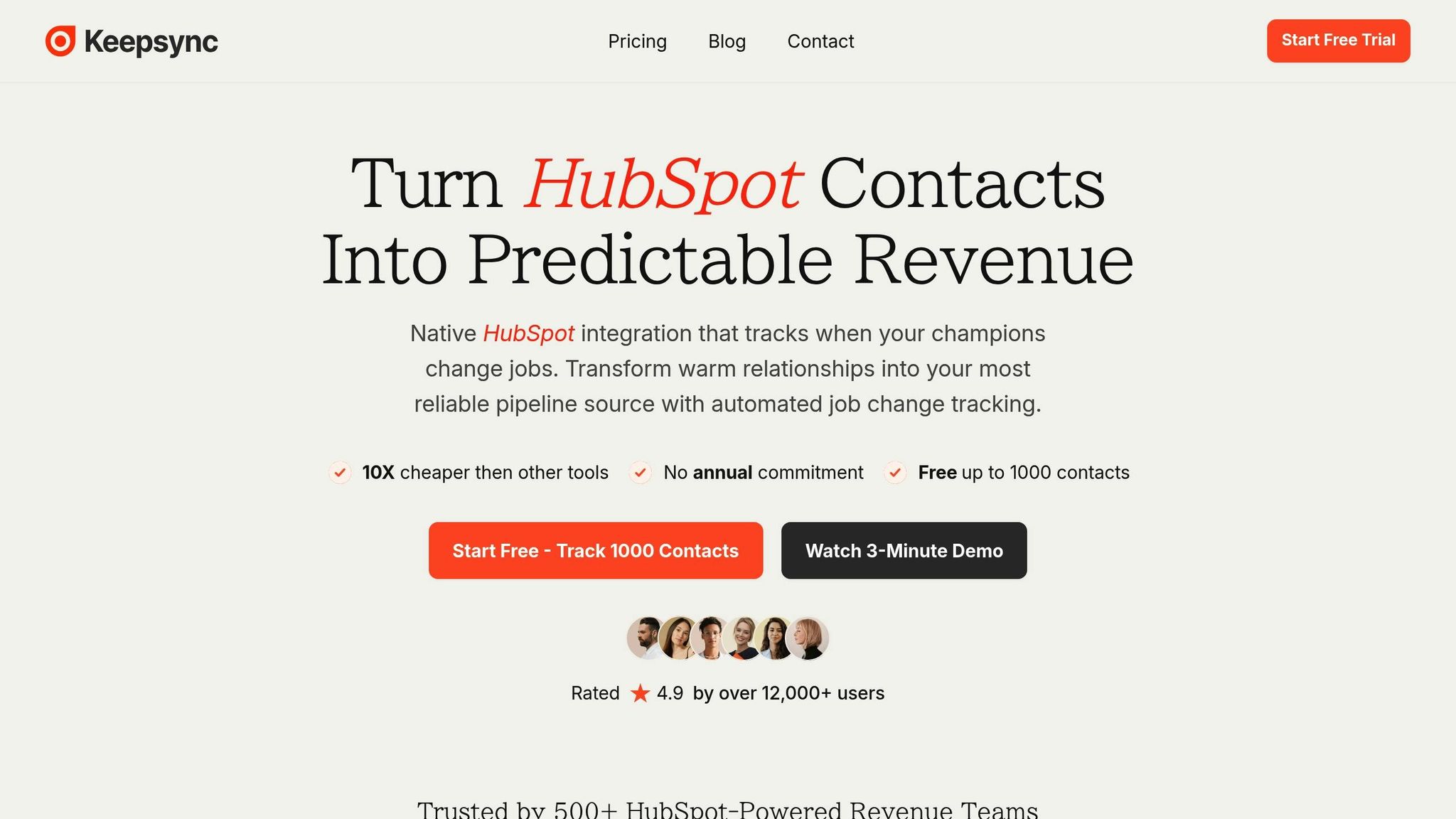
Job changes are one of the biggest contributors to B2B data decay. With 15% to 20% of professionals switching jobs each year [3], it’s no surprise your CRM can quickly become outdated. KeepSync addresses this issue by monitoring your contacts weekly across over 30 data sources with an impressive 94% accuracy rate [12].
The platform provides real-time updates via email or Slack whenever a contact changes roles or companies. It even updates their details automatically, turning outdated records into new opportunities.
"The ROI was immediate. Within 45 days we had closed two deals from former customers who moved to bigger companies. Our SDRs love it because these are actual warm leads, not cold calls." - Sarah Kim, Director of Sales, Velocity Commerce [12]
KeepSync’s pricing is flexible, starting with a Starter plan ($79/mo) for up to 1,000 contacts. The Team plan is $149/month (or $1,490/year) and supports 5,000 contacts, Slack alerts, and API integrations with tools like N8N, Make, and Clay. For larger needs, the Agency plan costs $399/month (or $3,990/year) and includes 20,000 contacts, white-label options, and a dedicated customer success manager [12].
This automated solution integrates seamlessly into your workflow, making it easier to follow up on opportunities as they arise.
KeepSync integrates with HubSpot in just five minutes, enabling automated actions like reassigning contacts, launching re-engagement campaigns, or sending Slack notifications when job changes are detected [12].
For instance, if a former customer joins a larger company, KeepSync can automatically create a new deal in HubSpot and assign it to the right sales rep based on industry or territory. This eliminates the need for manual LinkedIn checks and ensures your team takes action before competitors.
"With 1,500+ customers, manually tracking job changes was impossible. We were leaving money on the table every month. Now it's fully automated and integrated into our HubSpot workflows. Set it and forget it." - Julia Chen, VP Sales Operations, Nexus Software [12]
While automation handles most of the heavy lifting, a few additional practices can help keep your CRM in top condition. Start by implementing entry validation rules to block invalid email addresses and enforce required fields, ensuring bad data doesn’t enter your system [6][7]. Use HubSpot’s Format Data workflow action to standardize phone numbers to E.164 format (+1XXXXXXXXXX) and job titles to title case [10].
It’s also helpful to schedule regular maintenance alongside KeepSync’s weekly monitoring. Incorporate email verifications and database enrichment into your routine to fill in missing fields like company size or industry [5]. An annual audit can also help you review your data dictionary and spot duplicate patterns.
Finally, take advantage of HubSpot Breeze Intelligence to enrich records with details like revenue and employee count at the point of capture [10]. When paired with KeepSync and these best practices, your CRM will stay accurate and ready to deliver measurable results. By combining automation with a proactive approach, your CRM becomes a powerful tool for driving revenue growth.
The effectiveness of your CRM hinges on the accuracy of its data. With 91% of CRM data becoming outdated each year and businesses losing around 12% of revenue due to poor data quality, keeping your records accurate is not just important - it’s essential [1][5].
Shifting from manual data cleanup to automated solutions is no longer optional; it’s a necessity. Tools like KeepSync save your sales team from wasting time verifying outdated contacts [5]. Instead, they can focus on what they do best: selling. By integrating automated job change tracking with HubSpot workflows, your team can turn outdated information into fresh opportunities, ensuring they never miss a chance to connect. This proactive approach gives your team a clear edge in outreach.
"CRM data hygiene is a revenue discipline, not an admin chore." - Jordan Rogers, RevenueTools [13]
Looking ahead to 2026, clean data will be the backbone of AI-driven lead scoring, reliable email deliverability, and consistent growth. These advancements don’t just boost productivity; they create a solid framework for scalable success. Companies that prioritize data hygiene report a 25% to 27% increase in sales productivity [5], showing that automated solutions provide fast and measurable returns.
The decision is straightforward: continue battling data decay manually or embrace automated job change tracking tools that keep your CRM accurate in real time. Protect your revenue by choosing automation.
To figure out your CRM’s data decay rate, you need to measure how much of your data becomes outdated over a specific time frame - usually a year. Here’s how you can do it: identify which records are accurate, monitor changes over time, and use this formula:
Decay Rate (%) = (Outdated Records ÷ Total Records) × 100
For instance, if 2,250 out of 10,000 records are no longer valid after a year, your data decay rate would be 22.5%.
When it comes to maintaining clean and accurate CRM data in HubSpot, there are a few key metrics that can help you spot potential issues:
Keeping an eye on these metrics is essential for identifying and fixing data quality issues. By addressing these problems, you can ensure your CRM remains accurate and operates smoothly, boosting overall productivity.
To tackle the problem of data decay, the first step is to automate data enrichment and validation. This process helps fill in missing details, verify existing information, and keep records current with minimal manual effort. On top of that, automating regular cleanup tasks - like deduplication and standardization - ensures your CRM remains accurate and dependable. By addressing common challenges such as incomplete, outdated, or duplicate records, you can maintain the efficiency of your sales and marketing efforts.