
Digital Marketing
·
April 10, 2026
How SaaS Companies Handle Billing Disputes & Chargebacks
Learn how SaaS billing disputes happen, what triggers chargebacks, and how both sides can resolve them faster.

Compare HubSpot native automation and job-change tracking tools to streamline workflows, create warm leads from past contacts, and increase sales productivity.


Sales teams using HubSpot often struggle with inefficiencies - sales reps spend only 33% of their time selling, while the rest is lost to admin tasks like data entry and lead follow-ups. This drains productivity and impacts revenue, with 73% of companies missing revenue targets due to poor forecasting. Automation tools can help by saving reps over 2 hours daily and increasing lead generation by 129%.
This article compares two tools that optimize sales workflows for HubSpot users:
Both tools boost efficiency but address different needs. HubSpot excels in managing overall sales processes, while KeepSync focuses on job change tracking to generate high-converting leads. Using both together creates a powerful system for improving productivity and closing more deals.
HUBSPOT SALES AUTOMATION
Automate Job Change Tracking in HubSpot
KeepSync monitors your contacts for job changes and updates HubSpot automatically. Free up to 1,000 contacts.
Request Early Access →
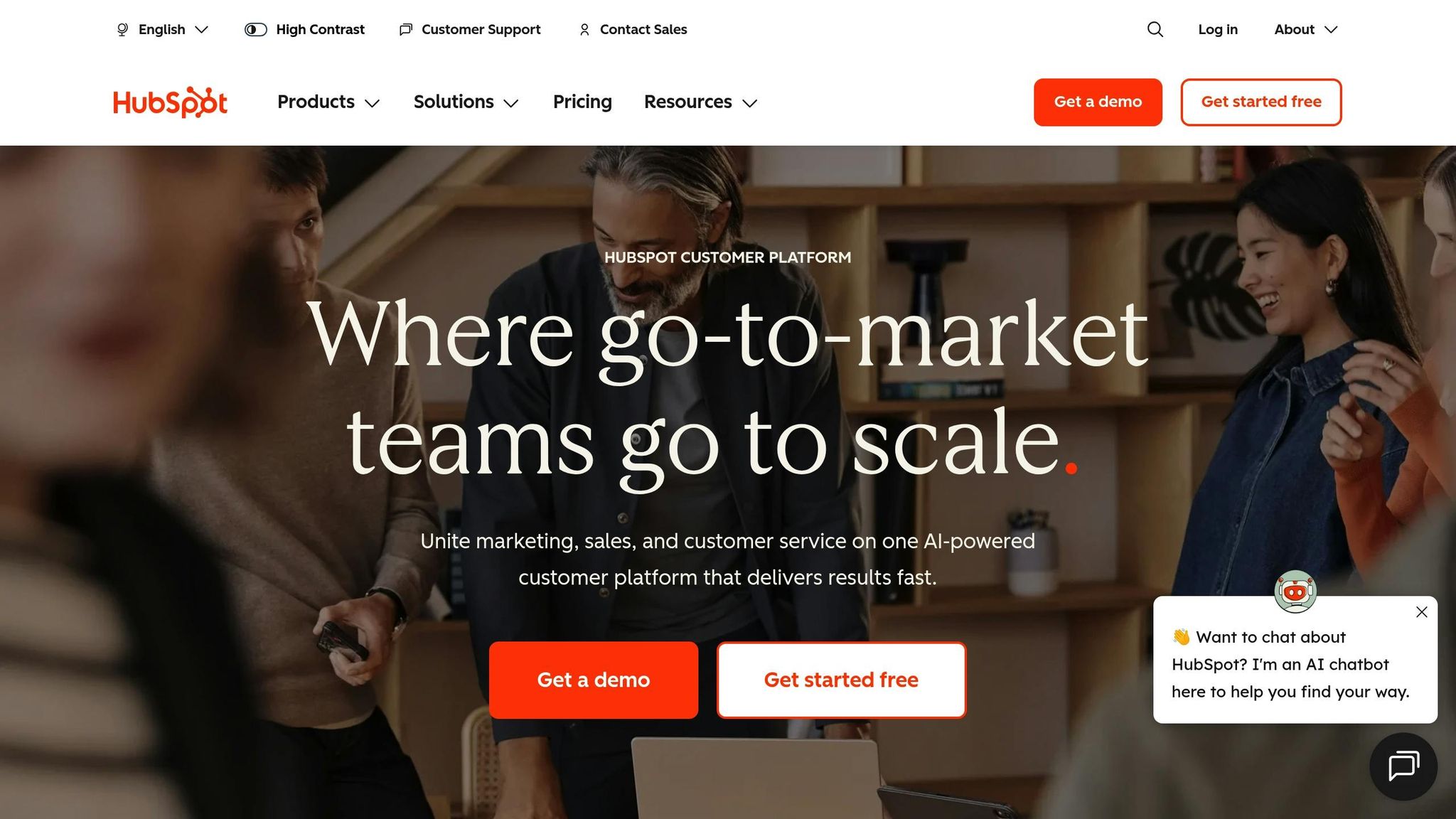
HubSpot's built-in automation suite offers an all-in-one platform that eliminates data silos and syncing issues. By operating within the Smart CRM, your workflows, sequences, and AI agents share a single source of truth. This means no more reliance on custom APIs or clunky manual processes.
The automation engine includes several standout features:
For example, in 2026, Pynest used HubSpot's AI agents to analyze company behavior across open sources. According to Andrew Romanyuk, Co-Founder and SVP of Growth, this reduced lead screening time by 32%, increased pipeline velocity by 22%, and boosted customer retention by 15% [1]. Similarly, Lattice's sales team leveraged AI to generate business cases from Gong call transcripts, achieving a 25% year-over-year increase in late-stage win rates [1].
These features are further complemented by HubSpot's lead intelligence tools, which take prospect prioritization to the next level.
HubSpot’s AI-powered Lead Scoring system ranks leads based on their behavior - like website visits or email clicks - and firmographics. This helps sales teams focus on high-intent prospects. The Breeze Prospecting Agent also tracks buying signals and researches companies, ensuring outreach happens at just the right time.
Custom scoring options let you evaluate contacts, companies, and deals based on two factors:
Leads are then categorized into color-coded labels or a matrix (A1 to C3), making it easy to identify top prospects. Sales teams using these AI tools have reported a 48% reduction in the average time it takes to close deals [3].
Setting up HubSpot's native workflows is simple. Start by defining your goal, auditing data fields, and setting enrollment triggers - whether based on filters, events, or schedules. You can then configure logic using Breeze AI or manual if/then branches, assign ownership with routing rules, and test everything before going live. Since these tools are built directly into HubSpot, there’s no need for custom integrations, and data syncs in real-time.
"The beautiful thing about a unified platform is that automation stops feeling robotic and starts feeling personal." – Chris Sorensen, CEO, ARMOR Dial and PhoneBurner
This seamless setup is available across HubSpot's pricing tiers.
HubSpot offers a Starter plan ($79/mo) that includes basic CRM and limited automation features. The Starter plan starts at around $9 per user per month, while the Professional and Enterprise plans - needed for advanced workflows and sequences - range from $90 to $150 per user monthly. AI-powered lead scoring, however, requires a Marketing Hub Enterprise subscription [2].
These tools are designed to save time, reduce manual work, and improve sales productivity, making them a great fit for teams looking to streamline their processes.
KeepSync enhances HubSpot's automation by focusing on job change tracking, a feature that helps uncover opportunities many businesses overlook.
This platform specializes in tracking when your key contacts - like former champions, power users, or decision-makers from closed-lost deals - move to new roles or companies. By identifying these changes, KeepSync generates a pipeline of warm leads who already know and appreciate your product.
KeepSync pulls data from over 30 sources, updating weekly to monitor job changes. When it detects a change, it springs into action, triggering HubSpot workflows to create leads, assign team members, and kick off personalized email sequences. Real-time notifications through Slack and email ensure your team can follow up quickly. Sarah Kim, Director of Sales at Velocity Commerce, shared her experience:
"The ROI was immediate. Within 45 days we had closed two deals from former customers who moved to bigger companies. Our SDRs love it because these are warm leads, not cold calls."
The platform boasts a 94% accuracy rate for job change tracking, thanks to triple-verification and human review for executive-level updates [4].
KeepSync goes beyond just tracking job titles. It enriches contact profiles with verified work emails (offering a deliverability rate of over 97%), direct phone numbers, and updated company technographics. It also groups leads into high-value categories, like "Past Champion Expansion", which are shown to convert three to six times faster than traditional cold outreach. Since 89% of job changes are typically missed without dedicated tracking, this intelligence ensures teams capitalize on opportunities that might otherwise slip through the cracks [4].
Setting up KeepSync with HubSpot is a breeze - it takes about five minutes and doesn’t require technical expertise [4]. Just connect your HubSpot account, import your contact list, and configure automated workflows. The platform also integrates with tools like Outreach, Salesloft, Apollo, and automation connectors like n8n, Clay, and Make.

HubSpot Native Tools vs KeepSync: Feature Comparison for Sales Automation
HubSpot Native Tools cover the entire sales funnel, while KeepSync zeroes in on tracking job changes for lead generation. HubSpot shines with its all-in-one approach, handling everything from lead routing and email sequences to scheduling meetings and updating deal stages. Teams using HubSpot automation report closing 35% more deals and boosting productivity by 76%, thanks to reduced manual data entry and admin work [6]. However, advanced workflows can be tricky to manage, and unlocking features like predictive lead scoring and multi-step sequences requires a Professional or Enterprise plan [7].
KeepSync, on the other hand, takes a more focused route by specializing in tracking job changes in HubSpot to identify warm leads. With 94% accuracy, it captures opportunities that often go unnoticed - 89% of job changes slip through the cracks without systematic tracking [4]. This approach pays off, as former champions and power users convert 3–6X faster when tracked to new companies [4]. KeepSync is easy to set up, taking just five minutes, and integrates seamlessly with HubSpot. However, it’s designed specifically for job change tracking and doesn’t replace broader sales automation tools.
| Feature | HubSpot Native Tools | KeepSync |
|---|---|---|
| Best For | Full-funnel sales process management | Specialized warm lead tracking |
| Tracking Method | Behavioral signals (email opens, page visits) | External job changes with 94% accuracy |
| Setup Time | User-friendly but complex for advanced workflows | 5 minutes, no technical expertise required |
| Free Option | Yes (basic CRM and simple automation) | Yes (1,000 contacts/month) |
| Paid Plans Start At | Varies by tier (Professional required for advanced features) | $149/month (5,000 contacts) |
| Key Strength | Comprehensive automation across all sales activities | Converts warm relationships 3–6X faster than cold outbound |
Each platform addresses different sales needs. For relationship-driven businesses, KeepSync’s specialized focus can deliver an impressive 10–79X ROI within 12 months. Meanwhile, HubSpot is ideal for managing overall sales operations.
Use HubSpot for day-to-day sales management and KeepSync to maintain and leverage key relationships.
Summing up the comparison, each tool offers distinct advantages that can enhance sales efficiency in unique ways. HubSpot's suite of tools covers the entire sales cycle seamlessly, from lead routing and email sequences to scheduling meetings. This makes it a great fit for teams managing daily sales operations. However, its focus on on-platform behavioral signals means it might overlook important external changes in relationships.
On the other hand, KeepSync excels in identifying external job changes. Its specialized tracking turns job changes - often missed by other tools - into actionable sales opportunities. According to data, leads from former champions convert 3–6X faster than cold leads[4]. Julia Chen, VP of Sales Operations at Nexus Software, shared her experience:
"With 1,500+ customers, manually tracking job changes was impossible. We were leaving money on the table every month. Now it's fully automated."[4]
For small to mid-market teams using HubSpot, KeepSync’s Team plan, priced at $149/month (with a Starter plan ($79/mo) for up to 1,000 contacts), offers an impressive ROI of 10–79X within a year[4].
The best approach? Use HubSpot to handle core sales automation - like workflows, sequences, and pipeline management - while pairing it with KeepSync to track external relationship changes. Together, these tools create a powerful combination that boosts both productivity and revenue for your sales team.
HubSpot automation can simplify workflows related to job changes, whether it’s notifying your team, updating contact information, or starting outreach sequences. This approach is especially useful for reconnecting with former customers or contacts who’ve taken on new roles.
Tools like KeepSync make this even more effective by offering real-time alerts and precise updates on job transitions. When paired with HubSpot, these updates ensure your data stays current, enabling you to act quickly and power efficient automation.
To set up automated follow-ups for job changes in HubSpot, begin by organizing your CRM data and adding custom fields such as "Previous Employer" and "Job Change Date." Next, integrate a tool like KeepSync to monitor job changes and send real-time alerts when they happen. From there, use HubSpot workflows to automate actions based on these alerts. This can include sending personalized messages, creating new deals, or notifying your team - helping you stay on top of opportunities with contacts who recently changed jobs.
To take advantage of advanced automation and AI scoring, you'll need to subscribe to the HubSpot Sales Hub Professional plan or a higher tier. This plan offers tools like AI-powered workflows and predictive lead scoring, designed to simplify sales processes and boost overall efficiency.
📚 HubSpot Sales Automation Series