
Digital Marketing
·
April 10, 2026
How SaaS Companies Handle Billing Disputes & Chargebacks
Learn how SaaS billing disputes happen, what triggers chargebacks, and how both sides can resolve them faster.

Compare five HubSpot integrations that automate lead routing, data enrichment, job-change alerts, and meeting scheduling to boost B2B sales efficiency.


HubSpot is a powerful CRM for B2B sales, but inefficiencies like manual data entry and outdated contact information can cost teams valuable time and opportunities. Integrating the right apps with HubSpot can solve these issues by automating workflows, improving data accuracy, and centralizing sales processes. Here’s a quick look at five top HubSpot apps that address common sales challenges:
Each tool offers unique features tailored to different team sizes and needs. Whether you’re a small team looking to automate basic tasks or an enterprise needing advanced data intelligence, these apps can help streamline your sales process and improve ROI.

HubSpot Apps Comparison: Features, Pricing, and Best Fit for B2B Sales Teams
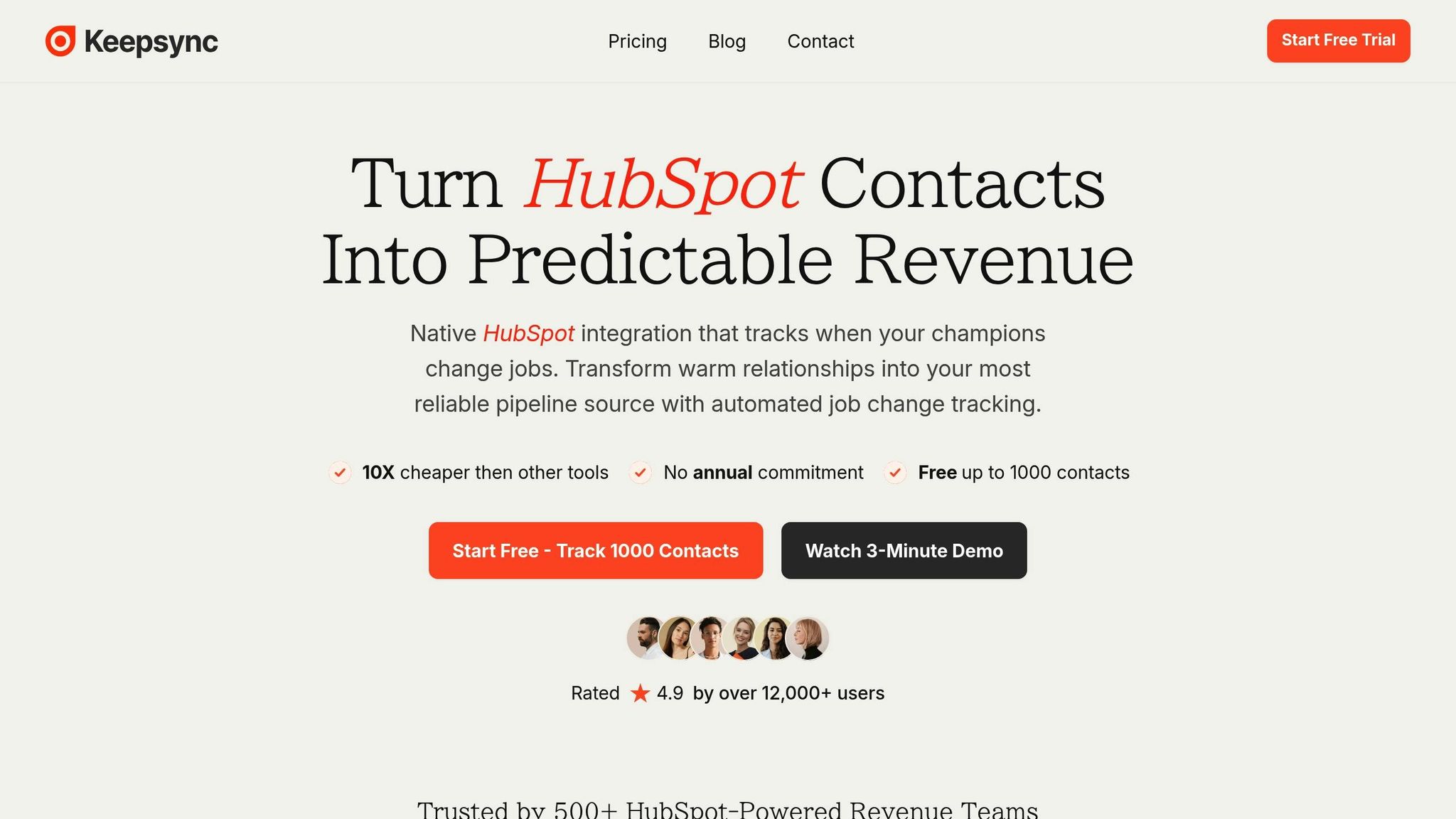
KeepSync is a HubSpot-native app designed to solve a common yet often ignored challenge: tracking job transitions among key contacts. By monitoring contacts weekly across 30+ data sources - including LinkedIn, company websites, and press releases - it gives sales teams a 30X speed boost in identifying and engaging warm leads [3].
KeepSync's job change tracking boasts a 94% accuracy rate, thanks to a triple-verification process that even includes human review for executive-level transitions. This level of precision addresses a major gap: without systematic tracking, 89% of job changes go unnoticed, and 36% of closed-lost deals can convert when engagement is timed strategically [3].
"The ROI was immediate. Within 45 days we had closed two deals from former customers who moved to bigger companies." – Sarah Kim, Director of Sales, Velocity Commerce [3]
These updates seamlessly integrate with automated workflows, making it easier for sales teams to stay ahead.
KeepSync doesn’t just stop at tracking - it turns insights into actionable steps. When a job change is detected, it automatically triggers HubSpot sequences, updates deal stages, and assigns leads to the right sales rep based on pre-set rules. It also integrates with tools like Outreach, Salesloft, and Apollo, launching personalized sequences immediately. High-priority changes? Slack alerts ensure your team doesn’t miss a beat. Best of all, it’s ready to go in just five minutes - no technical expertise needed [3].
Each job change alert comes packed with essential details: a new work email with a 97%+ deliverability rate, direct phone numbers, updated company technographics, and buying committee information. This eliminates the need for manual research and fuels multiple revenue opportunities, such as expanding past champion accounts, reviving closed-lost deals, and preventing churn [3].
"With 1,500+ customers, manually tracking job changes was impossible... Now it's automated and integrated into our HubSpot workflows." – Julia Chen, VP Sales Operations, Nexus Software [3]
KeepSync offers a Starter plan ($79/mo) for up to 1,000 contacts per month. Paid plans start at $149/month or $1,490/year for 5,000 contacts. With a 4.9/5 rating from over 12,000 users and an average ROI of 10-79X within 12 months, it’s clear why sales teams trust this platform [3][4].

HubSpot Sales Hub stands out as a powerful tool for B2B sales teams, offering built-in automation and engagement features. Integrated directly into HubSpot's CRM, it brings together multiple tools, eliminates the need for disconnected solutions, and provides AI-driven insights - all in one seamless interface.
HubSpot Sales Hub helps sales reps reclaim up to 25% of their workday by automating repetitive tasks like lead rotation, task assignments, and follow-ups [1]. Its workflow engine smartly routes leads by territory or deal size and triggers sequences based on engagement levels. Kyle Norton, CRO at Owner.com, shared that his team gained 25–30% more revenue-generating activity (RGA) time thanks to these automation features [1]. Additionally, the Breeze Prospecting Agent tracks buying signals, researches target accounts, and drafts personalized outreach using CRM data [1].
Beyond automation, the platform simplifies communication by unifying all channels.
Sales Hub integrates calling, email sequences, meeting scheduling, and messaging into a single workspace. The Conversations Inbox brings together emails, live chats, and social messages, allowing reps to respond from one place [5]. Douglas Botchman, Director of Revenue Operations at Ceros, noted an 18% increase in SQLs and a reduction in lead response times to under 5 minutes after implementing Sales Hub's engagement tools [6]. Similarly, Reposit Power scaled their weekly sales calls from 20 to 1,000, boosting monthly sales from 2 to 35 in just five weeks [6].
To streamline research, Breeze Intelligence (formerly Clearbit) enriches contact records with firmographic details like company size, revenue, and tech stack - cutting down on manual effort [1]. This enriched data powers predictive lead scoring, ranking prospects based on their fit and behavior, such as email opens and page visits. By automating these processes, sales professionals save around 2 hours daily on admin tasks, with 22% of reps delivering more tailored outreach [1].
HubSpot's automated lead routing slashes response times by 90%, instantly assigning leads based on factors like geography, product interest, or rep availability [7]. For instance, Espresso Translations reduced their average response time from 4.2 hours to just 37 minutes within a single quarter, leading to a 23% increase in conversion rates [7]. The system also includes failover handling, ensuring leads are reassigned if the primary rep is unavailable or misses a deadline [7].
"Automated routing ensures that the right lead is automatically transferred to the right team without an opportunity for human bias and without wasting time with manual reassignment." – Caspar Matthews, Director, Electcomm Group Electrical & Data [7]
Sales Hub offers Starter plan ($79/mo) with basic features for unlimited users, while paid plans range from $90 to $150 per user/month [1].
Salesloft brings specialized engagement tools to HubSpot users, catering specifically to high-volume outbound teams that rely on advanced multi-channel sequencing. Its integration with HubSpot includes a two-way CRM sync for contacts and companies, while deals sync one-way from HubSpot to Salesloft, and activities sync one-way back to HubSpot [8][11]. With over 900 installations in the HubSpot App Marketplace [11], Salesloft is particularly suited for teams focused on structured, phone-heavy outreach.
The Salesloft Team CRM Sync, recommended starting February 2024, simplifies data management by automating transfers between HubSpot and Salesloft, removing the need for manual data entry [9][10]. Administrators can set up automation rules based on HubSpot CRM data to trigger specific actions, such as creating new records or routing leads [8][11]. One user noted a threefold increase in productivity after implementing these automation capabilities [13].
Additionally, Salesloft logs key sales activities - like call outcomes, sent emails, and conversation recording links - directly into HubSpot, providing managers with a comprehensive view of sales interactions [8][10]. Beyond automation, the platform strengthens communication with its multi-channel tools.
Salesloft supports outreach across multiple channels, including calls, texts, personalized emails, and LinkedIn InMail, all organized into structured cadences. The Connect for HubSpot Chrome extension adds further convenience by embedding templates, snippets, and dialers directly within HubSpot [10][12]. Mizelle Hornilla, Business Transformation Manager, highlighted the platform's impact:
"It's impressive to see a shift from unstructured outreach to standardized best practices using Salesloft."
Users have reported significant improvements after adopting Salesloft, including a 322% increase in pipeline prospecting within the first year and a 28% boost in closed deals for those leveraging call recording features [13].
Alongside these engagement tools, Salesloft also provides robust job change tracking capabilities.
Salesloft enhances its automation and engagement features with tools to track key job changes. Through its Rhythm integration with LeadIQ, the platform identifies when past champions move to new companies and updates these insights in the Rhythm Live Feed [14]. This feature enables sales teams to act on buyer behavior by prioritizing outreach at the right time. Administrators can also configure automatic notifications and follow-up actions when job change signals are detected [14]. Ben Kwon, COO at LeadIQ, emphasized the value of this functionality:
"Identifying the right person at the right time with the right message is paramount to turning activity into action to be able to go from unread emails to unforgettable conversations."
Salesloft offers three pricing tiers - Essentials, Advanced, and Premier - with custom pricing tailored to team requirements. A HubSpot subscription (Starter, Professional, or Enterprise) is also necessary [11].
ZoomInfo integrates with HubSpot to provide access to over 320 million professional contacts and nearly 100 million company profiles [18]. By combining automation with robust sales intelligence, ZoomInfo enhances HubSpot's capabilities, particularly for midsize to enterprise teams managing extensive contact databases. As of September 4, 2026, the app had around 2,000 installations on the HubSpot App Marketplace [18]. Sam Balter, Content Director at ZoomInfo, highlights its value:
"This is a must-have for midsize to enterprise businesses with large contact databases. Marketing, sales operations, demand generation, and sales teams will benefit massively from this integration." [15]
ZoomInfo's data enrichment tools ensure that contact information stays accurate and up-to-date. Its Scheduled Enrich feature regularly updates contact records, while Inbound Enrich automatically adds verified emails, firmographic data, and technographic details to new HubSpot contacts [15]. The platform supports over 100 validated data properties, including details like funding events, tech stacks, and department sizes [18].
Bryon Main, Chief Operating Officer at Momentum Events, shared how this functionality has impacted their organization:
"To find a tool that was able to not only enrich that data, but to dedupe it... that day was a tremendous help to the organization and something that we benefit through everyday." [17]
MarketSpark, a B2B marketing agency, used ZoomInfo's data and intent signals to achieve 5x growth in both Marketing Qualified Leads (MQLs) and Sales Qualified Leads (SQLs), as well as generate five times more revenue opportunities [21].
This continuous data refresh also enables timely job change alerts for better prospect tracking.
ZoomInfo ensures HubSpot contact records remain accurate by tracking job changes. Through Copilot Signals, the platform notifies sales teams when prospects switch roles or companies [16]. Scheduled Enrich automatically updates these records, allowing teams to reconnect with former champions at their new roles at just the right time [15][19].
This accuracy also plays a key role in improving lead routing efficiency.
ZoomInfo’s lead-to-account matching feature links new leads to existing HubSpot account records using domain matching and company hierarchies. This allows teams to score and route leads instantly using HubSpot workflows [17][20]. Enriched data - such as industry or territory - can trigger workflows, speeding up engagement with qualified prospects [15][20].
The ZoomInfo Chrome Extension overlays valuable intelligence across the web, seamlessly matching content to prospects within the HubSpot interface [16]. Meanwhile, ZoomInfo Copilot leverages AI to craft personalized emails based on HubSpot data and real-time signals, even suggesting the next best action within workflows [19]. With the ability to process 1 billion buying signals each month, the platform ensures that intent data is always current [21]. These automation tools help reduce bottlenecks and improve sales productivity.
ZoomInfo offers three pricing tiers, all based on annual quotes:
The platform holds an average rating of 3.4 out of 5 from 10 reviews on the HubSpot App Marketplace [18].
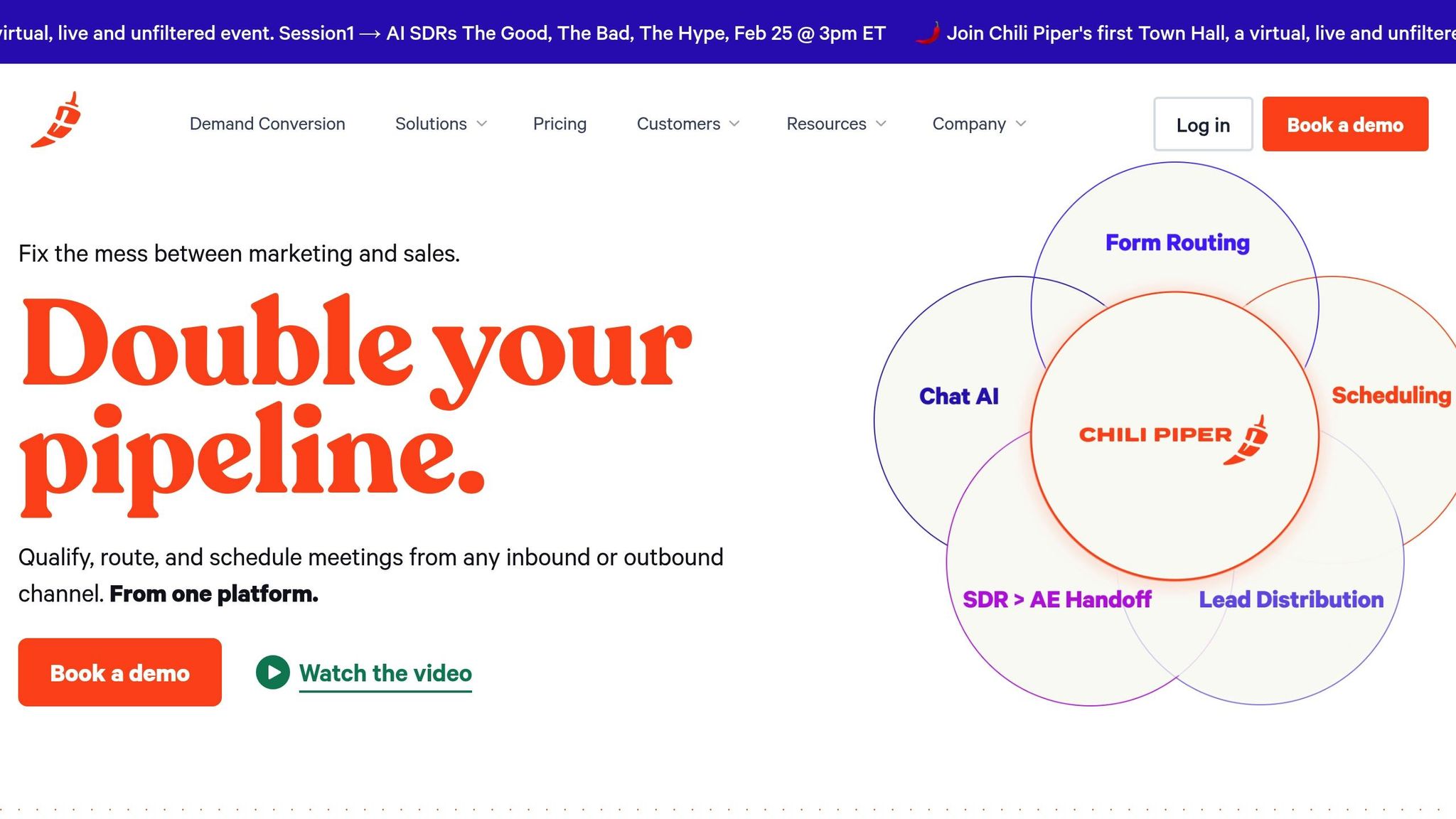
Chili Piper works seamlessly with HubSpot to streamline lead routing and meeting scheduling, cutting down on manual tasks. With a 4.6 out of 5 star rating from 673 reviews on G2, it’s known for improving inbound conversion rates [22]. Scott Brinker, VP Platform Ecosystem at HubSpot, calls it:
"one of the world's best sales scheduling and routing platforms, helping revenue teams at top B2B brands increase their conversion rates, customer satisfaction, and productivity" [26]
Chili Piper offers a suite of tools to handle lead routing with precision:
The results speak for themselves. Apollo saw a 50% increase in inbound meetings and managed to triple their revenue while cutting their sales team in half. Krishan Patel, VP of Growth at Apollo, shared:
Similarly, Workato reported a 10-15% revenue boost by fine-tuning their inbound processes with Chili Piper, all without increasing marketing expenses [22][28].
These tools lay the foundation for smoother sales workflows and faster lead conversion.
Chili Piper also excels in automating sales processes. Its two-way sync with HubSpot ensures contact and meeting records are updated automatically, eliminating the need for manual data entry [22][26]. Smart booking links can be embedded in marketing campaigns or emails, letting prospects schedule meetings in just a few clicks [22][25]. Automated email and SMS reminders help reduce no-shows, while easy rescheduling drives better attendance rates [27][28].
For example, LawGeex cut their SDR meeting no-show rate by over 50% and boosted their SQL rate by 33% using Chili Piper’s scheduling and reminder tools [22]. At Grow, 70% of hand-raising prospects successfully scheduled meetings. TJ Nokleby, Director of Marketing at Grow, explained:
"We've taken that whole 7-8 step demo scheduling process and turned it into a 2-3 step process. 70% of those that come in that are raising their hand are scheduling - that's a huge win for us" [22]
These automation features not only save time but also ensure sales teams can focus on closing deals.
Chili Piper offers modular pricing, starting at $30 per user per month, with an additional platform fee (around $150/month) that varies based on product selection and lead volume [22][24]. Teams can choose specific tools like Concierge, Distro, or Handoff to fit their needs [22]. Users frequently highlight the platform’s ability to double inbound conversion rates and simplify meeting scheduling [22][26].
Here’s a breakdown of the key benefits and trade-offs of each HubSpot-integrated app to help streamline your B2B sales workflow. Each tool offers specific strengths, but the right choice depends on your team’s unique needs and priorities.
KeepSync provides automated job change tracking with an impressive 94% accuracy, monitored weekly. At $149/month for up to 5,000 contacts, it’s budget-friendly and quick to implement, requiring just 5 minutes to set up without any technical expertise. This makes it a practical option for teams seeking immediate results with minimal effort[3].
HubSpot Sales Hub stands out with its native integration, ensuring smooth data sharing across marketing and service teams. Its AI-powered Breeze prospecting tool adds value for general sales workflows. However, teams needing advanced features like intent signals or automated scheduling may need to look at additional tools[1].
Salesloft shines with its multi-channel sequences, A/B testing, and AI agents that handle time-consuming research tasks. These features can save sales reps about two hours of admin work daily. That said, its complexity means teams will need dedicated training and management to fully benefit from its capabilities[1].
ZoomInfo offers highly accurate B2B data and intent signals, helping teams focus on high-priority accounts. However, its credit-based pricing model may pose challenges for smaller teams with limited budgets[2].
Chili Piper simplifies lead routing and meeting scheduling with a modular pricing structure that can flex to fit different team sizes and needs. While its setup is efficient and can enhance scheduling workflows, teams should carefully evaluate how costs may scale as usage grows.
When considering these tools, it’s essential to evaluate your current workflows to avoid “integration fatigue.” Overloading your system with too many apps can actually reduce productivity[2]. Focus on solutions that directly address your biggest challenges - whether that’s tracking job changes, enriching data, or automating outreach - to get the most out of your investments. These insights set the stage for a broader discussion on how to integrate these tools for maximum sales efficiency.
After diving into the details of each app, let’s break things down by team size to help you choose the right HubSpot app based on your team’s needs, budget, and biggest time sinks.
For small teams (under 10 reps), the focus should be on automating repetitive tasks so a lean group can handle more deals without burning out. KeepSync is a great fit here, offering automated job change tracking with 94% accuracy. It’s quick to set up (just 5 minutes) and costs $149/month for up to 5,000 contacts.
Medium-sized teams (10–50 reps) should prioritize tools that enhance the buyer experience. Chili Piper is an excellent option, making inbound lead scheduling seamless and helping nurture prospects more effectively.
As teams scale up, their needs evolve. Enterprise teams (50+ reps) often require advanced data accuracy and tools for multi-channel orchestration. In this case, ZoomInfo stands out by providing detailed B2B intelligence and intent signals, perfect for account-based selling at scale.
Before committing to any tool, take a close look at your workflows to identify major pain points like manual data entry, outdated information, or slow response times. As Mamta Tainwala from Sybill.ai wisely points out:
"A perfectly integrated tool that doesn't solve a real problem is just a faster way to do the wrong thing." [2]
Start by using HubSpot Sales Hub, a platform packed with tools to help your team manage contacts, automate follow-ups, and track deals effectively. To make communication and scheduling smoother, consider integrating apps like Gmail or Google Calendar. These integrations ensure your team stays on top of emails and appointments without juggling multiple platforms.
Want to cut down on manual tasks? Tools like Sybill or KeepSync can handle data entry and pipeline management automatically. This means your team can spend less time on admin work and more time focusing on what matters most - closing deals.
To keep your HubSpot CRM running smoothly, stick to integrations that directly enhance your key sales processes - like automating follow-ups or adding valuable details to lead profiles. Stay away from tools that add layers of complexity without offering clear advantages. Make it a habit to review your integrations regularly and remove any that don’t deliver measurable results. Keeping things simple boosts efficiency, ensures accurate data, and maximizes ROI, all while reducing the hassle of managing unnecessary tools.
To get more out of HubSpot and improve your ROI, focus on automating repetitive sales tasks. Start with things like lead nurturing, follow-ups, and pipeline management. These automations not only save time but also make your workflows smoother. By automating data entry and updates, your team spends less time on mundane tasks and more time closing deals. Use HubSpot's core features - like email sequences and lead management - as your starting point. They deliver quick results and lay the groundwork for more advanced workflows down the line.